


Our AI Visibility metrics are less correlated than we think. We (think: “I”) often assume there is a causal chain from retrieval to citation and then mention. But reality is more complex.
For example, the retrieval-to-citation ratio is roughly 1 in 7 pages (~15%) for ChatGPT. And, in the Ghost Citation problem, I showed only 13.2% of URLs are cited and mentioned in the same answer across 4 LLMs.
This Memo is about the aggregate view: how citations and mentions trend on the model level, and how model releases and interface updates change the denominator. I’ve found fascinating patterns, like baselines shifting over night, no causality between citations and referral traffic or source mix shift.
The denominator here is the total number of citations and mentions an engine hands out per answer. When an engine doubles the links it shows, your citation count rises without any work from you to influence it.
HubSpot shared an export with me of its AI Search Sensor covering ChatGPT, Gemini, and Perplexity. I analyzed aggregate data covering nearly 210 million prompt runs, 1.7 billion citations, and 657 million brand mentions.
A few clarifications before you read on:
This is aggregate data, which is more indicative of how the denominator of citations and mentions changes. It’s not telling us how those metrics trend or relate to each other for single brands. So you might see different patterns in your prompt tracking.
When I write about “citations” I mean reference links on the side or bottom of AI answers. And “mentions” are brand names (unlinked) that appear in AI answers.
1/ Citations and mentions don’t move together
You could describe the relationship between citations and mentions as… complicated. The relationship ultimately depends on the time range and metrics examined:
Between early July and mid September, ChatGPT shows a soft negative correlation between citations and mentions, while Gemini and Perplexity have strong positive ones. But Gemini changed from −0.45 across the full data time range to +0.92 in the July window. Its relationship isn’t a permanent property of the engine.
“Moving together” doesn’t mean “growing at the same speed”. Perplexity’s citations per prompt rose 80%, while mentions rose 25%.
Gemini has the stronger overall relationship; Perplexity has the stronger daily-change relationship. When we correlate daily changes, Gemini falls to +0.43, while Perplexity remains at +0.57. Over the full period, Gemini’s citations and mentions trend in the same direction. Day to day, they move in step less often.
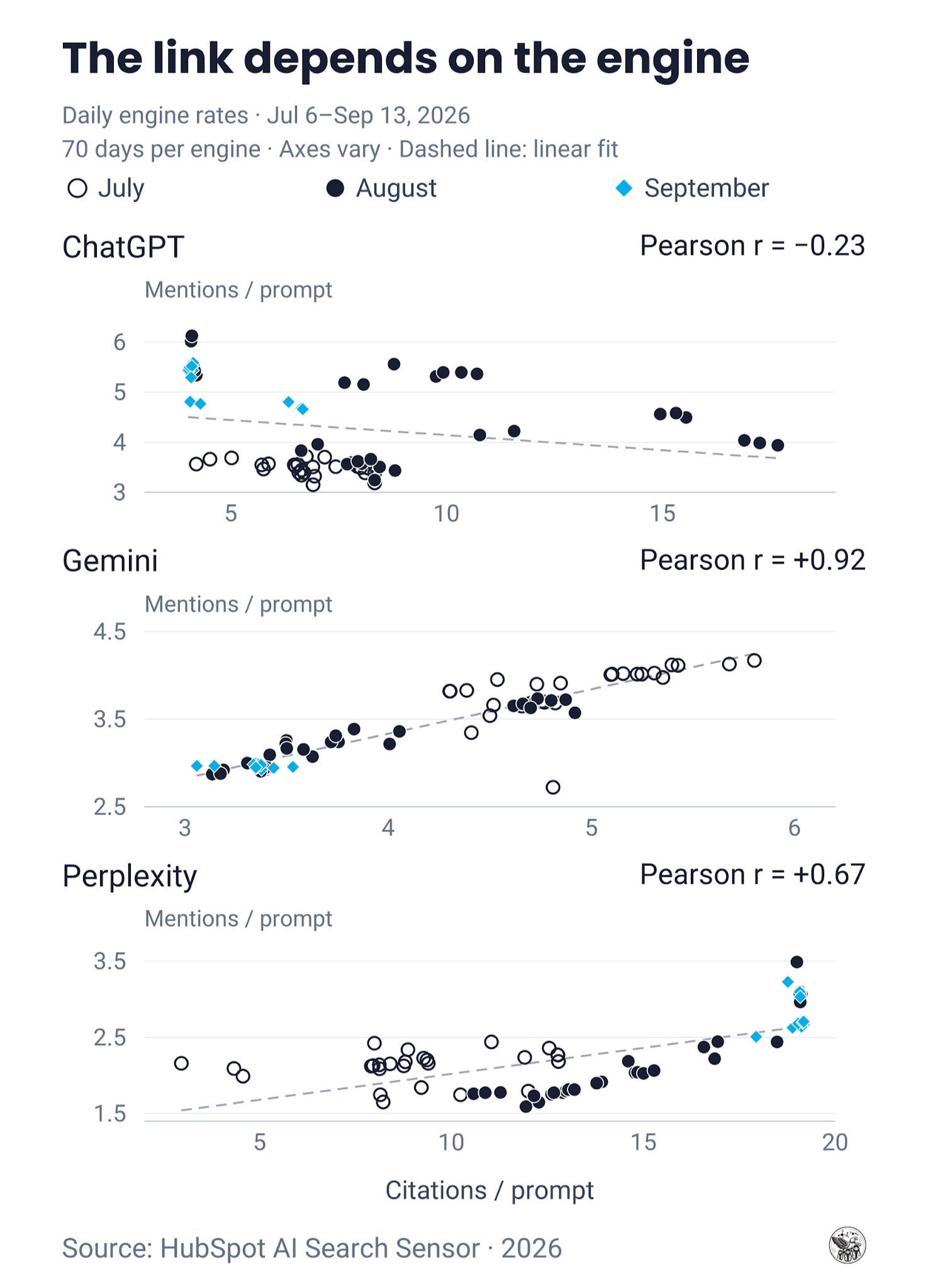
So, there is no fixed relationship between citations and mentions on the engine level. Track each brand metric next to the engine’s total for the same prompts, so you can see whether your brand grew or the engine changed its output:
Count your cited URLs per prompt, then divide them by all cited URLs in the same answers. When an engine doubles the links per answer, your count doubles with it, and only your share tells you whether you gained ground.
Track the share of answers that name your brand. Add your mentions divided by all brand mentions from your competitor set.
If your tracker logs the background searches each engine runs, count fan-out queries per prompt. Then track the share that returns your domain or target it directly with a “site:yourdomain.com” search.
Pull GA4 referrals from chatgpt.com, gemini.google.com and perplexity.ai. Compare them with each engine’s visit trend in Semrush or Similarweb before you blame your content for a drop.
Reading the weekly memo is one thing… but walking into a leadership meeting with the AI Search Strategy Pitch Deck is another. Premium subscribers get both.
2/ Variables that wildly change the landscape
The way AI answers and sources are shown, plus the training data and behavior of new models, have a major impact on how often brands are cited and mentioned.
For example, an update of ChatGPT 5.6 on August 6th led to 51% more cited URLs per prompt and 14% more mentions. After the update, it used 69% more fan-out queries in general and searched 45x more often for specific domains with a “site:” query. But a few weeks later, around August 25, ChatGPT’s citation rate fell 55% while its mention rate rose 4%. That shows you how volatile the denominator can be.
Nothing shows this better than the change in total mentions and citations over time by model.
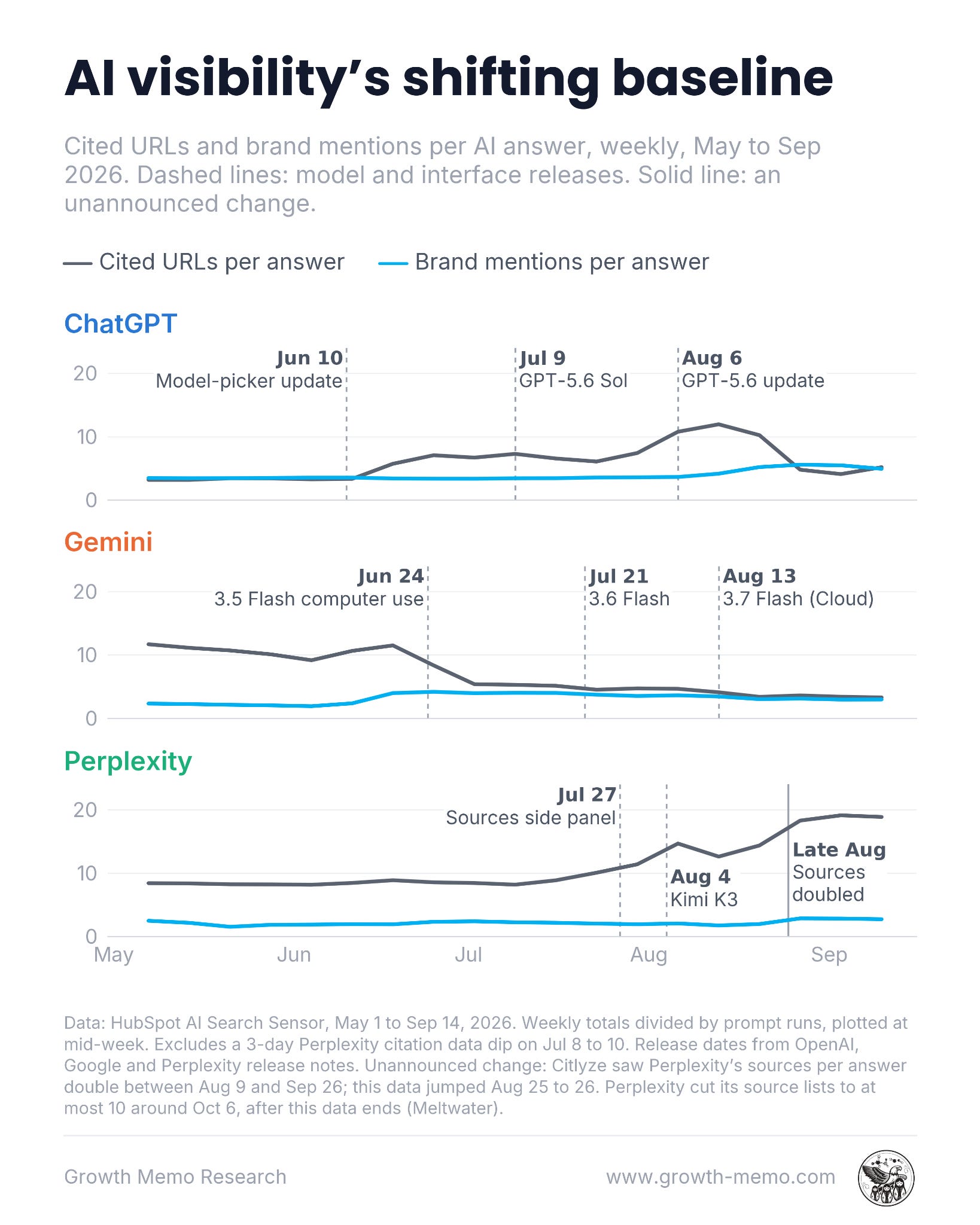
The event annotations from the graphic above:
ChatGPT
June 10: Model-picker update simplified reasoning controls and let users toggle automatic switching from Instant to Medium.
July 9: GPT-5.6 Sol began rolling out to eligible paid ChatGPT plans.
August 6: GPT-5.6 update brought revised Sol responses and a thinking-effort slider to Plus and Pro; Luna began rolling out as the Free and Go default.
Gemini
June 24: Computer use for Gemini 3.5 Flash entered public preview in the Gemini API, with support for browser, mobile and desktop actions.
July 21: Gemini 3.6 Flash became available to Gemini app users globally through the model picker.
August 13: Gemini 3.7 Flash became generally available on Google Cloud. On the same day, the Sensor’s citations per prompt fell 27% and mentions per prompt fell 15% versus August 12.
Perplexity
July 27: Sources side panel put citations and supporting sources alongside Search answers.
August 4: Model and Computer updates included Kimi K3 for Pro and Max subscribers and multi-model analysis with Model Council.
My takeaway from all this is that model releases are the new algorithm updates. We need to track them and their implications for each AI engine to know whether the denominator changes and how our optimizations and experiments are affected.
Planning for 2027 means deciding what to fund and how to measure whether it works. This week’s sponsor, AirOps, is hosting What’s Next for AI Search in 2027 on Tuesday, December 8 at 1pm ET / 10am PT.

Eli Schwartz and I will each share three bets on where AI search is heading and what to prioritize, alongside new AirOps research.
3/ More citations ≠ more referral traffic
I’ve been quite vocal about my doubt that AI referral traffic ever amounts to the volume we got from SEO at peak times. I also don’t think referral traffic is the right metric to focus on, unless you’re a marketplace (maybe). I’ve found some evidence for my doubt in the fact that more citations don’t always lead to more referral traffic.
Across the same 4-week windows, ChatGPT and Gemini showed fewer cited URLs per prompt while estimated referrals increased. Perplexity showed the reverse: more cited URLs per prompt and fewer estimated referrals.
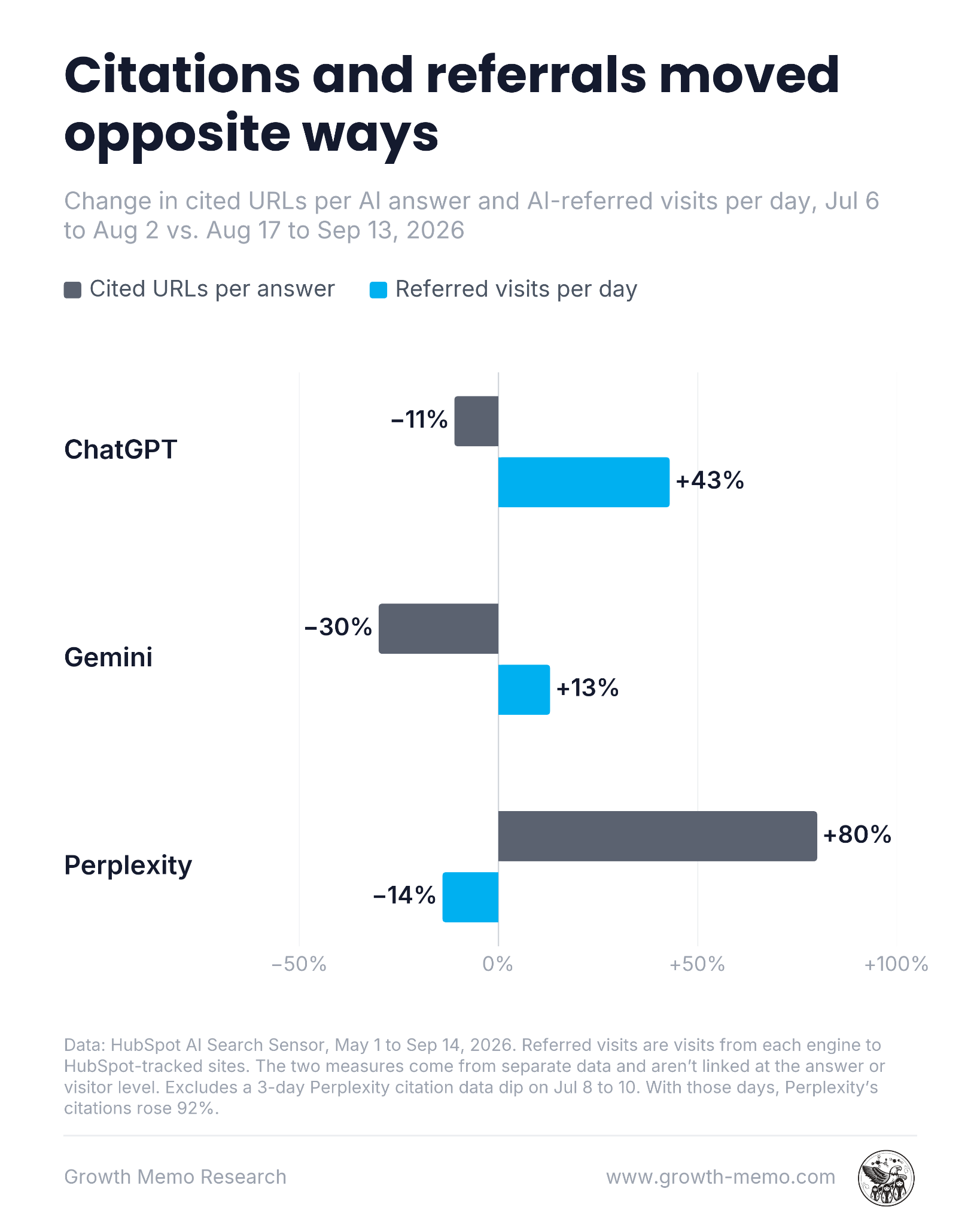
The average Perplexity answer went from about 9 cited URLs to 18. Meanwhile, estimated referrals fell from about 11,200 to 9,600 per day. Mentions increased too, but much less than citations: 25% versus 80%.
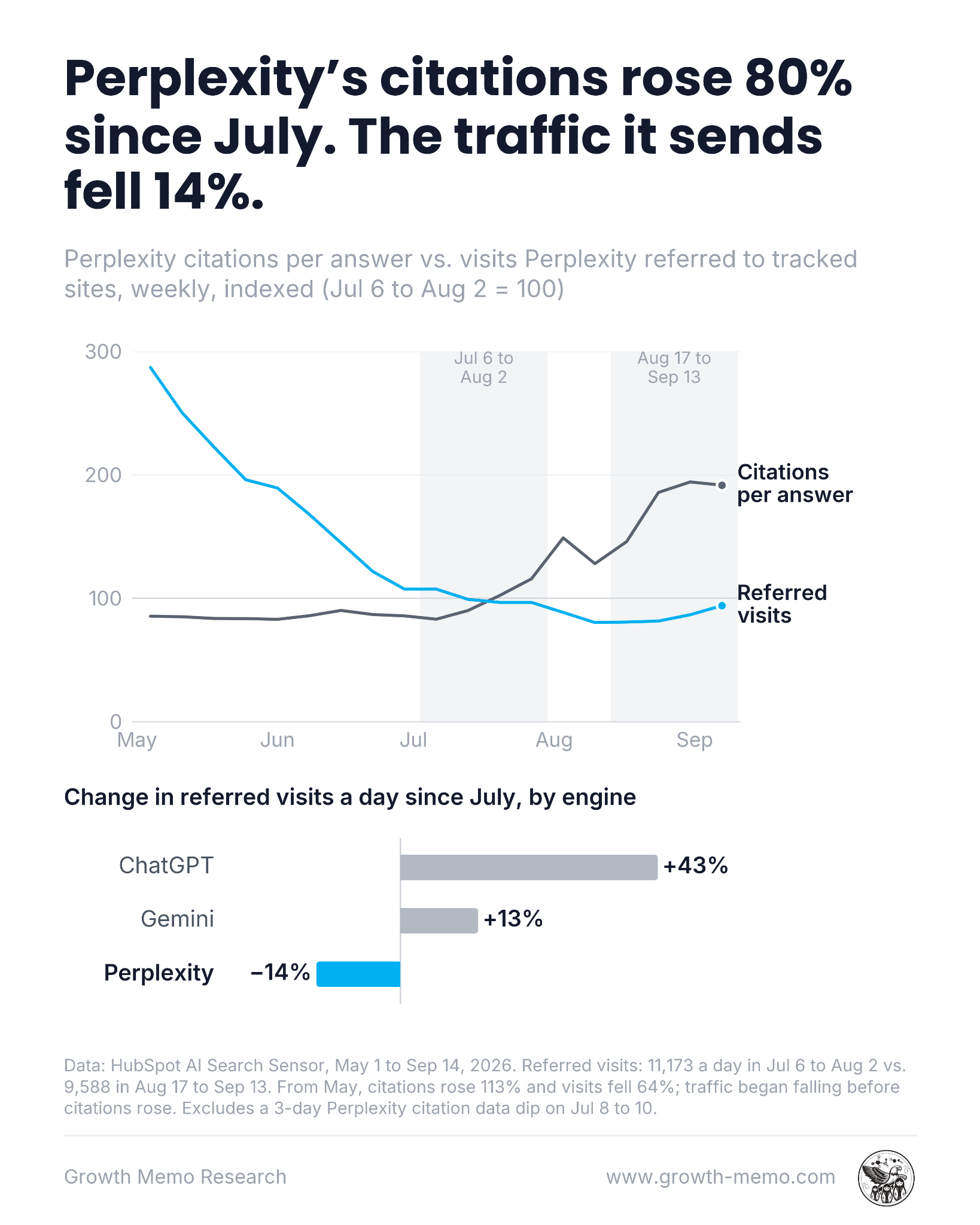
Why? I assume because Perplexity usage is trending down. Again - mind the denominator.
Similarweb says Perplexity.ai visits peaked in October 2025 and have fallen in most months since.
Its share of AI website traffic went from 1.5% in April to 0.9% in August and September.
Its global website rank slid from #235 in May to #366 in September.
Semrush and Similarweb put the drop in web visits from late spring to September at roughly 20% to 40%.
The correlation between citations and referral traffic is negative across the board. In the case of Gemini and Perplexity, it’s even strongly negative (less than -0.5), which looks like the more citations they show, the less people click through.
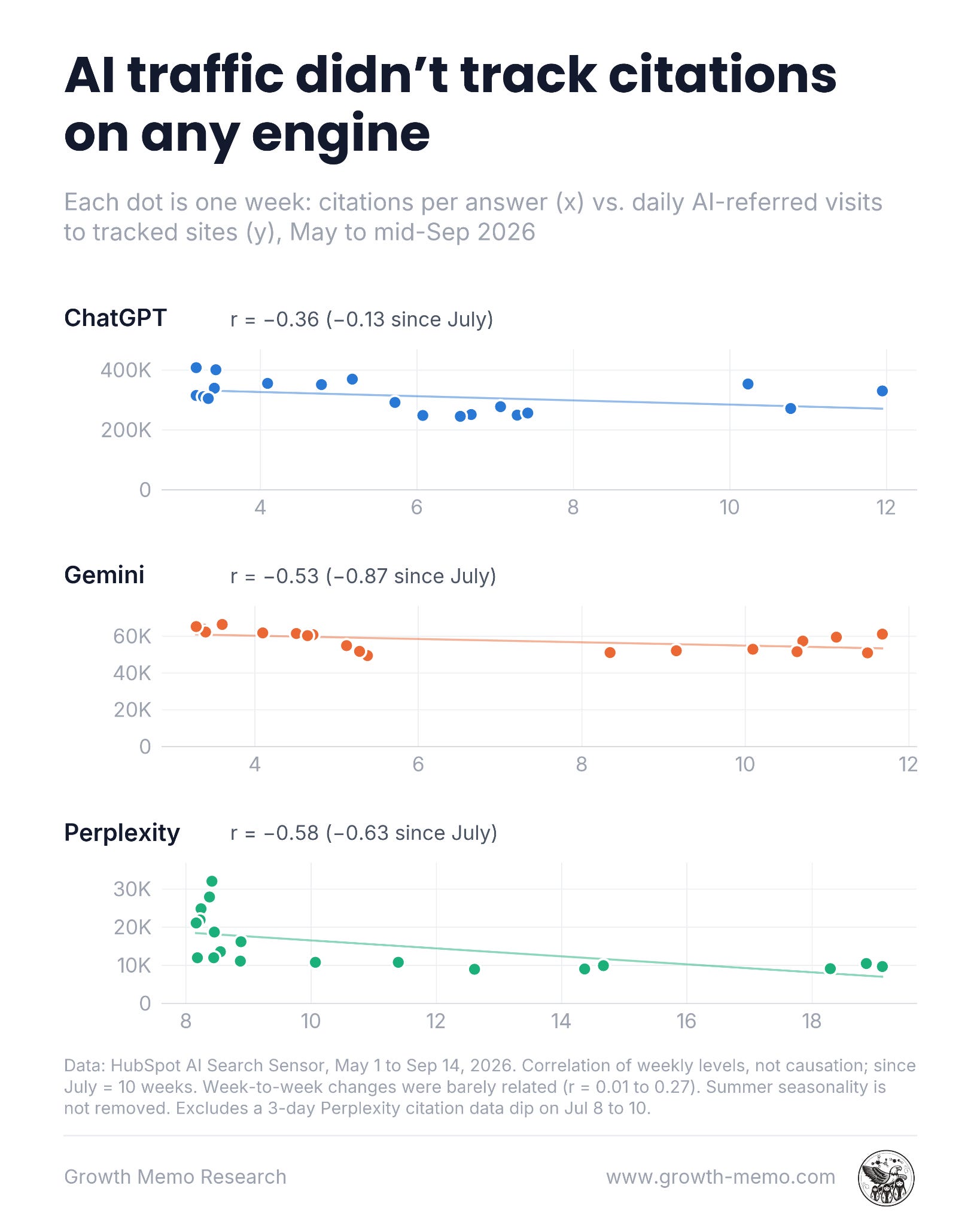
Referrals depend on how many people use the engine, not how many links each answer shows.
4/ Citations change all the time
Where citations come from, eg your own site or a competitor’s, matters. And, it changes all the time.
Hubspot tracks this in a specific way:
HubSpot counts every cited URL once for each tracked brand it ties to that URL. Imagine an answer cites a comparison page between 3 brands. That produces one cited-URL and 3 brand–URL associations in the data. I compared these “brand-URL associations” per prompt during July 6–August 2 with August 17–September 13.
The source categories describe the cited website’s relationship to the tracked brand: its own website, competitors, peers, another product or service company, or another source type.
Citation (source) mix shift happens all the time, but AI engines move in different directions. Just comparing 2 months, we see:
Perplexity’s brand-URL associations per prompt rose 91%, with 65% of the increase coming from peers.
ChatGPT shifted toward competitor sites. Competitor citations per prompt rose 51%. Peers fell 12%.
Gemini’s brand-URL associations per prompt fell 24%, fairly spread out across all citation categories.
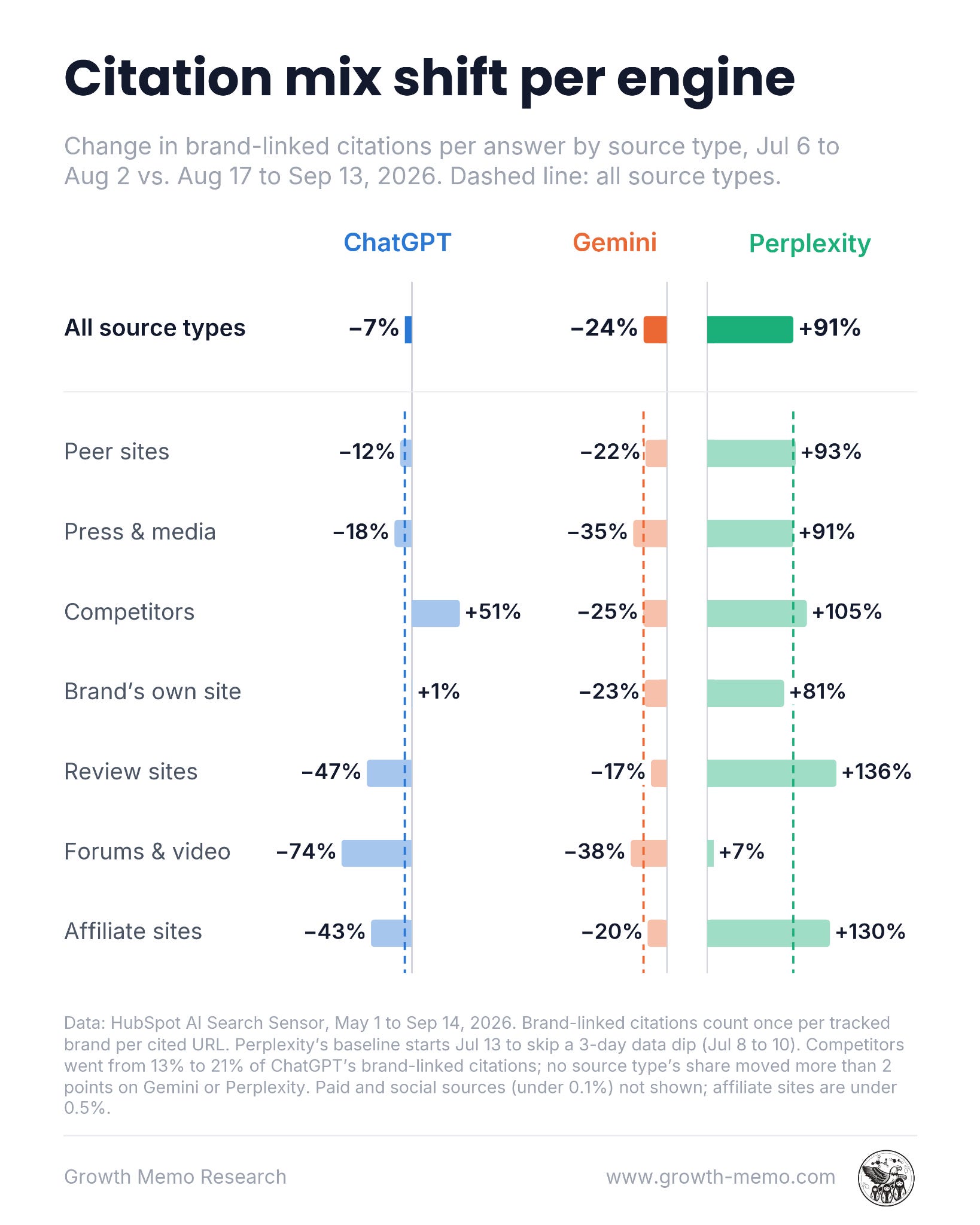
For example, Gemini gave more 50% citation share to brands while decreasing press & media by 20%. But it also cut the number of cited pages from 11.5 to 5.4 (-53%) from June to July (denominator!).
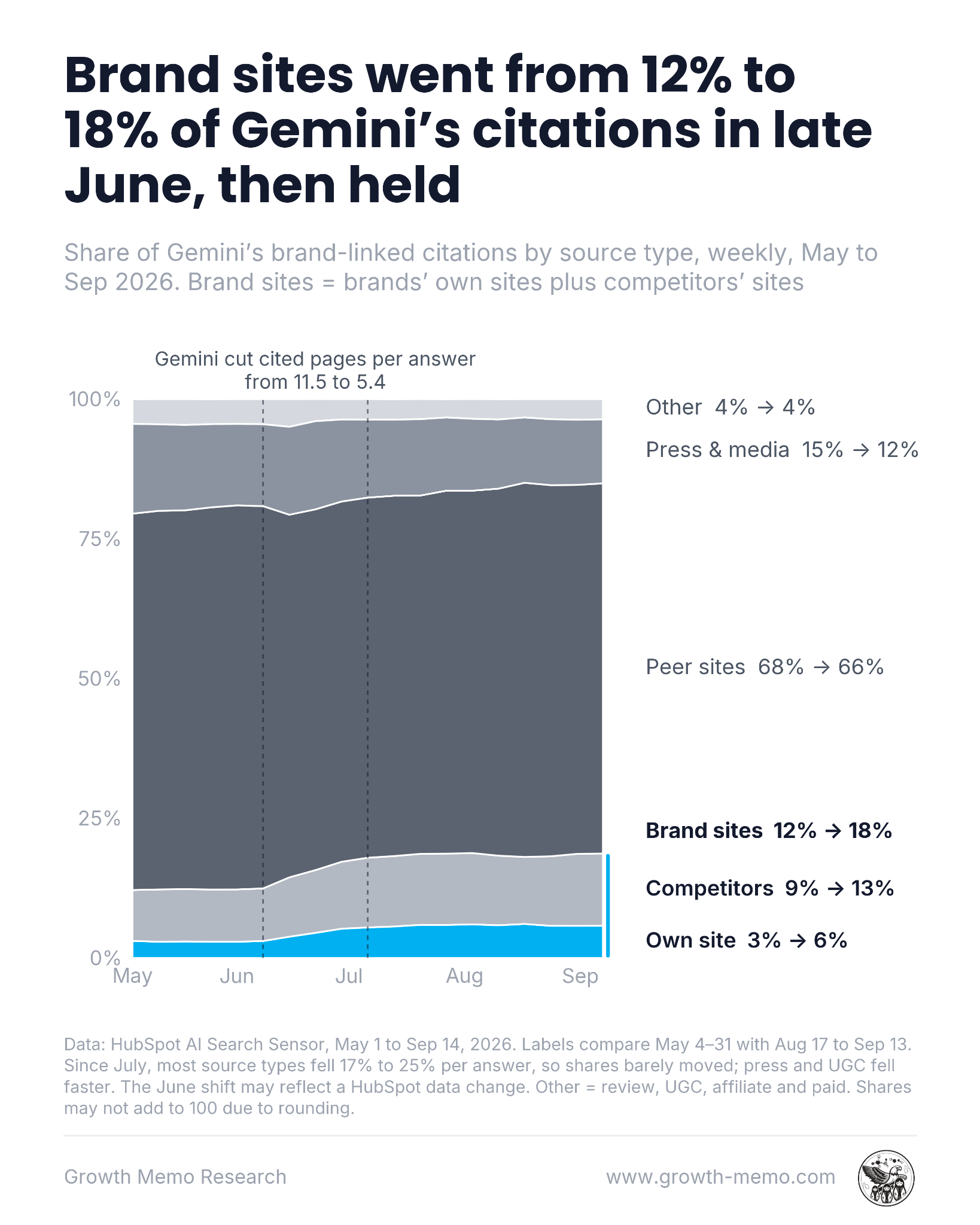
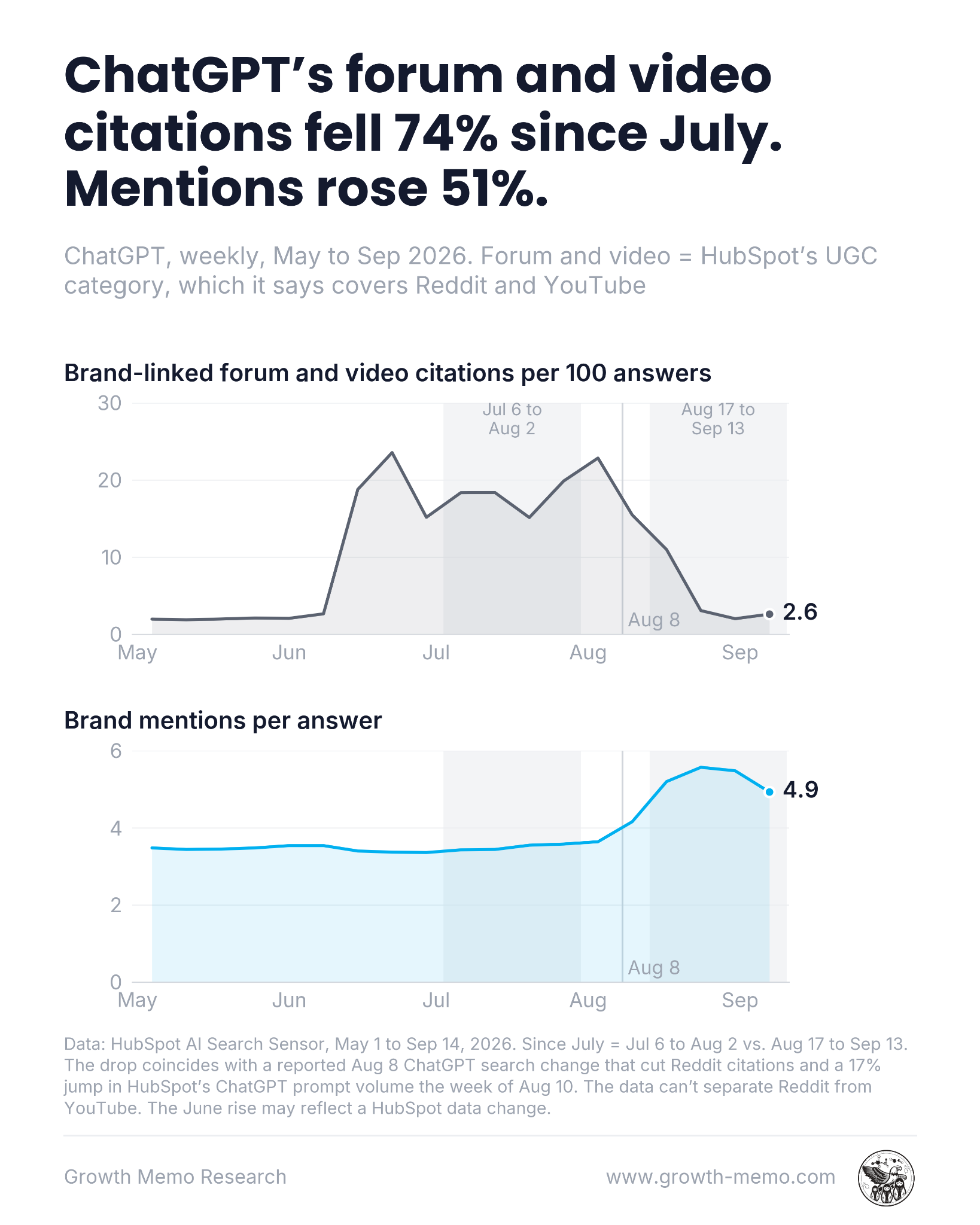
Another example is ChatGPT cited a 74% fewer forum and video pages but showing 51% more brand mentions around the same time.
All 3 AI engines cited pages that cover more brands over time. The driver is page type: Listicles and comparisons cover many brands at once, and listicle share moved with the ratio (r = 0.69 to 0.90 per engine).
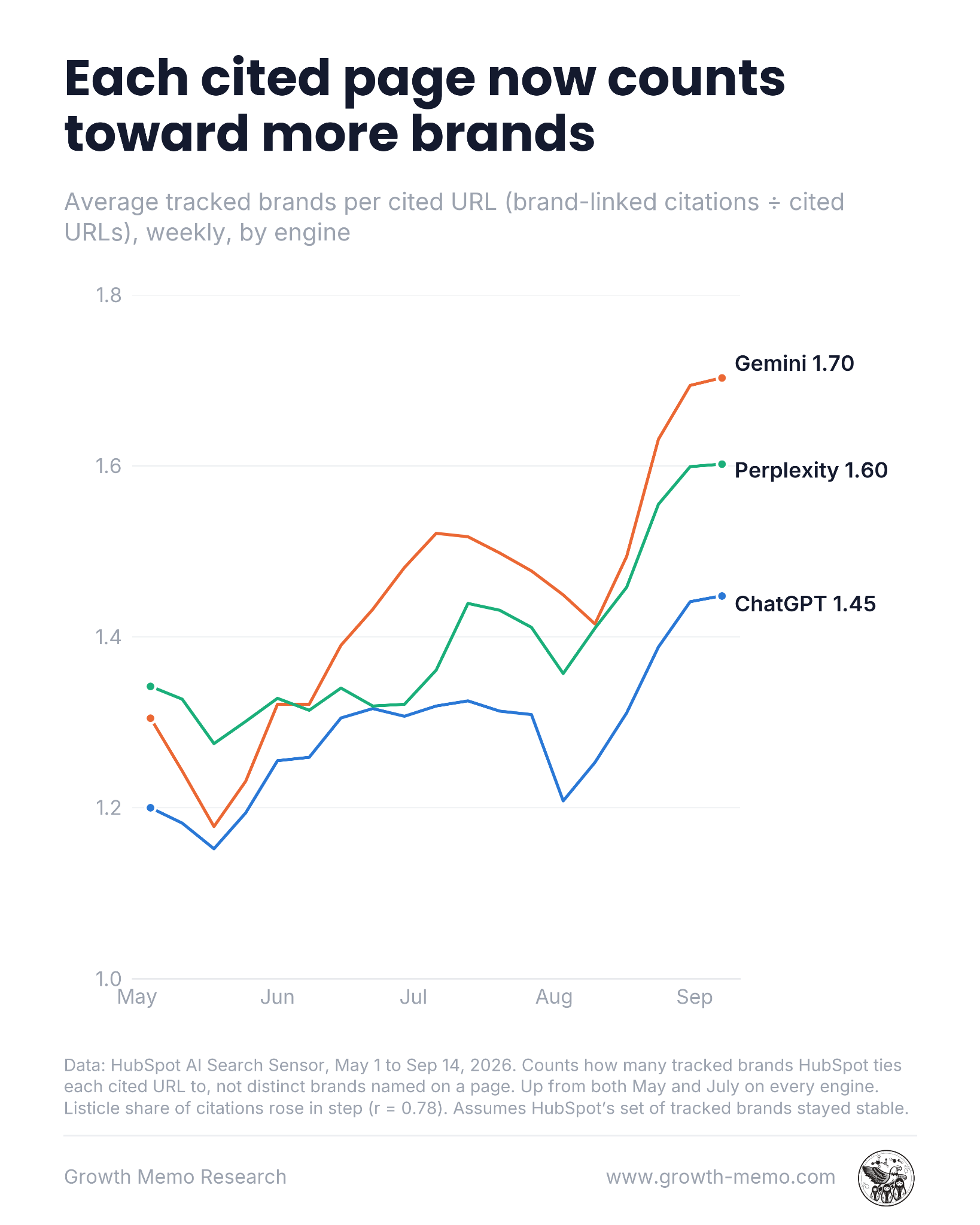
It’s another denominator effect. Your brand-linked citation count can rise without any extra page being cited, simply because each page covers more brands. But it also means more of your citations are shared with competitors. If the page that cites you also lists 2 competitors, the reader sees you as one option among several. So your position inside 3-party roundups can matter as much as being in them.
To act on this:
Track both the number of associations per prompt and each source category’s share. A category can grow because the engine is citing more across the board; a rising share tells you its weight within the measured source mix increased.
For your own brand, compare the same prompts and source categories over time. If competitor sources gain share, inspect which pages are appearing and how your brand is represented in the answers. Use that evidence to choose what to test next.
Free subscribers get today’s analysis. Premium subscribers get everyday access to the audit tool, the checklist, and the slide deck for the executive conversation.
Humility and the denominator
A changing denominator can produce a result we’d like to credit to our own work.
Tolstoy said “A man is like a fraction whose numerator is what he is and whose denominator is what he thinks of himself. The larger the denominator, the smaller the fraction.” Arrogance shrinks our true worth, while humility allows our real character to shine. In a meta sense, we need humility to acknowledge when a changing denominator leads to a certain result, i.e., when there’s a shift in how LLMs display our work INSTEAD of our work.
Each AI engine has a different trajectory for the number of citations and mentions. And, of course, their underlying behavior. My conclusion from all this is that we need to track interface and model releases more closely to understand whether our optimization efforts drive real change or the environment, aka denominator, changed.
Build a report by engine with citations per prompt, brand mentions per prompt, and AI referrals. Keep the prompt set and tracked-brand cohort as stable as possible, and compare the same time windows across metrics.
A rise in citations per prompt tells you that tracked answers contained more cited URLs on average. The mention and traffic series show what happened to the other 2 outcomes. When they diverge, inspect the underlying answers and referrers before deciding what to change.
Humbly,
Kevin
Methodology
The export covers May 1–September 14, 2026: 137 daily observations per engine and 19 complete weeks of source and content classifications.
4-week citation and mention rates equal period totals divided by prompt runs. Referrals per day equal total referrals divided by days. August breaks compare 7 days before each date with the 7 days beginning on it.
Sensor describes AI referrals as referrer-based, modeled estimates from anonymized customer data. The traffic and prompt series may cover different populations, and the export does not connect individual citations to visits.
The export does not establish a fixed prompt set, a fixed tracked-brand cohort or the exact daily mention-counting rule. In a July 23 email, HubSpot described the prompt mix as “reasonably stable since May 1” and separately reported citation-parsing fixes. Combined prompt runs per day rose 22.4% between windows; rates do not control for changes in the mix.
Source and content rows count classified brand–URL events. The event-to-citation ratio divides source events by cited URL occurrences in the same full weeks. Listicle share divides listicle events by classified content events; unclassified content is excluded.
Across 76 daily observations per engine from July 1 through September 14, Pearson r for citations and mentions per prompt was −0.21 for ChatGPT, +0.93 for Gemini and +0.61 for Perplexity. Gemini’s day-to-day changes were less closely correlated, at +0.44.
Supporting source analysis: From July 6 through September 13, the weekly correlation between the brand–URL event-to-citation ratio and the mention rate was +0.65 for ChatGPT, −0.59 for Gemini and +0.85 for Perplexity. For absolute week-to-week changes, the correlations were +0.40, +0.04 and +0.44, respectively. The calculations cover 10 weekly levels and nine changes and do not establish that pages associated with more brands caused more mentions.
The share of classified content events tagged as listicles also grew. It rose from 19.7% to 38.2% on Gemini and from 22.3% to 38.1% on Perplexity. These are classified events, not unique listicle articles, and the shift does not establish a cause for the mention or association trends.
Agreed that referrals are the wrong scoreboard, since your Perplexity data shows more citations and fewer clicks. A buyer can see your brand named and never visit. A "how did you hear about us" field with ChatGPT, Gemini and Perplexity as options would catch some of those buyers. The answers will be messy, but they tie the report to revenue.