How do you write a listicle that performs well in classic and AI Search?
In last week’s Memo, I dug deep into 5.3M search results to see if Google demoted listicles or not.
Quick recap:
Listicles are still everywhere. At least one true listicle appeared in the top 10 SERP results for 55.1% of the 60,000 queries analyzed, and in the top 3 for 32.3%.
Query intent is the biggest lever. Google shows 5.3x more listicles when the query explicitly asks for a set of options.
No universal demotion. Google shuffled who ranks: only 52.5% of queries kept the same position-one URL between January and August.
Publishers beat brands. Publishers supplied 46.8% of the highest-ranking listicles vs. 19.2% for brands/vendors, and won 54% of head-to-head matchups on the same SERP.
Results vary sharply by vertical. Top-10 listicle presence ranged from 42.0% (entertainment/gaming) to 67.2% (beauty/fashion); brand-owned listicles appeared on 46.2% of B2B software SERPs, reflecting how heavily B2B leans on the tactic for AI search.
The real threat is indirect: competition for attention. 92% of listicle SERPs carried Reddit or YouTube, and AI Overviews covered 83.7% of queries on average (93.4% in B2B).
In Part 2 below, I’m answering the question: What makes a listicle perform well?
What higher-ranking listicles have in common
I analyzed over 15 variables across 3,000 listicles, but most of them didn’t survive the control checks, where I did a few analyses to determine if the findings held when normalizing certain variables. Interpret the ones with a “yes” in the Direction stable column below as “maybe, but we cannot prove it yet.”
The clearest signal was freshness. A date from the previous 2 years appeared on 66.6% of pages in the top 3, compared with 57.3% of pages in positions 8-10. That’s likely not a surprise: Search and LLMs love freshness.
An old date, or a date the crawler could not interpret, appeared on 8.2% of top-3 pages and 15.1% of pages in positions 8-10.
After controlling for vertical, query wording, and listicle type, an old or unreadable date was associated with 56% lower odds of ranking in the top 3 (when filtering down to one page per domain).
If a finding from this week changes a decision for your brand, the Growth Memo Premium Resource Library has 45+ (and growing) checklists, light tools, AI workflows, and stakeholder slide decks to put it to work.
Counted listicles perform better. A counted listicle is one that has an explicit item count or numbered-list evidence in its title or search snippet, such as “17 Best Project Management Tools.” An editorial roundup recommends or compares several options without an explicit number, such as “The Best Project Management Tools.” The name describes how the page was classified in this analysis, not whether someone manually counted every item on the page.
56.8% of the direct matchups went to counted listicles. This comparison covers 6,114 search results pages where a counted listicle and an editorial roundup both appeared in the organic top 10.
The best counted listicle averaged position 3.77 on the 28,228 search results pages where one appeared in the top 10. The best editorial roundup averaged position 4.59 across 10,791 search results pages. “Best organic rank” means the highest ordinary unpaid position reached by that page type on each search results page.
Counted listicles landed in the top 3 55.9% of the time when present in the top 10. Editorial roundups did so 41.4% of the time.
The pattern was not universal. Editorial roundups won the direct matchup in consumer technology, fitness and sports, and automotive, while counted listicles won in the other 12 verticals.
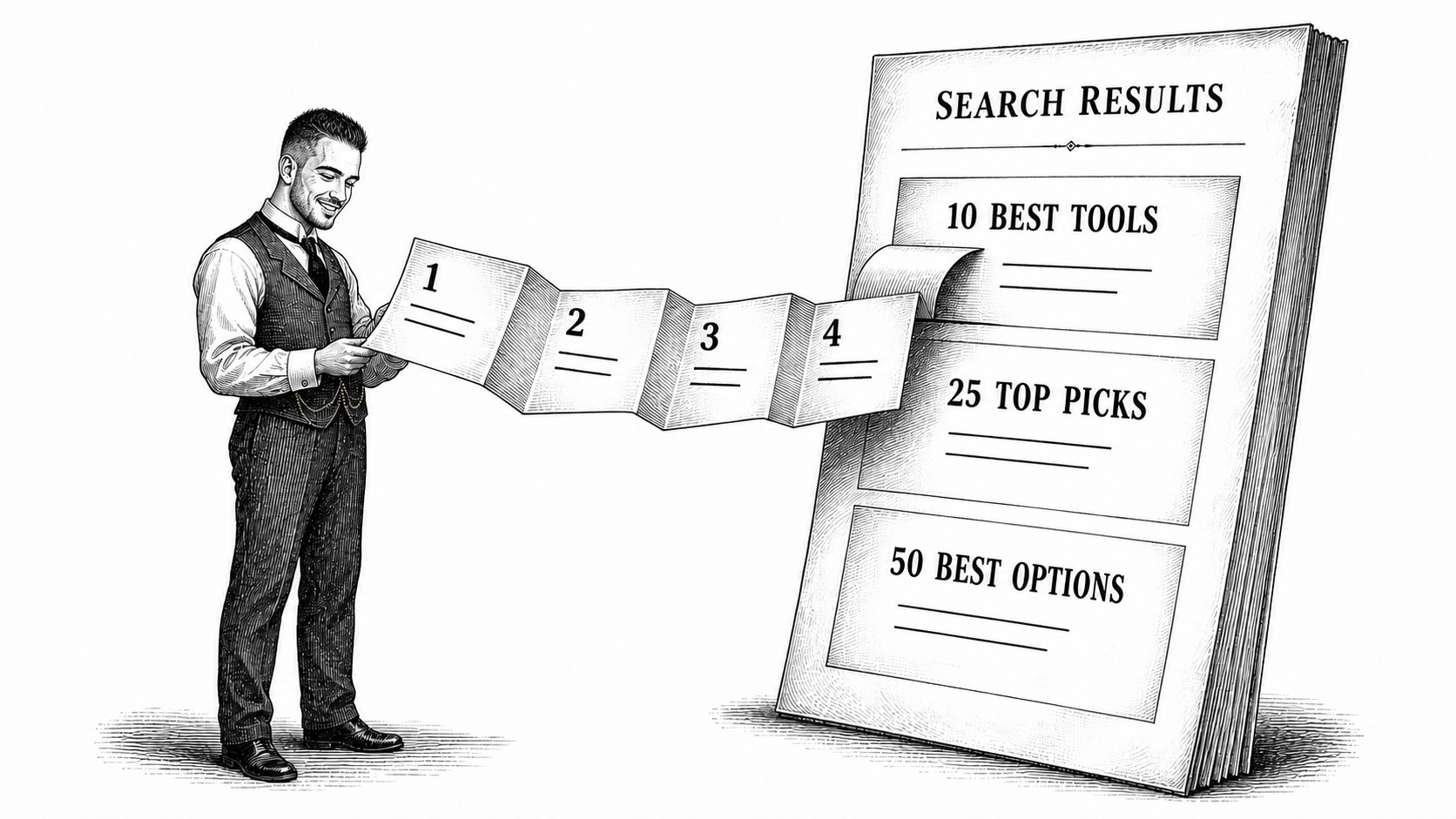
Larger title numbers rank higher. The rank pattern strengthens as the leading number in the title rises. Among explicit list queries, counted listicles with 51 to 100 in the title had a mean best organic rank of 4.11. Titles with 2 to 5 averaged position 5.85.
The leading title number is only a proxy for list length. A title can say “50 ideas” while the page contains fewer, more, or differently grouped items.
Top-3 pages had 21.5% more words and 38.9% more images at the median, but these differences did not remain consistent in every adjusted model. Median numbered-heading and ordered-list counts were zero in both groups.
What doesn’t help: More section headings did not predict a better position. A one-standard-deviation increase in heading count after adjusting for unusually large values was associated with 29% lower top-3 odds.
So, while signaling depth through big numbers in the title earns higher rankings in this dataset, over-structuring content with many headings is counterproductive.
“50 best tools” may signal comprehensiveness, match explicit list intent, or attract clicks. But 50 products can also appear in cards without creating 50 headings.
Self-serving listicles are well and alive
In Part 1, we saw that some listicles lost traffic. In the cohort I analyzed for Part 2, I found that self-serving listicles that were published toward the end of last year grew in traffic: 3.5x more than the rest.
So, while older cohorts were partially demoted by Google, newer ones travel well. However (!), vendors putting themselves first in their listicles is not responsible for their growth. They grow despite it.
Brands aren’t publishing self-serving listicles just to rank in Google. They also want AI tools to recommend them.
Today’s sponsor, Semrush, examined how brand visibility differs between ChatGPT and Google AI Mode. Its new research analyzes 126M+ prompts across 22 industries, comparing the brands each platform mentions, the sources it cites, and the competitors it puts alongside them.
For teams publishing listicles for AI visibility, that’s useful context: the goal isn’t simply to get a page ranking, but to understand where and how your brand appears in AI answers. Download the report for free
After accounting for starting traffic, industry, listicle type, current rank group, and repeated pages from the same publisher, the advantage quickly disappeared. Self-promotion was associated with only 4% stronger growth, with a 95% interval ranging from 51% lower to 120% higher (p-value was 0.91).
My read is that companies put more effort into listicles after realizing their role in AI Search, and that’s why we see the growth. At the same time, the result supports the argument that self-serving listicles still work, even though Google demoted a lot of them.
Naming your own product first holds up when the page carries something a competitor cannot copy. The Commodity Content Audit gives you the substitutability score before you publish, so the ranking argument rests on evidence. It’s in the premium library.
Details:
Across 83 manually reviewed pages from 8 industries, median organic traffic estimates reached 1,977 in August 2026 compared to 568 for 600 control listicles.
74.7% of eligible B2B vendor comparisons put the publisher’s own product first. 62 ranked the vendor first vs. 21 that did not.
Of the 434 vendor-owned B2B listicles I reviewed, 83 compared the vendor with genuine peer alternatives.
90.4% of self-promoting pages gained measured traffic between August 2025 and August 2026, compared with 67.3% of the overall benchmark.
Among pages that already had measurable traffic at the starting point, the median gain was 186%, compared with 20% for other listicles.
Listing your brand first: Cringe?
I get the cringe factor of writing a listicle about your brand and naming yourself first. Besides the question of whether humans would actually read this (or go to Reddit instead because they’re aware of the bias), how do you morally reconcile this?
My recommendation to clients is to use 3rd-party data as a proof point for your listicle ranking. If you have G2 reviews that support you being “the best for x”, you can write about it with a clear conscience. If not (and if you care about this), maybe listicles are not the best option. Maybe leaning on an affiliate partner or creator to do this is the better way.
There is an inherent philosophical problem with Google Search. When you search for a query like “project management software” and you’re Asana, shouldn’t you automatically show up in the search results?
The answer is no because there are only so many software solutions and Google doesn’t want to be “on the hook” for which brands show up first and why.
The workaround: Instead, it often links to third parties that curate brands like publishers or marketplaces. Hence, listicles. Listicles are basically curations and they avoid Google having to take a stance.
Now, AI Overviews change that. In AI Overviews, you get a clear recommendation for brands (see screenshot above). It’s a philosophical shift in how Google takes a position on which brands to recommend. And part of what allows this is personalization and longer (think: unique) prompts.
As a result, while listicles still rank well and might inform AI answers (perhaps less, these days), Google’s shift to name brands in AI Overviews makes their value even more questionable.
Methodology
This follow-up combines four analyses from the original study of 59,984 valid Google search results pages across 60,000 US English queries and 15 verticals.
First, I compared counted listicles with editorial roundups.
A counted listicle showed an explicit item count or numbered-list evidence in its title or search snippet.
An editorial roundup recommended several options without an explicit number.
Direct matchups only included search results where both formats appeared in the organic top 10.
Second, I crawled a balanced sample of 3,000 currently ranking listicles.
The sample contains 200 pages from each vertical, split evenly between counted listicles and editorial roundups.
The crawl recorded objective page signals, including word count, headings, estimated list items, images, author information, dates, canonical URLs, and structured data. It did not judge first-hand experience, product testing, subjective content quality, or monetization.
To identify which signals were associated with higher rankings, I compared pages whose best observed position was in the top 3 with pages in positions 8 to 10. The adjusted models accounted for vertical, query wording, listicle type, how often a page appeared in the study, and repeated pages from the same domain. I also repeated the analysis with one page per domain to limit the influence of large publishers.
Third, I compared organic traffic estimates between January 15 and a live August 24, 2026 snapshot. The sample begins with pages that ranked in August and looks backward, so it describes today’s surviving pages rather than all listicles published during the period.
Finally, I reviewed vendor-owned listicles for self-promotion. A page qualified only when it compared the vendor’s product with genuine peer alternatives. I classified it as self-promoting when the vendor placed its own product first, labeled it “Best Overall” or “Top Pick,” or otherwise made it the first substantive recommendation.
Humbly,
Kevin
PS: I gave the charts an overhaul. Would love to hear your feedback!