


From 1907 to 1929, the share of homes in the US with electricity jumped from 10% to 70%. Standardized 110/120 volt outlets opened whole new consumer markets and brought on innovations like dishwashers, mixers, shavers and televisions.
I believe we’re at a similar moment with AI, and the impact could be even bigger. My lens is organic growth: AI is changing how people discover, compare and choose brands, often before they visit a website. But the technology and consumer behavior are changing fast, so the answers we have today might look different in a few months.
I’ve published 3 meta analyses before:
In this Q4 update, I show you what changed since my last analysis. From now on, expect me to publish a meta analysis once a quarter to chart the way and capture the current state of AI (Search). As always, it’s important to keep in mind that one single study says very little, while a body of research says a lot but takes time to accumulate.
1. How much of search is moving to AI?
This question should not be understood as “How many people stop using Google and use ChatGPT” but as “how many people still use Google search as opposed to AI Chatbots like Gemini, ChatGPT or Claude”. Someone might start on Google, read an AI Overview, ask ChatGPT to compare options, and return to Google to check a brand. To understand how much search is moving to AI, we need to separate the people using AI from the searches they would otherwise have made. And, of course, it’s not black or white because any change is always gradual.
In my 2025 AI Mode analysis, voluntary adoption looked slow. Google now reports more than 1 billion monthly active users. Those figures measure different things, so they don’t tell us how many traditional searches AI Mode has replaced. I wouldn’t count the numbers as voluntary opt-ins since Google simply started showing AI Overviews in already used search features and funnels more people into AI Mode.
AI Overviews are appearing on more commercial research queries. In my 2025 AI Overviews analysis, I found they appeared mainly for informational searches. More recently, Semrush tracked 400 U.S. desktop commercial keywords and found that Overview coverage rose from 45.75% in September 2025 to 88% in August 2026. The sample covers selected queries in banking, ecommerce and software, not all searches. Profound classified 7.5 million U.S. English ChatGPT conversations and found that commercial-intent conversations rose from 13.9% to 19.2% between June 2025 and June 2026.
Search users seem to use AI answers more. A 2026 Pew survey of 5,119 U.S. adults found 49% used an AI chatbot at least once (up 16 percentage points from 33% in 2024), 24% used one daily, and 42% used chatbots to search for information. 60% read an AI summary at the top of a search result.
Google search remains central, despite widespread fragmentation of search across many AI platforms. In Bain’s 2025 survey of 1,500 consumers, 56% said they mostly or always used search engines as their default, versus 16% for chatbots. A separate SparkToro analysis of 41 search-enabled websites put Google at 73.7% of observed U.S. desktop searches in Q4 2025.
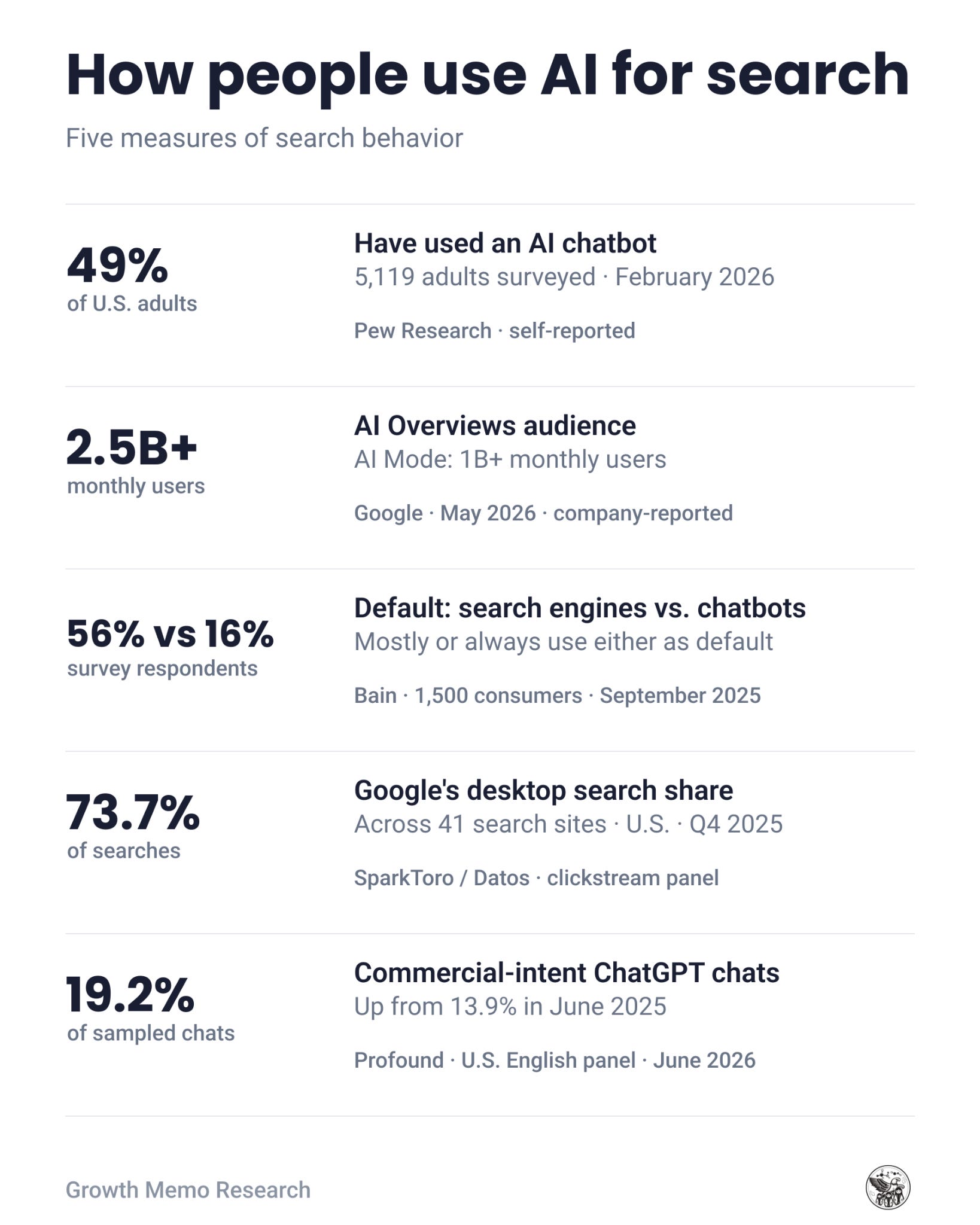
Verdict: we can’t say “AI is x% of search” because it all melts together. But we can say that consumers adopt AI as a way to search, whether by reading AI Overviews or using AI chatbots. I couldn’t find evidence for a cut of Google usage.
2. Do AI answers reduce clicks?
I think it’s pretty obvious at this point that AI answers reduce clicks. But, I often hear conflicting numbers for the question “ by how much?”
There is the groundbreaking Pew study of a 900-person U.S. browsing panel from March 2025, which came to the conclusion that users clicked a traditional result on 8% of visits with an AI summary, compared with 15% of visits without one (~50% less). They clicked a link inside the summary on only 1% of visits with a summary!
Since then, randomized experiments by Agarwal and Sen and Wang et al. have strengthened the evidence that AI Overviews and AI Mode can reduce external clicks:
Agarwal and Sen found in a 2026 field experiment that when an AI Overview appeared, outbound organic clicks fell by 39.8% and zero-click searches rose by 34.5%. The randomized comparison supports a causal effect! Also, sponsored clicks and overall search frequency remained unchanged.
Wang et al. ran a field experiment with 1,100 active U.S. participants. It showed forcing searches into AI Mode reduced external click-through by 18.8 percentage points versus normal Google search.
In my 2025 AI Mode analysis, user behavior studies already showed that people often stayed inside Google. In my own study, 77.6% of task sessions produced no external visit.
Khosravi and Yoganarasimhan used a difference-in-differences comparison of Wikipedia articles and saw a 5.45% reduction in English Wikipedia external-search referrals associated with AI Overviews, using German Wikipedia articles as the comparison. Ahrefs analyzed 300,000 desktop keywords and found that the position-one CTR for keywords showing an AI Overview was 1.6% in December 2025, compared with a modeled 3.7% without an Overview, a 58% relative gap.
A contrasting finding: Semrush and Datos examined more than 200,000 keywords in 2025 and reported that, for the subset that began showing AI Overviews between May and October, the measured zero-click rate fell from 33.75% to 31.53%. But keep in mind that zero-click share is different from (lower) CTRs.
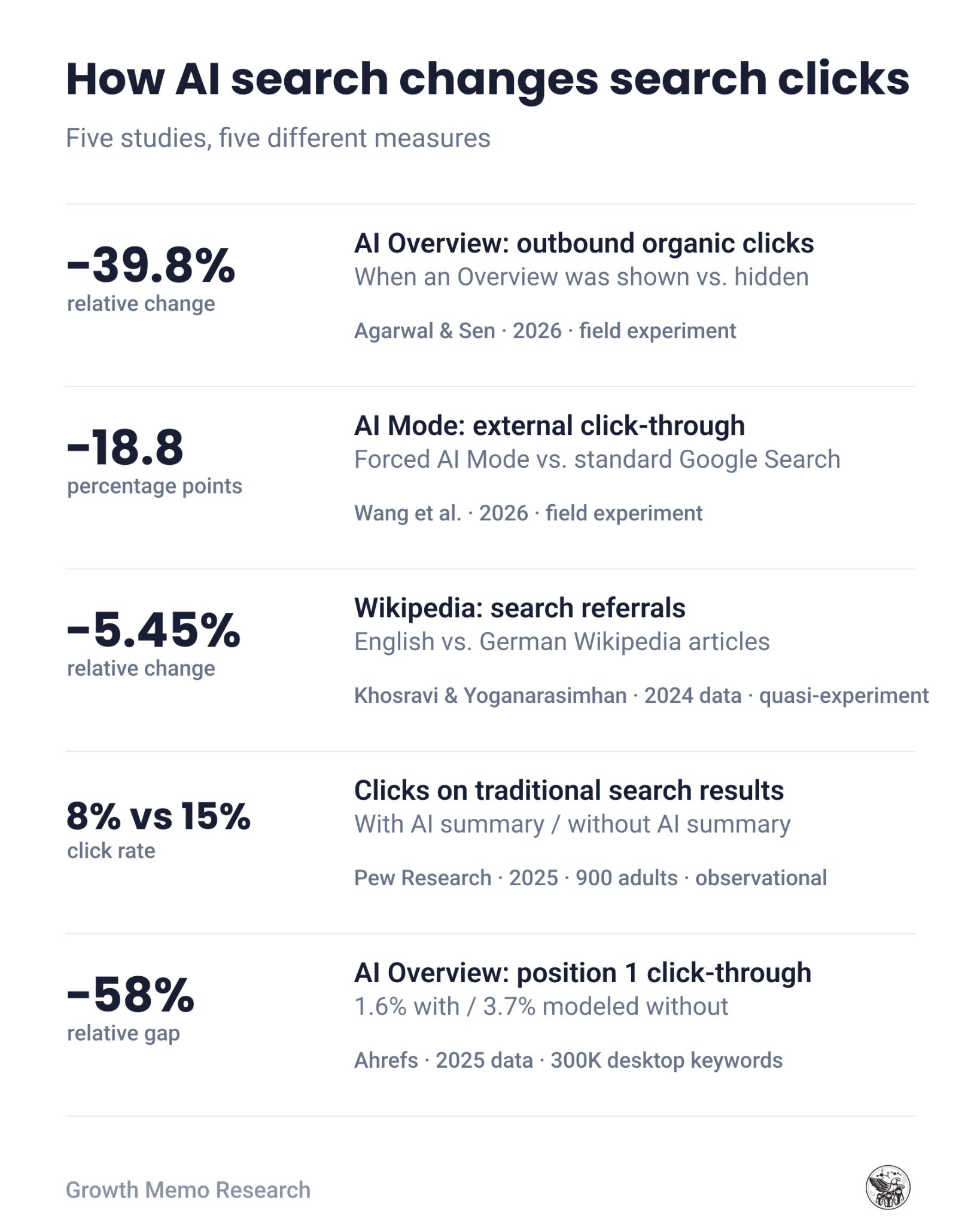
Verdict: AI answers can reduce clicks, but the size of the effect depends on the format, query and context. The studies don’t support applying one percentage to every website.
3. What determines whether a brand appears in AI?
With AI adoption growing rapidly, the next-logical question is how brands can be visible when and where it matters. A traditional rank report tells us where a page appears. An AI answer can find several sources, cite some of them, and name brands in its response. The path from a page being found to a brand being recommended has more steps, and each creates a different opportunity to gain or lose visibility.
In my 2025 AI Mode analysis, I focused on brand strength, relevance and freshness, and suggested frequent content updates. Since then, research has made the steps between discovery and visibility clearer. AirOps found that many retrieved pages were never cited, while my study with Semrush found that a site can be cited without its brand being named.
The research points to four stages where brands can gain or lose visibility:
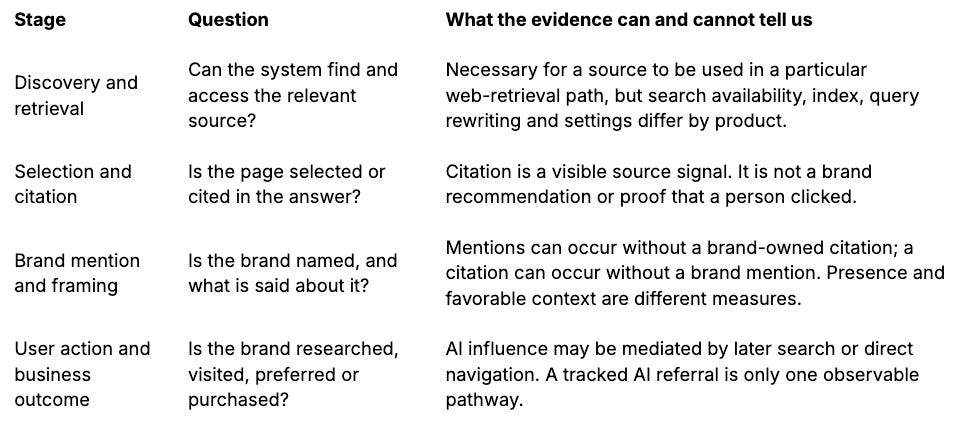
Discovery and retrieval
When an AI system searches the web, getting found is the first hurdle. And that search can extend beyond the original prompt. AirOps studied 15,000 prompts and 548,534 pages retrieved by ChatGPT. 85% of retrieved pages were never cited. And among cited pages that appeared in a top-20 search result, 32.9% appeared only for a follow-up, or “fan-out,” query rather than the original prompt.
That means tracking the original prompt alone can miss part of the search process. A question about the best CRM, for example, might lead to follow-up searches about pricing, integrations or customer support.
A study by Chen and Koudas points in the same direction: retrieval and topical relevance were more informative for predicting citations than features such as FAQ blocks or schema. The researchers used API replays, so the results are not a direct observation of the full consumer interface.
The controlled SAGEO Arena benchmark adds another wrinkle. Rewriting body text to add technical terms, insert source references or improve fluency reduced retrieval rates in its tests. Reworking structural information, including titles and meta descriptions, improved retrieval. Keep in mind these are benchmark results, not direct measurements of live Google or ChatGPT.
That distinction matters because, as Martinez’s review points out, some GEO studies give the model a set of pages upfront. They can tell us how an AI uses a supplied page, but not whether it would have found that page in the first place.
Selection and citation
Getting retrieved doesn’t guarantee a citation. The AI still has to select a source.
In my study with AirOps, pages higher in the retrieval results had higher citation rates. The first retrieved page had a 58% citation rate, compared with 14% further down the list. Pages whose headings matched the query more closely also had higher citation rates. A separate controlled study of 252,000 two-document trials found that relevance and source position had the largest effects on which source was cited first.
Other findings are interesting, but don’t prove that a specific page edit causes citations. SISTRIX found associations between citations and features such as the current year in the title, a table of contents and schema. In my study with Gauge, the eight pages that qualified as primary research averaged 11.3 citations each, compared with 3.4 for the other pages.
There are also reasons to be skeptical of one-size-fits-all tactics. In C-SEO Bench, adding statistics lowered a document’s average ranking in 19 of 24 tested task-and-model combinations. In a separate test, the advantage from two edits shrank as more competing documents used them. The researchers supplied documents to the models, so the benchmark didn’t test whether the edits affected retrieval.
Brand mention and framing
Being cited and being named are two different things. An AI answer can link to a page without mentioning the brand, or mention a brand without linking to its website. In my study with Semrush, 61.7% of the 3,981 recorded domain appearances were citations without a brand mention. I call them ghost citations. Another 13.2% were both cited and mentioned, while 25.1% were mentioned without a citation.
Ahrefs’ analysis of 75,000 brands also found a correlation between branded web mentions and AI visibility. But brand size, existing demand and category could influence both, so the finding doesn’t prove that increasing mentions alone will increase AI visibility.

Which brands show up when people ask AI for holiday deals and gift ideas? Semrush, this Memo’s sponsor, analyzed 269 holiday-shopping topics across four AI platforms, covering Black Friday, Cyber Monday and Christmas. The study shows:
Where specialist retailers outrank the biggest names.
Which brand leads in mentions without a single citation.
How ChatGPT, Gemini and Google AI Mode build different shortlists for the same queries. Semrush for Enterprise
It also includes a visibility checklist for the shopping season.
User action and business outcome
The final question is what people do after seeing an answer. In my Wynter survey, 145 of 200 respondents, or 72.5%, reported visiting vendor websites after an AI chat.
In Profound’s opt-in panel, brand-site visits within seven days were 2.07 percentage points higher after a ChatGPT mention than a forecast based on the same users’ previous behavior. That is a useful signal, although the study cannot establish that the mention caused the visit.
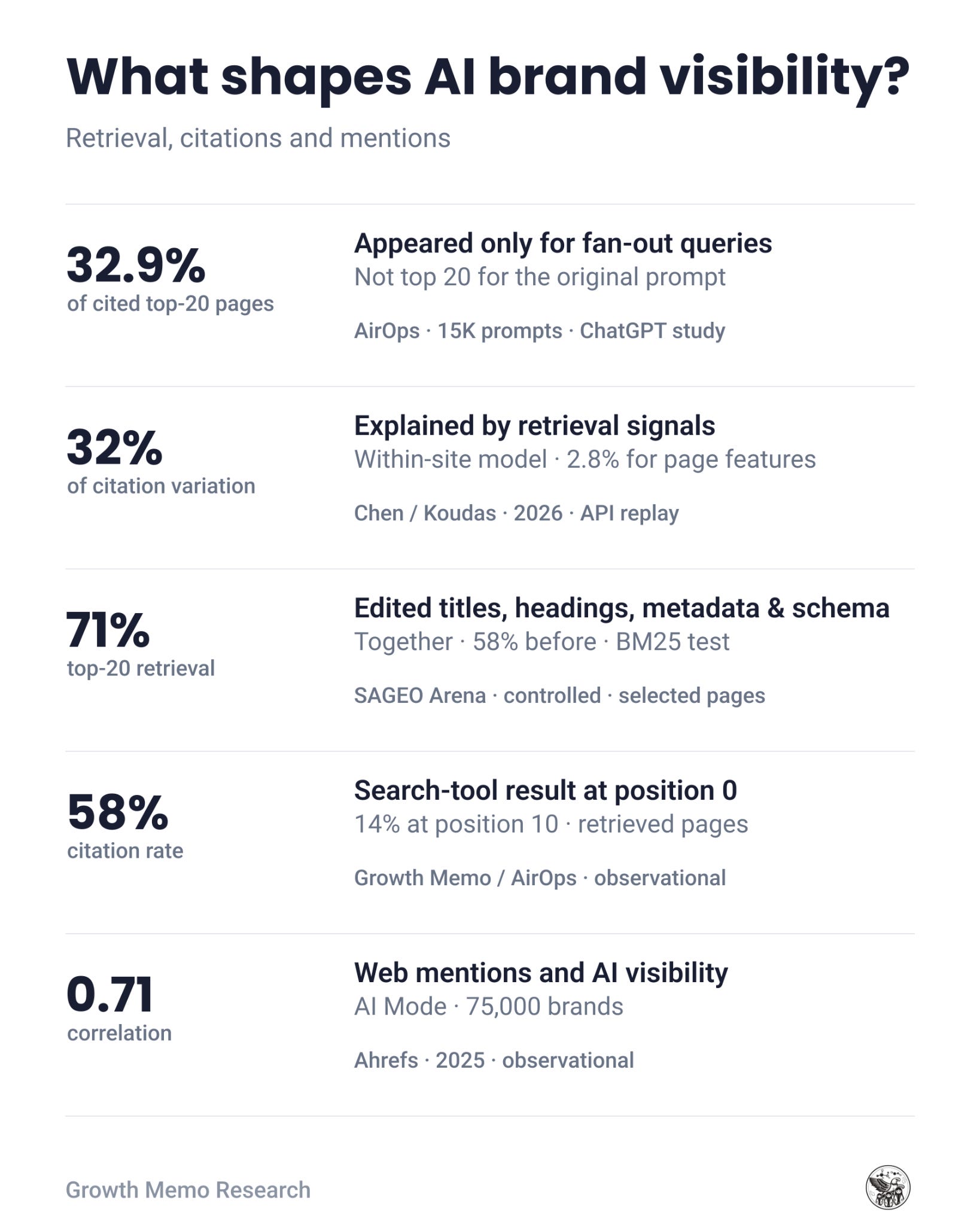
Verdict: Relevance and retrieval show up repeatedly in the research, but no single page feature guarantees a citation. And a citation doesn’t guarantee a brand mention, visit or purchase. The opportunity is to understand where you appear, how you’re presented and what buyers do next.
4. How do people use AI recommendations?
Are people taking AI recommendations as one input or the best answer they can get?
My 2025 chatbot analysis already pointed to evidence that AI recommendations could influence which products people consider. Newer research gives us more detail about what happens after the answer. In my Wynter study, AI introduced additional vendors to buyers who already had candidates in mind, and many respondents visited vendor websites after their chat. AI can expand a shortlist while the buying journey continues elsewhere.
That finding stands somewhat in contrast to my Growth Memo’s study with Citation Labs and Clickstream Solutions, where 48 U.S. participants completed 185 recorded purchase-research tasks across four categories. We found that many finalists came from the AI output without an outside check and a 64% no-click rate in AI Mode. We also saw that the first-ranked item was the top choice in 74% of 137 codable AI Mode observations; the corresponding figure for the smaller search comparison was 71%.
In a separate Profound study, 56 people completed 224 ChatGPT shopping tasks, 221 of which were codable. Across the relevant tasks, 92.8% ended without a meaningful open-web click; selected brands had 24% share of voice in answers versus 11% for brands passed over. The reported correlation between visibility and choice was 0.57.
These observations do not imply people never leave AI: In Attentive’s August 2026 survey of 3,054 U.S. adults who had recently browsed or shopped, 93% of the AI-assisted shoppers describing a recent experience said they sought outside information or proof while deciding whether to buy.
A separate preregistered experiment with 2,012 participants tested commercial persuasion in an ebook-selection task. When a conversational system was explicitly instructed to promote a sponsored book, 61.2% selected it, versus 22.4% in the search-placement condition and 26.8% with chat placement alone.
A Growth Memo/Wynter analysis of 200 self-reported software-research experiences found that 145 respondents, or 72.5%, visited vendor websites after the AI chat, and 96, or 48%, Googled afterward. Of 158 respondents who already had vendors in mind, 99, or 62.7%, reported adding another vendor through AI. Among the 126 who reported choosing a vendor, 78 said it had appeared in the first answer.
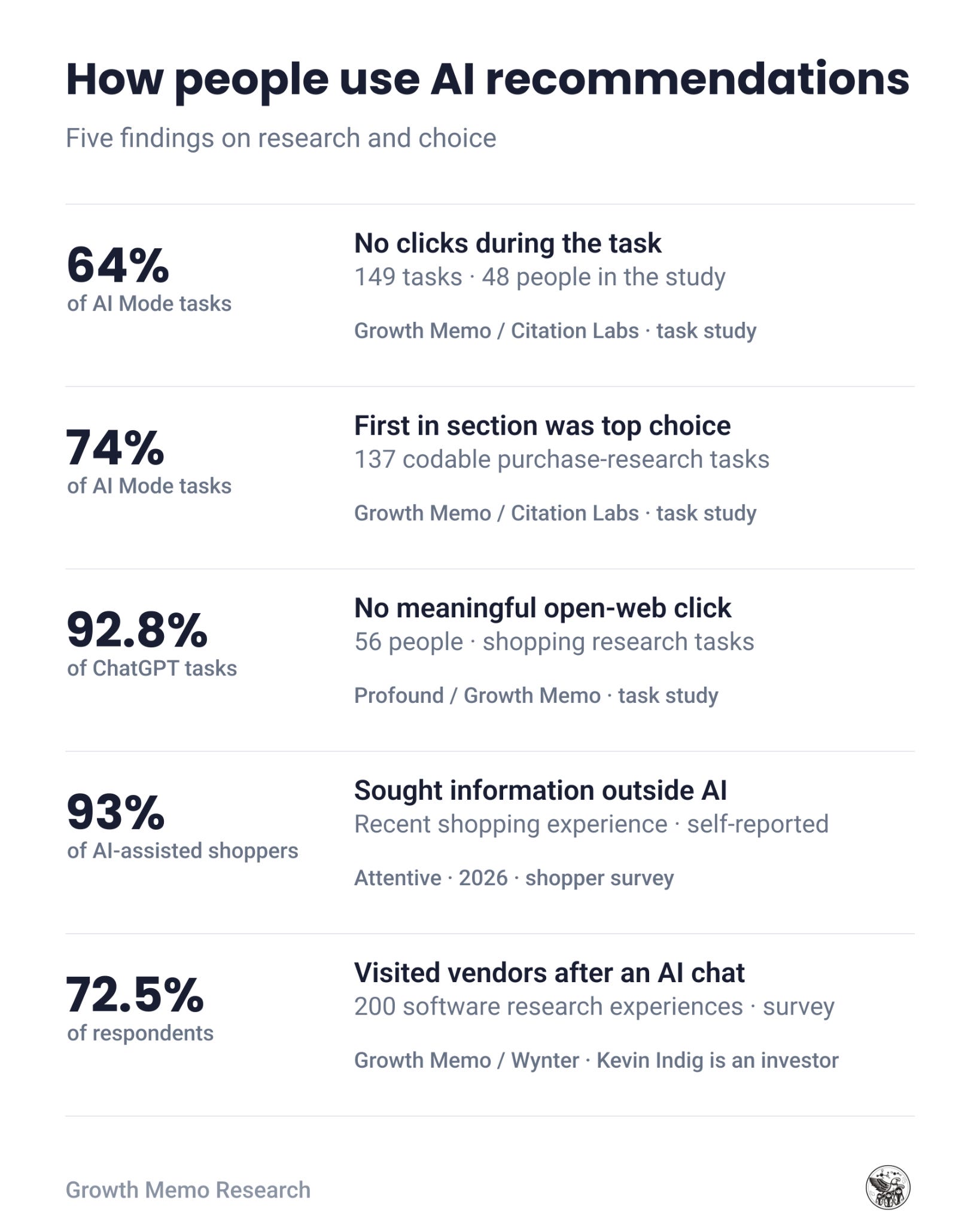
Verdict: AI may both narrow a presented set within a session and add a new candidate to the buyer’s pre-existing set. But a task isn’t a complete buying journey. Buyers still navigate to websites to transact or verify claims from AI. The opportunity is to appear on the shortlist and give buyers a reason to keep you there.
5. Are people ready to let AI shop for them?
There is a lot of buzz around agentic shopping. “AI shopping” can mean asking a chatbot to compare TVs or letting an agent choose one and place an order. Those are different levels of control. To understand how ready shoppers and technology are, we need to separate research, choice, checkout, and the completed purchase.
In my 2025 chatbot analysis, I expected AI to take on more tasks for users and Google to add more agentic capabilities to search. The research now separates two questions: how much people want to delegate and how reliably AI can perform the task.
Gartner’s January 2026 survey of 322 U.S. consumers found that 31% were willing to let AI narrow household-supply choices and 28% were willing to do so for personal electronics. Willingness to let AI make the purchase decision topped out at 11% across the lower-stakes categories studied.
Visa’s November 2026 shopping benchmark tested 22 models across 15 scenarios with three attempts each. Models passed 57.2% of attempts overall, and only 34.2% of model/scenario combinations passed all three attempts. The tests asked models to uncover customer requirements and arrive at an appropriate buy/no-buy decision. The benchmark did not test checkout, payment or order placement.
Wharton researchers ran roughly 26,000 simulated shopping tests using screenshots of an eight-product fitness-watch grid. Changing the prior review, source ordering, injected user context or delivery of tool results changed the model’s choice, sometimes dramatically.
In Growth Memo and Siteline’s study, Claude Sonnet 4.6 agents performed 1,500 runs across three tasks for 100 B2B products. Pricing/features had a 79% first-party answer rate, compared with 93% for integrations and 92% for security. Among pricing runs, 45% cited at least one third-party source when no real price was disclosed, versus 18% when a numeric public price was available. Access errors appeared in 7% of all runs; among pricing runs, the authors reported third-party fallback of 77% with an access error versus 17% without one.
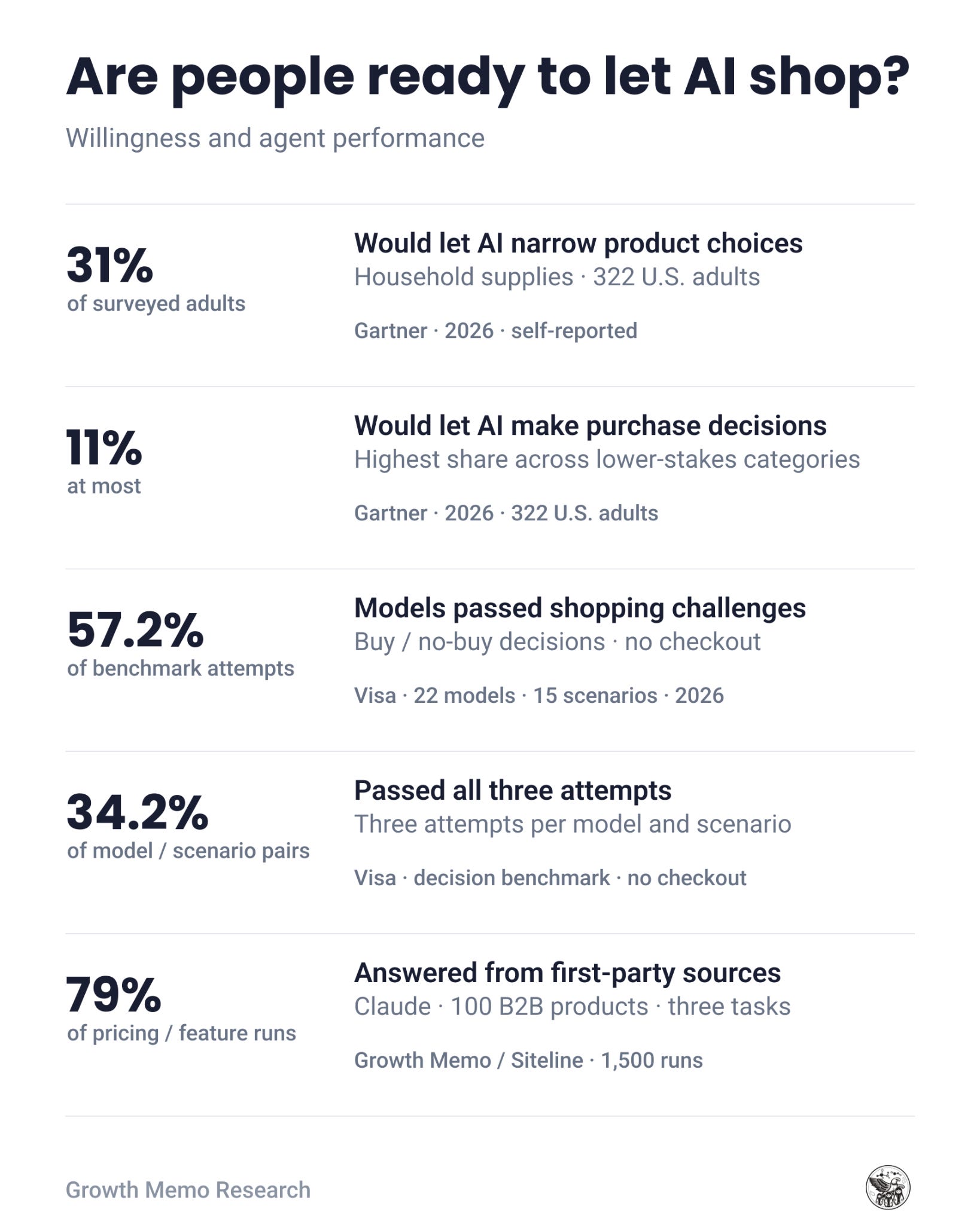
Verdict: There is a difference between consumers wanting AI to shop for them versus AI being able to. People appear more comfortable with AI helping them shop than making the decision for them. Many tests show that AI hits limits across technical and availability issues.
The central finding
AI search is changing the path from discovery to decision across both Google and chatbots. AI answers can reduce clicks today, while recommendations can introduce buyers to brands and shape their shortlist before a website visit.
The opportunity for brands is to show up while buyers are researching and give them the information they need to choose. Autonomous shopping is at an earlier stage: people appear more comfortable getting help from AI than letting it make the decision.
How to act on this:
Measure the journey: Track organic clicks, AI mentions and citations, qualified visits, leads and sales as distinct outcomes.
Make decisions easier: Give buyers and AI systems clear information about pricing, features, comparisons and proof.
Test your visibility: Run important prompts repeatedly, check how your brand is described, and look for changes in traffic and business outcomes.
Methodology
I started with my research workbook and supplemented it with academic papers, Growth Memo research, industry studies, and platform data, with targeted source checks through November 13, 2026.
The full research review cites 52 distinct original studies or analyses. This article discusses 32 distinct original studies or analyses across its five questions. I counted an analysis once when it appeared in multiple sections or was described in multiple publications. Literature reviews, product documentation, and supporting data files aren’t included in that count. These counts describe analyses discussed, not all sources screened or necessarily independent datasets.
This is a structured research review. I didn’t combine the results into a single statistical estimate. The studies use different populations, products, time periods, and measures, including experiments, surveys, browsing panels, modeled traffic data, and agent simulations.
Many samples focus on selected websites, prompts, or U.S. desktop users. A survey measures what people report; an observed click measures what they did in a particular setting. A simulated agent test doesn’t establish how often an autonomous purchase happens in the real world.
Some research providers sell AI search or analytics products. I’m also an investor in Wynter, whose survey appears in this review.