



How do you attribute the value of AI Visibility? Is attribution even the right measuring instrument?
Attribution was invented to measure the allocation of advertising budget, made possible by cookies and clicks. I argue it was never a good measure for non-paid marketing, but clicks gave us the illusion. Now that cookies and clicks are fading, we need to rethink how we allocate budgets outside of advertising.
For this piece, I’ve tapped George Bonaci, VP Growth @ Ramp. George and I recently met at an advisor board meeting in SF, where we spoke about the gaps and issues with attribution. That conversation made me realize that this Memo needs to be written, and George is the perfect thought partner.
Just as a reminder, Ramp is an absolute beast. It moves over $100B in annualized payments for more than 70,000 businesses and just hit a $44B valuation on a $750M round. But the part that matters for this Memo: Ramp sees more real business spend than almost anyone. When George says attribution is a crutch, he’s speaking from an experience most marketers don’t have.
The measurement paradox
Somehow, our ability to understand where customers come from and what they do has become worse even though our technology has become better. For example:
Google AI Overviews and ChatGPT give users answers without requiring a website visit. The experience gets “better for users”, while companies lose the referral, click, and conversion data that previously revealed how customers discovered them.
Google Analytics became more sophisticated, with event-based tracking and machine learning. Yet it increasingly models conversions because consent restrictions and fragmented customer journeys prevent direct observation.
Apple let iPhone users opt out of cross-app tracking in 2021, but advertisers lost visibility into which ads drove purchases. Meta responded with modeled conversions, replacing observed customer behavior with estimates.
The paradox exists because platforms capture more behavior, ie value, but expose less to advertisers and marketers to raise margins. Heightened awareness for privacy, amongst others, kindled by the 2016 election and Facebook privacy scandal, drives more users to opt out from tracking. Multi-device usage punches holes into user journey tracking.
This loss of observability exposes a deeper problem: attribution can only assign credit for the parts of the customer journey it can see. As more discovery happens beyond clicks and cookies, attribution explains a shrinking fraction of what drives demand.
The collapse of attribution
Attribution comes short for non-branded channels. But the alternative cannot be to reduce the investment. George has a great point on this:
Attribution and direct measurement in general has become a crutch replacing critical thinking. Every attribution model is wrong, there is not a perfect one and this is not a solved problem - which is why it should be used as a tool to align incentives and the pros and cons of the model must be top of mind.
AI erodes the classic search → click → convert concept. To be clear, that journey was never really linear and much messier than is often portrayed. Back in 2024, I wrote about the Messy Middle:
How well do the numbers we measure reflect user behavior really? I’d argue: not well. And I’ve been guilty of doubling down on numbers myself. But maybe it’s impossible to accurately map customer journeys. Maybe all we can measure and influence is what we invest in being visible, assisting visitors throughout exploration / evaluation, and monitoring conversions.
The new model is prompt → synthesize → direct visit. Much harder to track and a lot less viable for click-based attribution models. According to Graphite [1], AI can be underattributed by 10x. But that is not a pledge to ignore attribution completely. Just to view it more critically or critically at all and leave oxygen for bets that are hard to attribute.
Referral traffic is incomplete, but it remains one of the few AI Search signals companies can observe directly.

Infidigit used the sponsor of this episode, Semrush Enterprise AIO, as the shared data foundation for its AI Search and SEO workflows. Within the first few months, the agency grew AI referral traffic by 57x for a US information-services client and 37x for a leading APAC ecommerce platform. The advantage came from running both workflows on the same data, giving the team a consistent view of what was changing and where to act.
Referral traffic shows that something changed. It cannot tell you what happened before the click or how much demand the work created. That distinction is why George still uses attribution, with caveats:
George:
You will still need an attribution model and you will still need org level goals. But, be clear on the nuance of what it’s for and where it fails. So we still use an MTA model and we still have high level goals set against that model. But there isn’t a day, or probably even an hour, that goes by where the nuance of that model is not discussed and different channel level impact measurement is used.
A better alternative
So, what can you do? George:
The better approach is to understand what the business is trying to accomplish and scope goals and measurement to the action. For example, maybe the right measure for success in an ABM motion is actually what percentage of your TAM you reached, what percentage engaged, and what percentage activated every month.
We often tie leading indicators to revenue. But when that’s not possible - or harder - George advocates sticking to the leading indicators because we can logically reason to their impact, even if we cannot measure it right away.
I see 2 better alternatives to attribution for non-paid channels and activities:
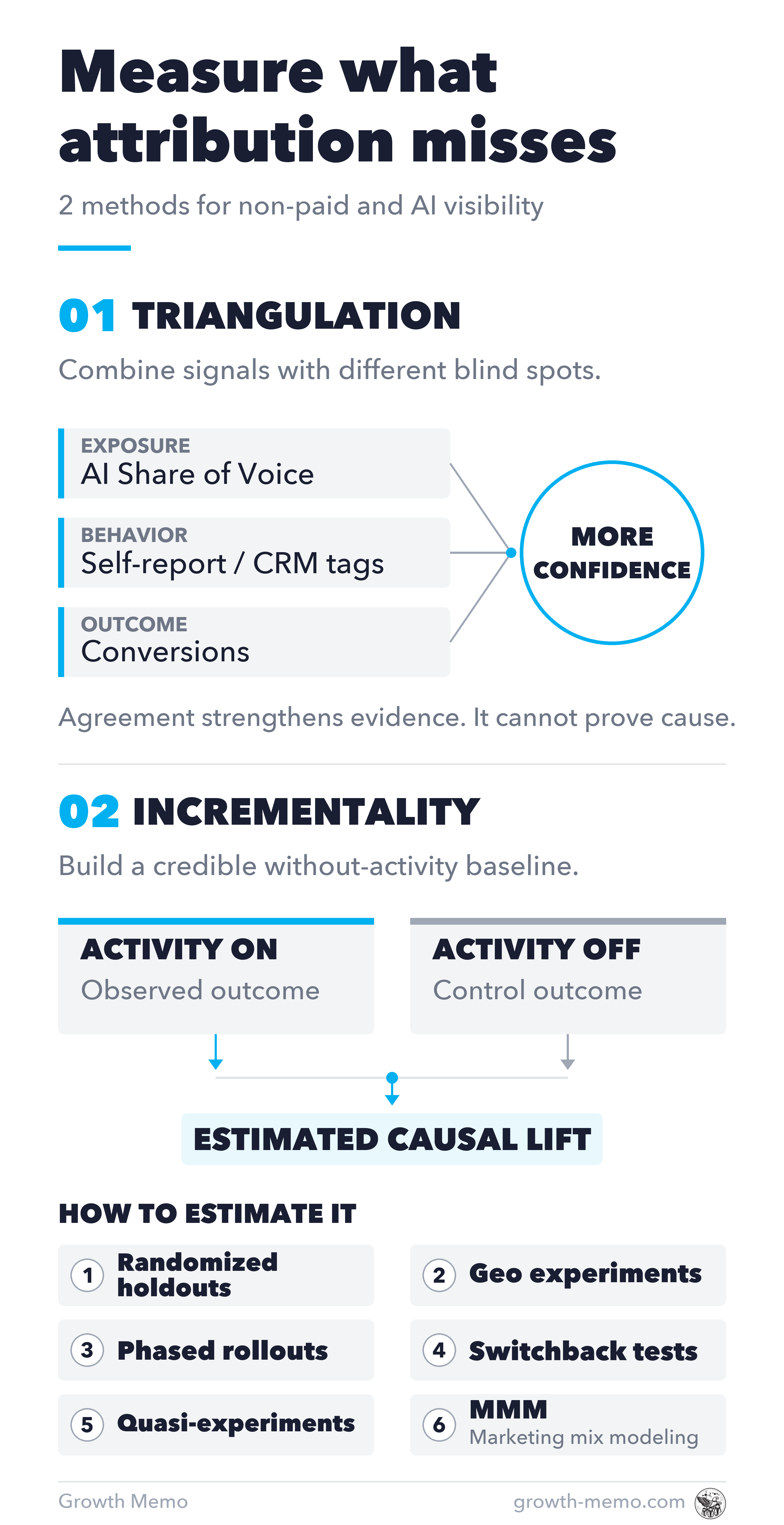
1/ Triangulation: measuring multiple metrics that indicate success.
An example is measuring AI recommendations against self-reported attribution + CRM tagging. You construct a 3-dimensional view of a problem.
Another example: In a user behavior study, we found a medium-strong correlation between AI Share of Voice and conversions. Of course, you want to measure conversions in this case. But since most will come through direct traffic and you don’t exactly know what happens before, measuring Share of Voice is a good proxy.
Combine three signals with different blind spots: an exposure metric, a behavioral signal, and a business outcome. For AI visibility, that could mean Share of Voice, self-reported discovery or CRM tags, and conversions; confidence rises when they move together, while divergence tells you where to investigate.
But keep in mind that triangulation strengthens the evidence, but cannot establish causality on its own.
Triangulation is already common, but we don’t use it a lot in AI Search. A BCG survey of 3,000 senior measurement professionals found that 46% use MMM, incrementality testing, and multi-touch attribution together. Leaders using such an integrated approach achieve up to 70% stronger revenue growth! [2]
2/ Incrementality: building counterfactuals by comparing what happened as a result of an activity against the result without that activity. Attribution tells you who gets credit, but incrementality tells you what works. The main methods are:
Randomized holdouts: Withhold the activity from a randomly selected group of users, accounts, or locations. Compare outcomes between the exposed and control groups.
Geo experiments: Run the activity in selected markets and compare the lift against similar markets where nothing changed.
Phased rollouts: Introduce the activity across markets, audiences, or pages at different times. Use the groups waiting for rollout as temporary controls.
Switchback tests: Alternate between active and inactive periods, then compare outcomes while controlling for recurring patterns.
Quasi-experiments: When randomization is impossible, construct a counterfactual using matched controls, difference-in-differences, synthetic controls, or interrupted time-series analysis.
MMM: Estimate the contribution of broad, overlapping channels from historical variation. Use experiments to calibrate the model where possible.
Use randomized holdouts when you can isolate exposure, phased or geo experiments when you can vary where or when it occurs, and quasi-experiments when randomization is impossible. Use MMM for broad, overlapping activities that cannot be cleanly isolated, ideally calibrated with experimental results.
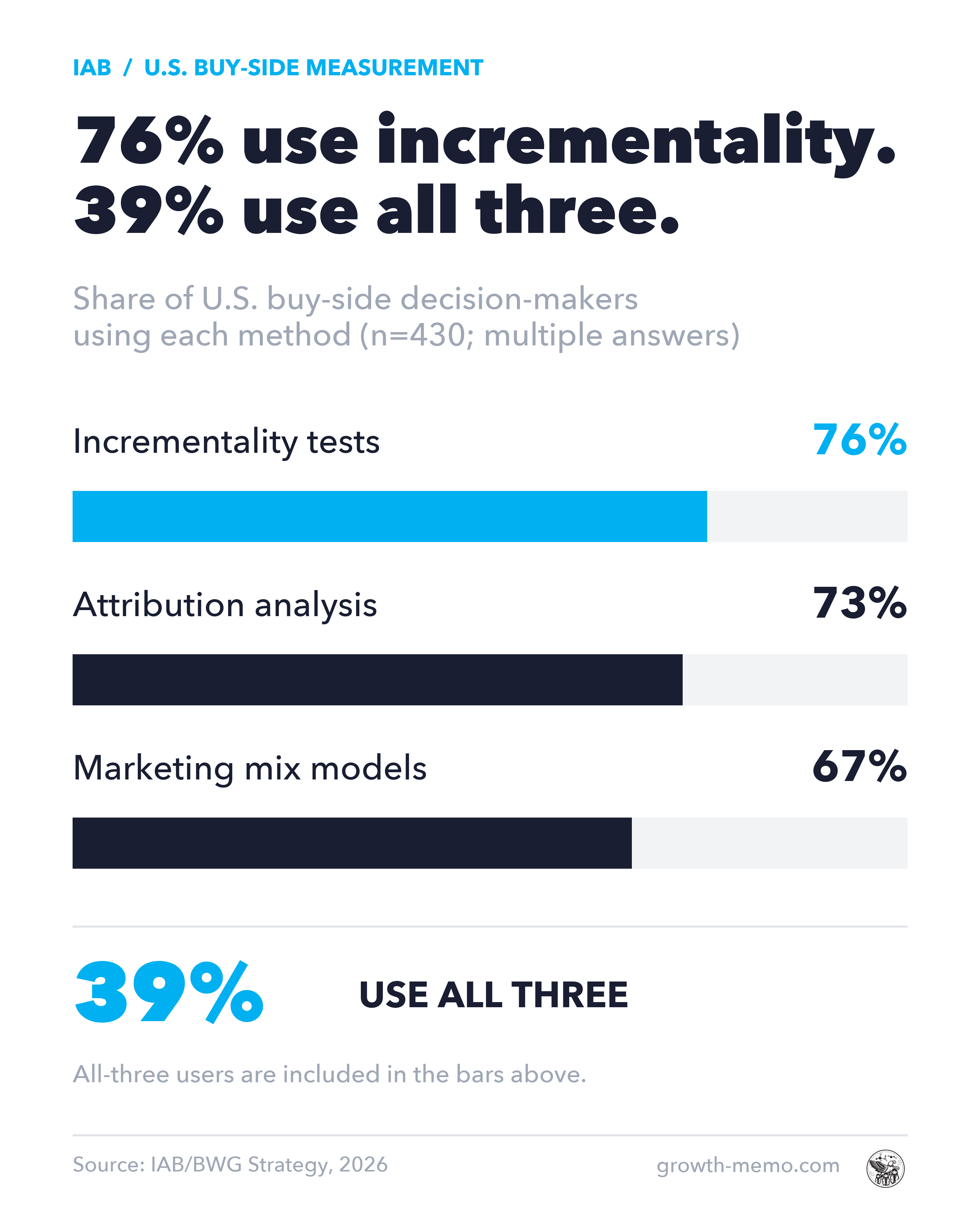
Incrementality is already widely used. The IAB found that 76% of U.S. buy-side decision-makers use incrementality tests, slightly more than attribution analysis at 73% and MMM at 67%. Yet only 39% use all three together, leaving most teams with individual measurement tools rather than a coherent system. [3]
AI makes unmeasurable work more important
In our conversation, George made a point that fundamentally changes how I see the role of data in the AI future:
Almost everything directly measurable is becoming commoditized thanks to AI. Most measurable work is no longer differentiated and the least measurable work is not valued.
CMOs and CFOs will see how the alpha is in things that are not directly measurable by things like attribution models and they will be the ones pushing for more nuanced measurement or indirect second order “attribution”.
To reflect that back in my own words: In a world where everything measurable can (soon) be automated, alpha lives in the unmeasurable. Creativity and originality are hard to quantify and automate. But that’s where good differentiation often comes from.
George:
Just looking at attribution alone would have led us to cancel all the brand marketing we do, all our stunts, all our direct mail, all our events. Instead we would be plowing more and more money and time into generic outbound campaigns and simplistic paid ads. This would have been fine for a while but the results would have been very average and we are trying to be great, not average.
You either believe that AI becomes good enough to automate and take over more of our work, and thus, everything measurable can eventually be automated. Or, you believe we’ll face a severe AI winter, and I’m very curious about your reasoning. I find this idea of working in the unmeasurable, creative and original terribly intriguing.
Premium is built for operators who need to defend a budget. Brand Tax Calculator, Brand SEO Scorecard, AI SEO Budget Reallocation Planner. All in one library.