



It’s not every day that you can look over people’s shoulders when they use AI. Especially not when making buying decisions. But that’s exactly what Peep from Wynter has shared with me. (Full disclosure upfront, I’m an investor in Wynter. But this data is interesting all the same, and I’d share it even if I wasn’t an investor.)
I analyzed survey results from 200 participants for 13 questions about their AI interactions when buying software. Participants shared their first prompts and follow-up sequences, giving us a view of how they evaluated software with AI.
The results are enlightening and nuanced.
Data and methodology
This analysis covers 200 responses to a 13-question Wynter survey. All participant industry profiles included SaaS/software. We calculated unweighted percentages and compared answers within each respondent’s record, showing the denominator for each chart. Results are self-reported and not representative of all B2B buyers; some personal or non-purchasing accounts remain included. Prompt quotes may be recalled, and a reported demo/signup does not confirm a purchase. The survey cannot identify whether an AI-introduced vendor was ultimately chosen or received a demo/signup, or establish AI’s causal influence.
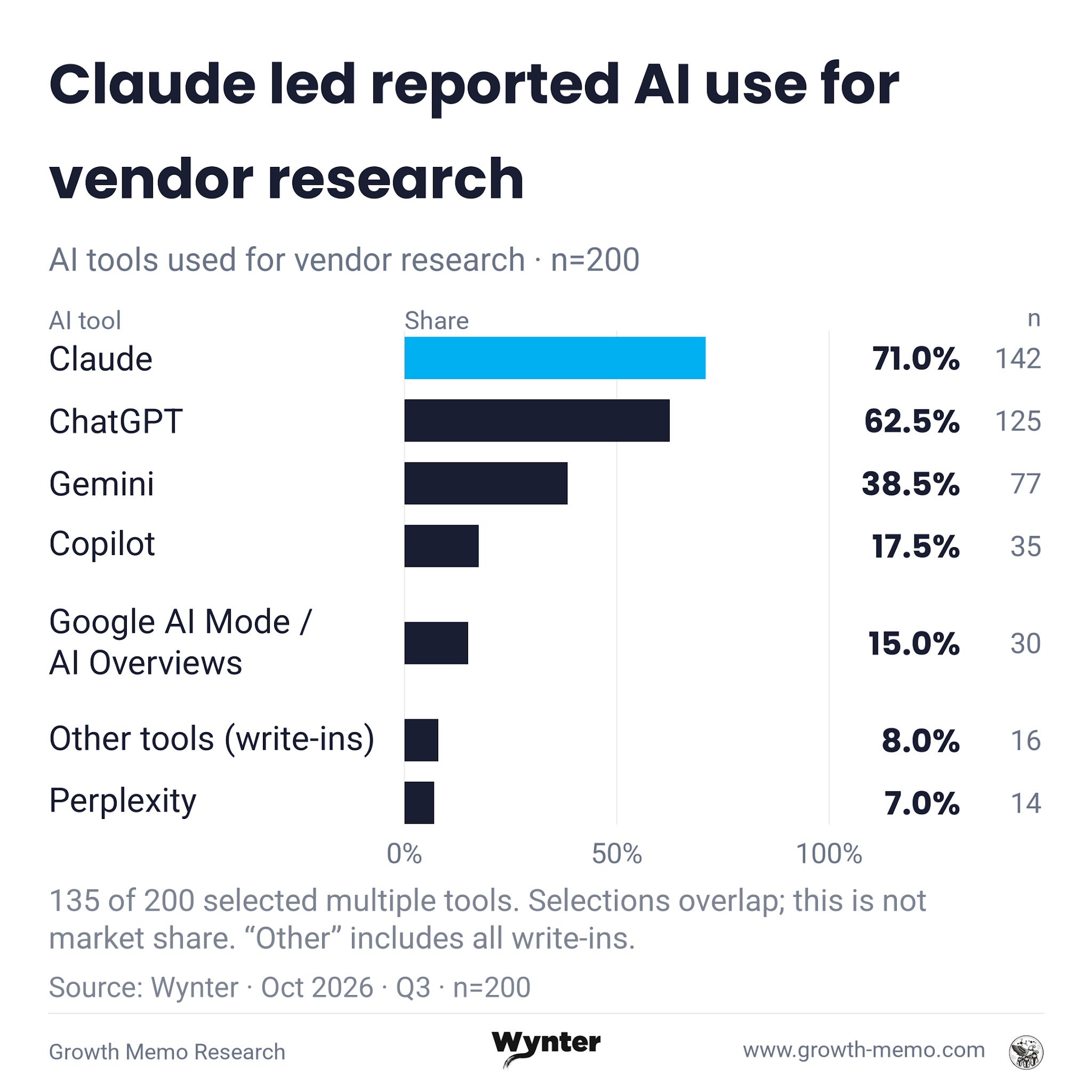
Demo/signup shares were 35.2% among Claude users (50/142), 31.2% among ChatGPT users (39/125), and 33.8% among Gemini users (26/77). All three groups had a median of 3–5 follow-ups. These groups overlap, and their actions and message counts cannot be attributed to an individual tool.
137 of 200 respondents (68.5%) selected “Fresh chat, no extra context,” but only 105 (52.5%) selected that option alone. Other selections included projects or saved instructions (26%), uploaded files (21%), continued chats (16.5%), and “Not sure” (1.5%). Options overlap; account memory was not measured. Both breakdowns appear in the appendix.
Survey questions, lightly edited for clarity:
What were you trying to buy?
Where were you in the buying process when you started this chat?
Which AI tool(s) did you use?
When you started, how much did the AI already know about your situation?
Before you started, how many vendors did you already have in mind?
Did AI introduce a new vendor that made your shortlist?
Write your first message to the AI as closely as you remember it.
What did your first message include?
Roughly how many follow-up messages did you send to the LLM?
Paste or write the follow-up messages in sequence, as many as you can.
What did your follow-ups ask about?
Was the vendor you chose in the AI’s first answer?
What did you do after the AI chat?
AI introduces new options
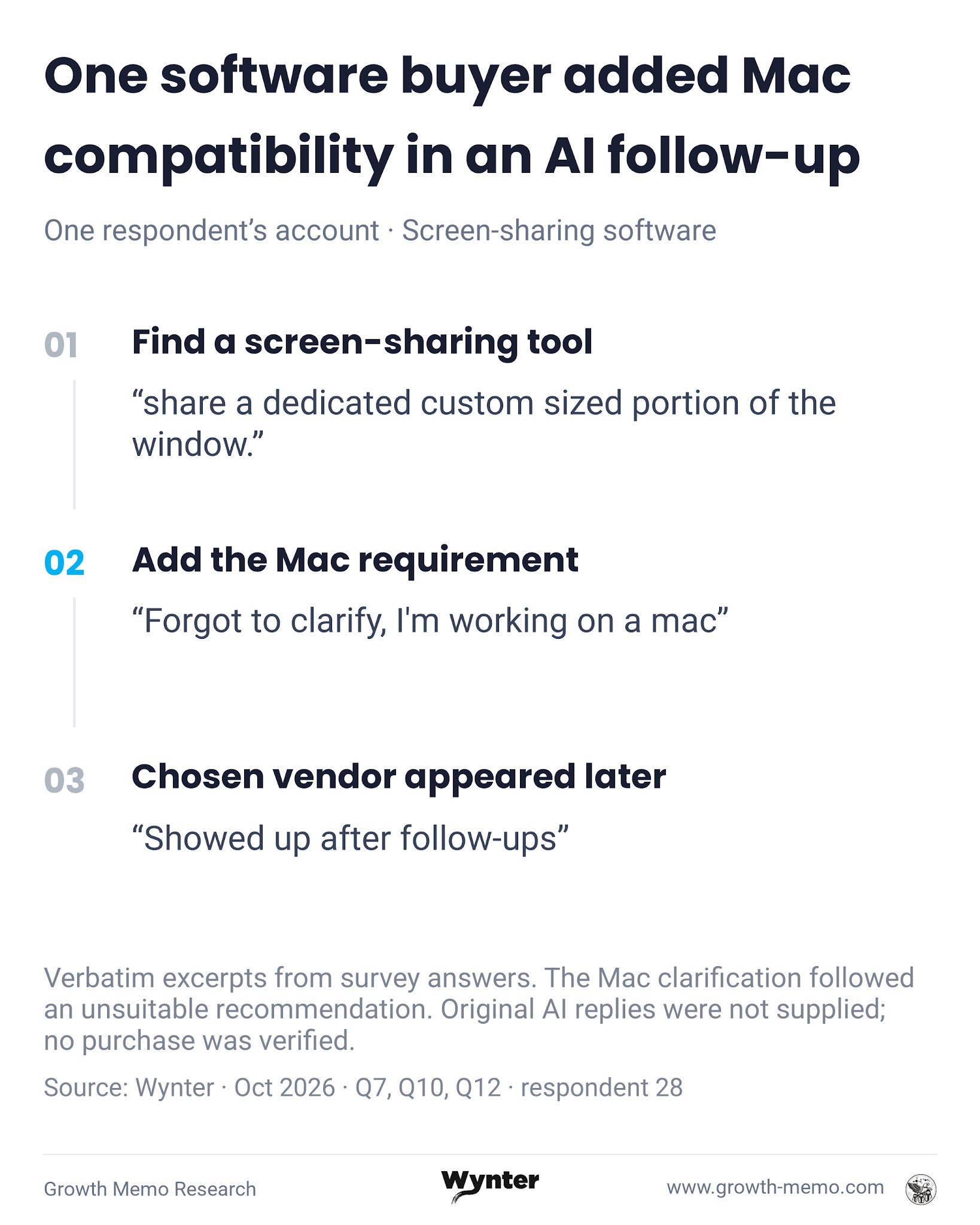
We have long assumed AI helps software buyers narrow their shortlist. That turns out to be true, but in an interesting way. Most buyers come to a decision with 2 options in mind. Wynter’s survey found 99 of 158 respondents (62.7%) with existing candidates in mind added another vendor through AI. For example, an engineer evaluating AI visibility tools had 2 or 3 candidates in mind and reported adding another. After receiving unsuitable suggestions, they repeated a requirement in their first prompt: “I care about product level insights, not just brand level.”
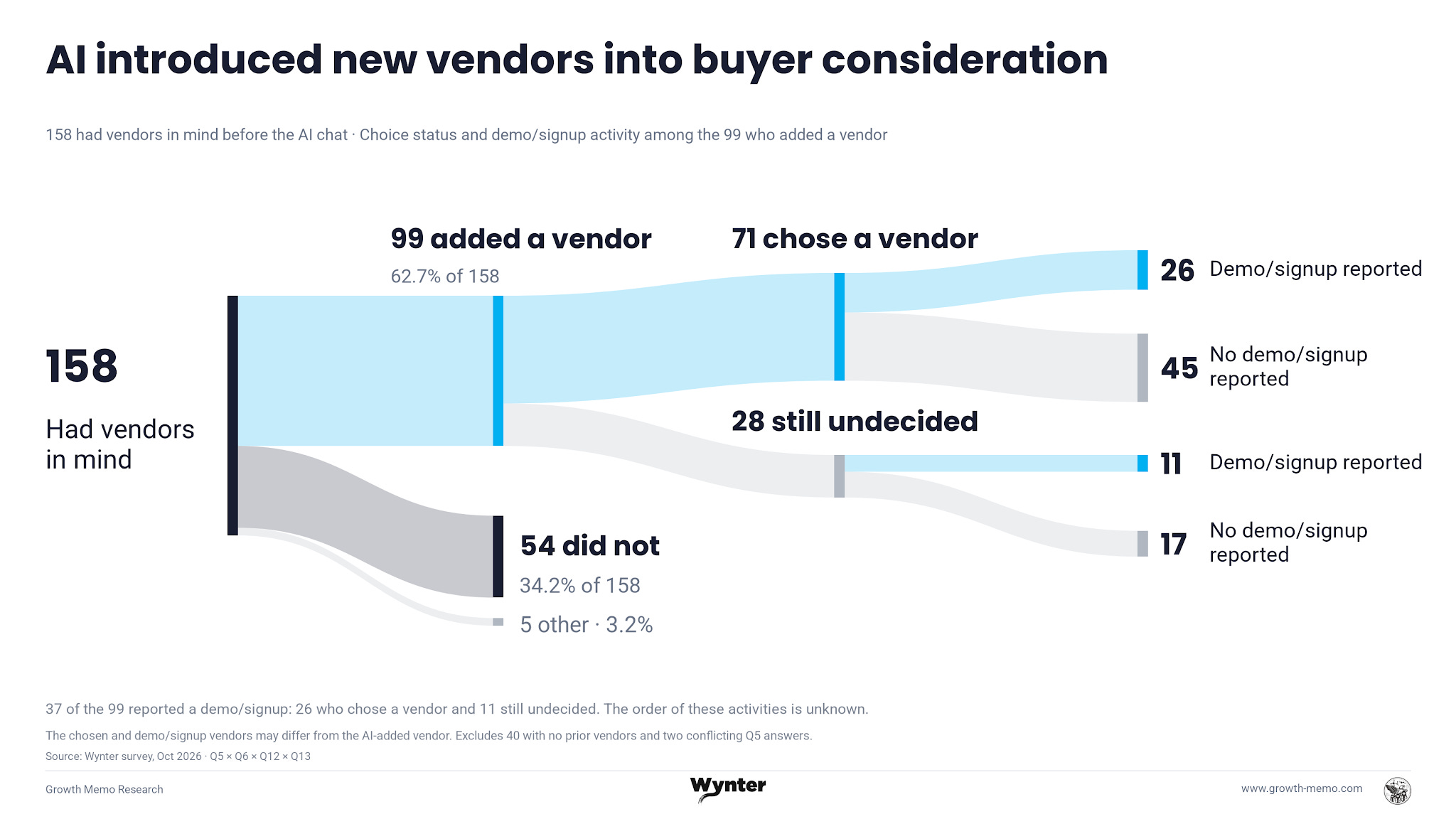
72% of those 99 who added a vendor reported having made a vendor choice, 28 were still undecided. 37 reported a demo/signup: 26 of the 71 who chose a vendor, plus 11 of the 28 still deciding.
To be clear, reporting a demo/signup didn’t mean the decision was settled: One product manager researching learning management software reported a demo/signup while still undecided. They asked AI: “Can you find real customer reviews that they didn’t post? Like G2 or something?”
Before the AI chat, 158 of 200 respondents (79%) already had at least one vendor in mind. Forty (20%) had none, and two (1%) gave conflicting answers.
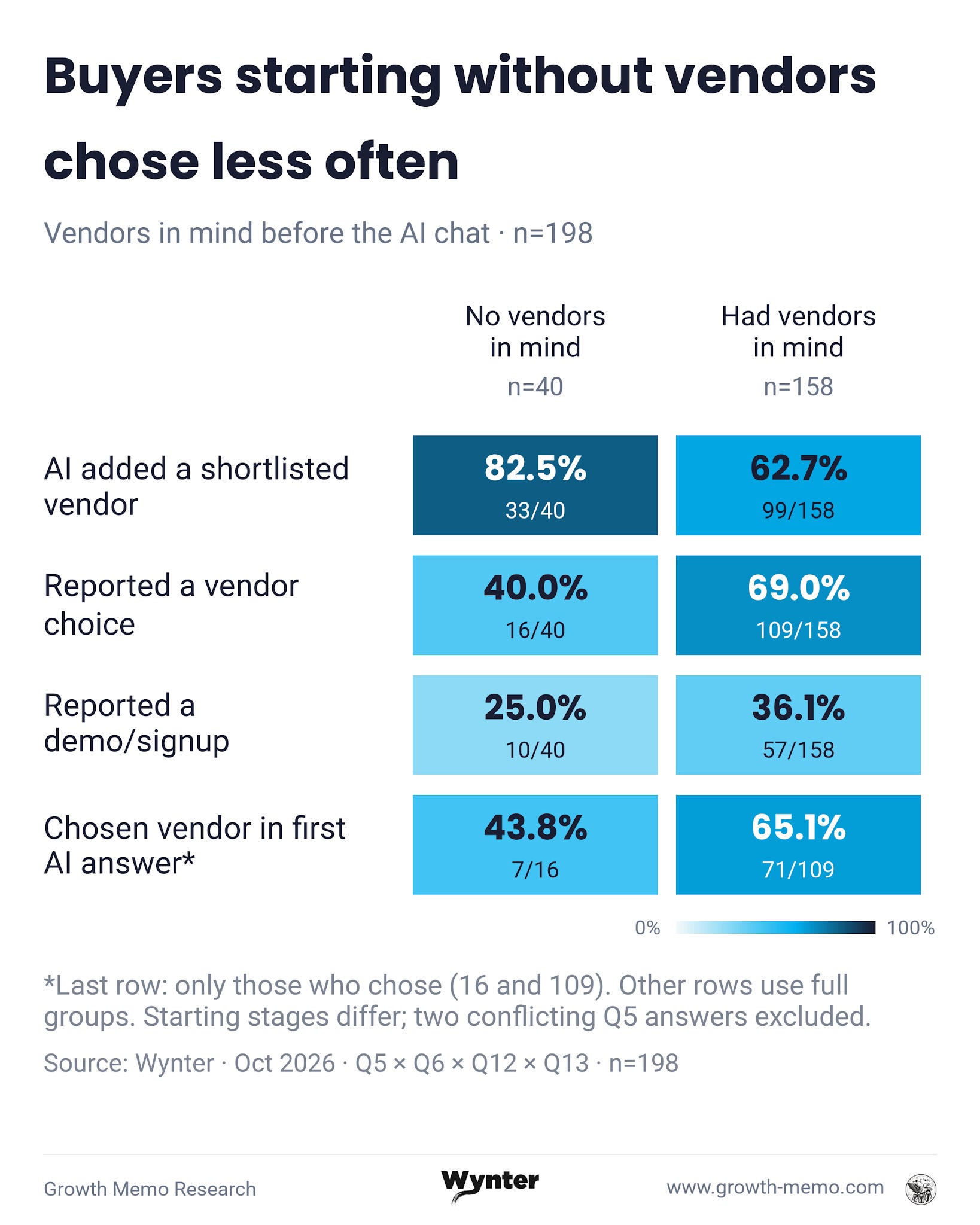
AI added a shortlisted vendor for 33 of the 40 respondents who started without candidates (82.5%). But only 40% of that group reported choosing a vendor. Among the 158 who already had candidates, 62.7% added another and 69.0% reported a choice.
Demo/signup activity followed the same direction: 25.0% among those starting without vendors, versus 36.1% among those with candidates. Their starting stages also differed. About two-thirds of those without candidates were exploring the category when the chat began, compared with about half of those with candidates already shortlisted. That difference matters when interpreting how far each group progressed.
A brand appearing in an AI answer, entering a buyer’s shortlist, and receiving a demo request are different outcomes. Counting mentions gives you only part of that picture.
On November 20 at 2 PM ET / 11 AM PT, this week’s sponsor AirOps is hosting Inside AI Search Measurement with Matt Hammel, Pranav Piyush (Paramark), and Hitesh Wadhwani, creator of Google Meridian. They’ll discuss how to measure AI exposure, account for the difference between mentions and recommendations, and bring AI search into marketing mix models.
If you own an AI search budget, save your spot.
The measurement challenge also spans AI platforms: 67.5% of participants used more than one for their research.
My takeaway: build brand awareness before buyers are “on the market,” and work to be recommended in AI answers once they start researching. Advertising, creator partnerships, social media, and email are part of that first job.
AI is adding vendors to your buyers’ shortlists, so you need to know which prompts surface your brand and where it drops out. The Buyer Journey Prompt Map in the Premium Subscribers Resource Library maps the prompts buyers use at each of 5 stages, scores where your brand disappears, and turns the gaps into shippable tasks.
Buyers use AI to evaluate software products
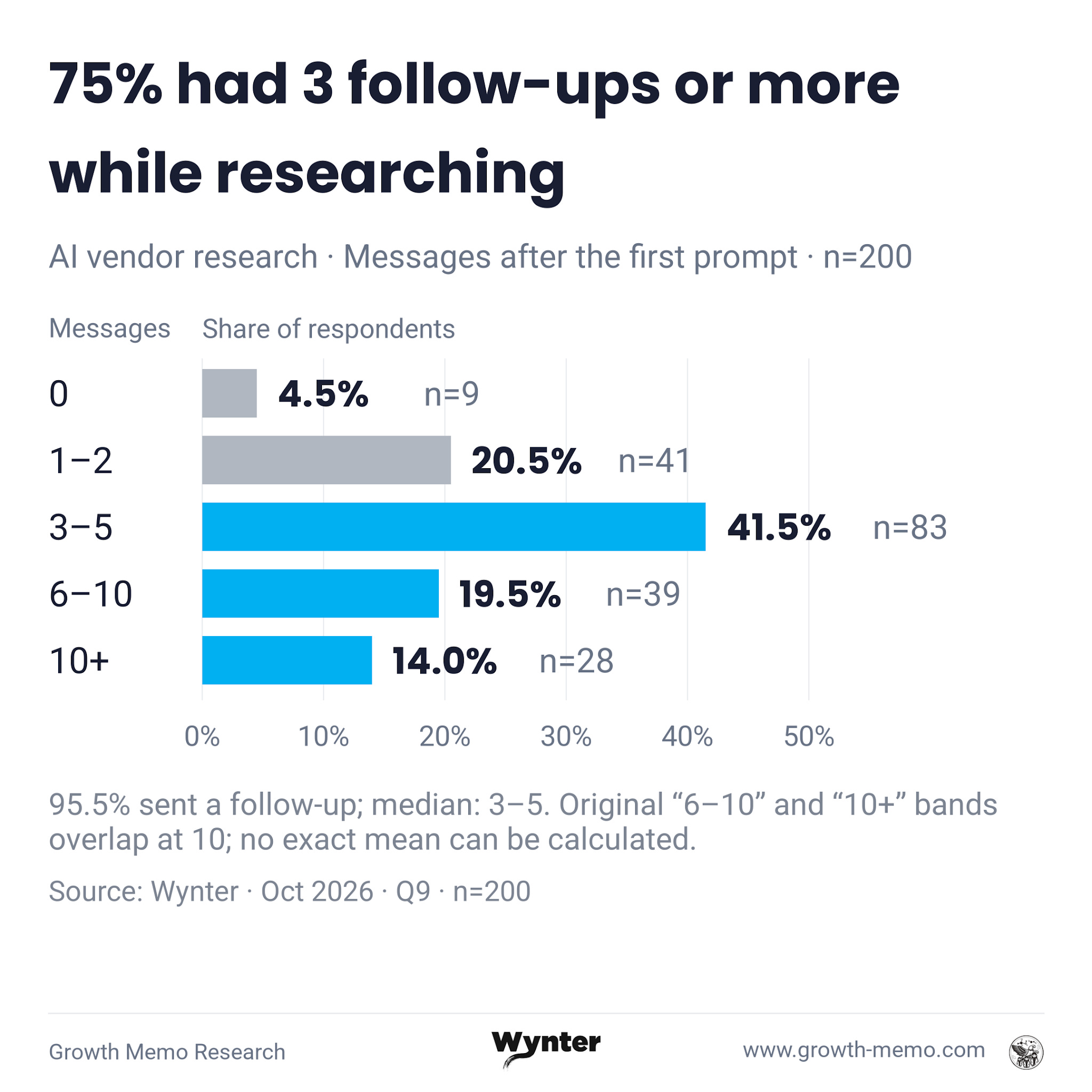
It’s obvious to me that buyers have a conversation with AI that goes back and forth. The data supports this: 41.5% of participants had 3-5 messages after the first prompt. One-third sent 6 or more follow-ups.
78 of the 126 respondents who reported choosing a vendor (62%) said that vendor appeared in the first AI answer. Another 43 (34%) said it appeared after follow-ups. Early inclusion frequently accompanied continued evaluation: 75 of the 78 first-answer choosers still sent follow-up messages.
A demo or signup was reported by 32 of the 78 first-answer choosers (41.0%), compared with 15 of the 43 whose chosen vendor appeared later (34.9%). These groups describe when the chosen vendor first appeared. They do not isolate an effect of early recommendations or tell us how long each conversation lasted.
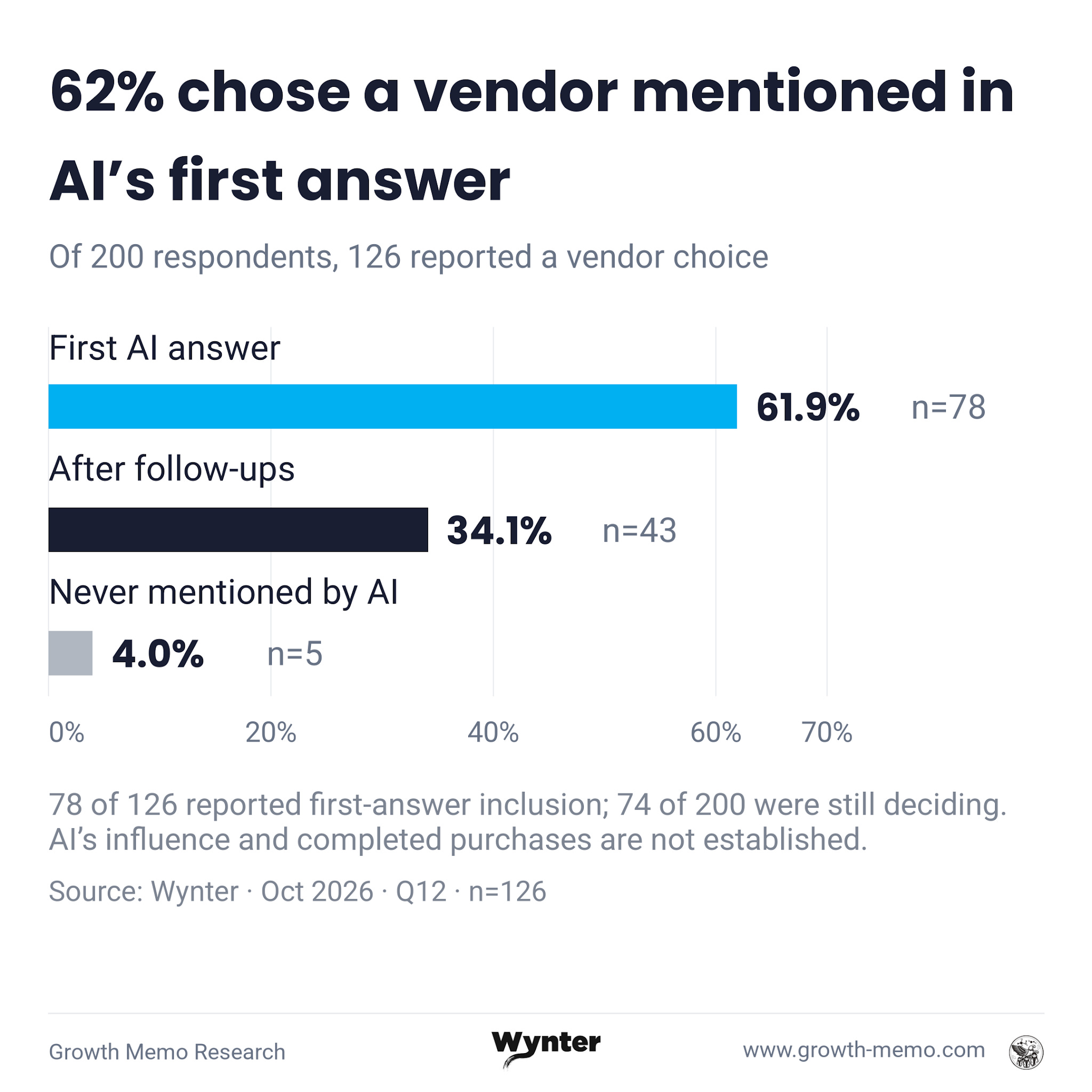
The way I reconcile these 2 charts is that buyers evaluate the product through multiple questions. One respondent’s chosen vendor appeared in the first answer, but they subsequently asked: “Eliminate any vendors that don’t have an API integration with Marketo.”
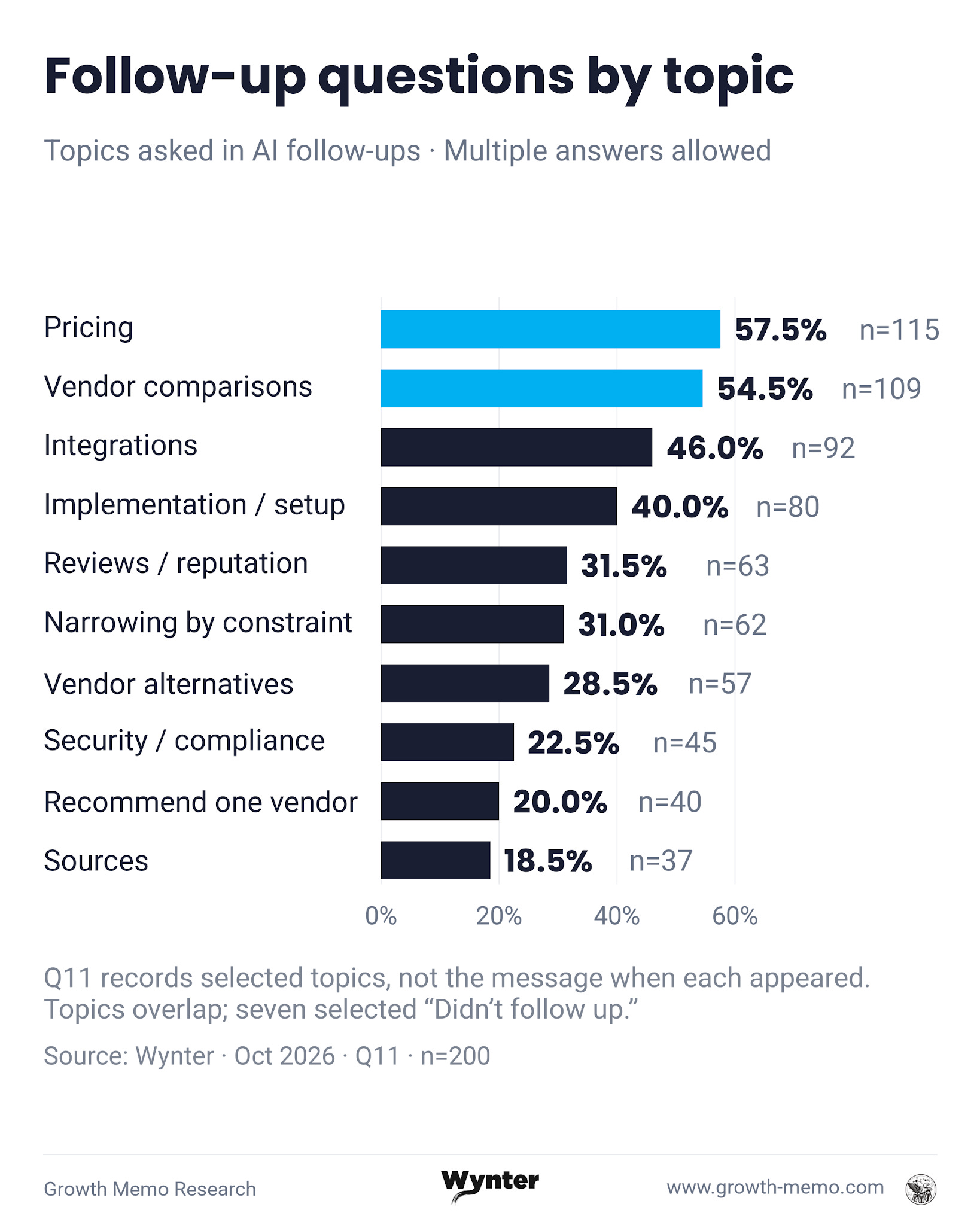
Pricing, vendor comparisons, integrations, and setup were the most frequently selected follow-up topics in this sample: 57.5% asked about pricing, 54.5% compared vendors, 46% asked about integrations, and 40% asked about setup.
The longer people chat about vendors, the more topics they cover. Respondents with one or two follow-ups selected an average of 2.4 topics in the survey’s follow-up checklist, compared with 5.0 among those with 10+. In longer chats (10+ messages), respondents reported asking about pricing, comparisons and implementation, as well as asking AI to recommend one vendor. These are requests for a recommendation; the survey does not establish whether AI delivered one.
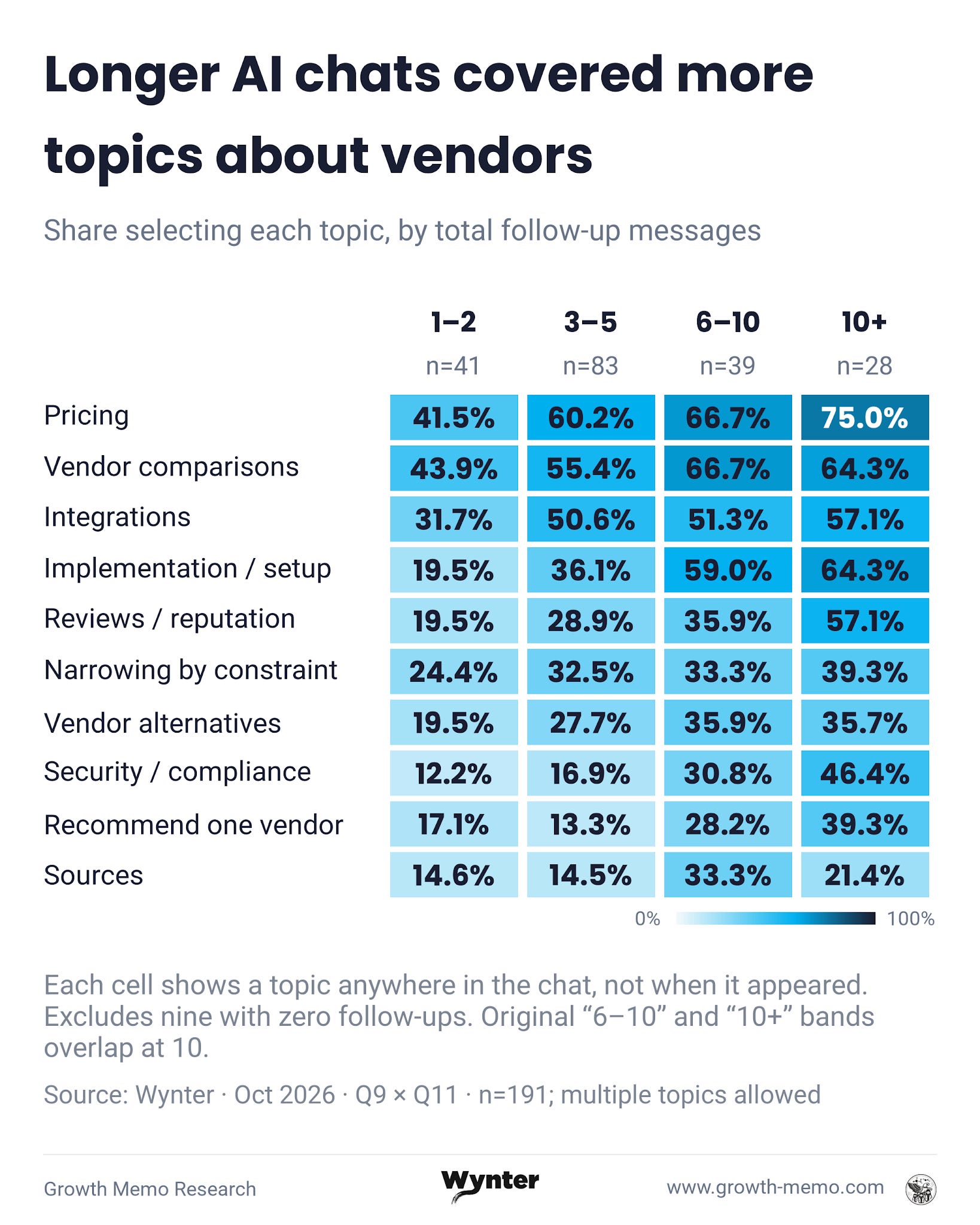
Longer conversations covered more ground. Did they also accompany more action? Respondents who sent six or more follow-ups reported a demo or signup more often than those who sent one to five: 41.8% versus 32.3%. But the pattern wasn’t consistent across conversation lengths. The rate peaked at 6–10 follow-ups, then fell in the 10+ group. More questions could reflect thorough evaluation, complexity, or uncertainty; the survey cannot establish that longer conversations caused the action.
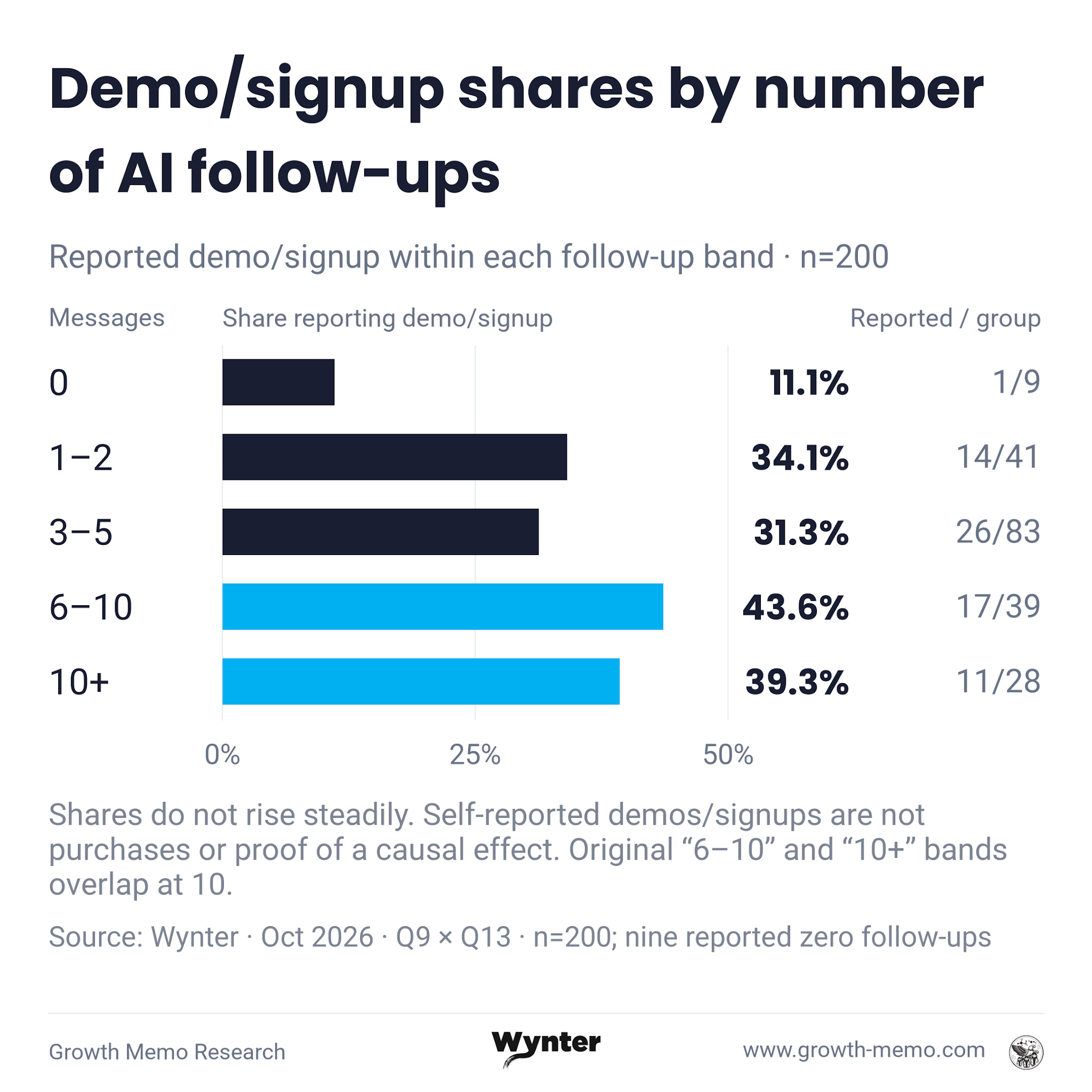
Buyers use AI to eliminate unsuitable products, assess trade-offs, and prepare internal decisions. The evidence is very strong for AI guiding buyers through decisions across different stages.
Buyers who spell out integrations, team size, and use case in their prompts get a sharper recommendation. Premium subscribers can build personas around those exact requirements with the LLM-Ready Persona Card Generator. It turns your query data into LLM-ready persona cards, or refines the ones you already have.
AI research complements Google
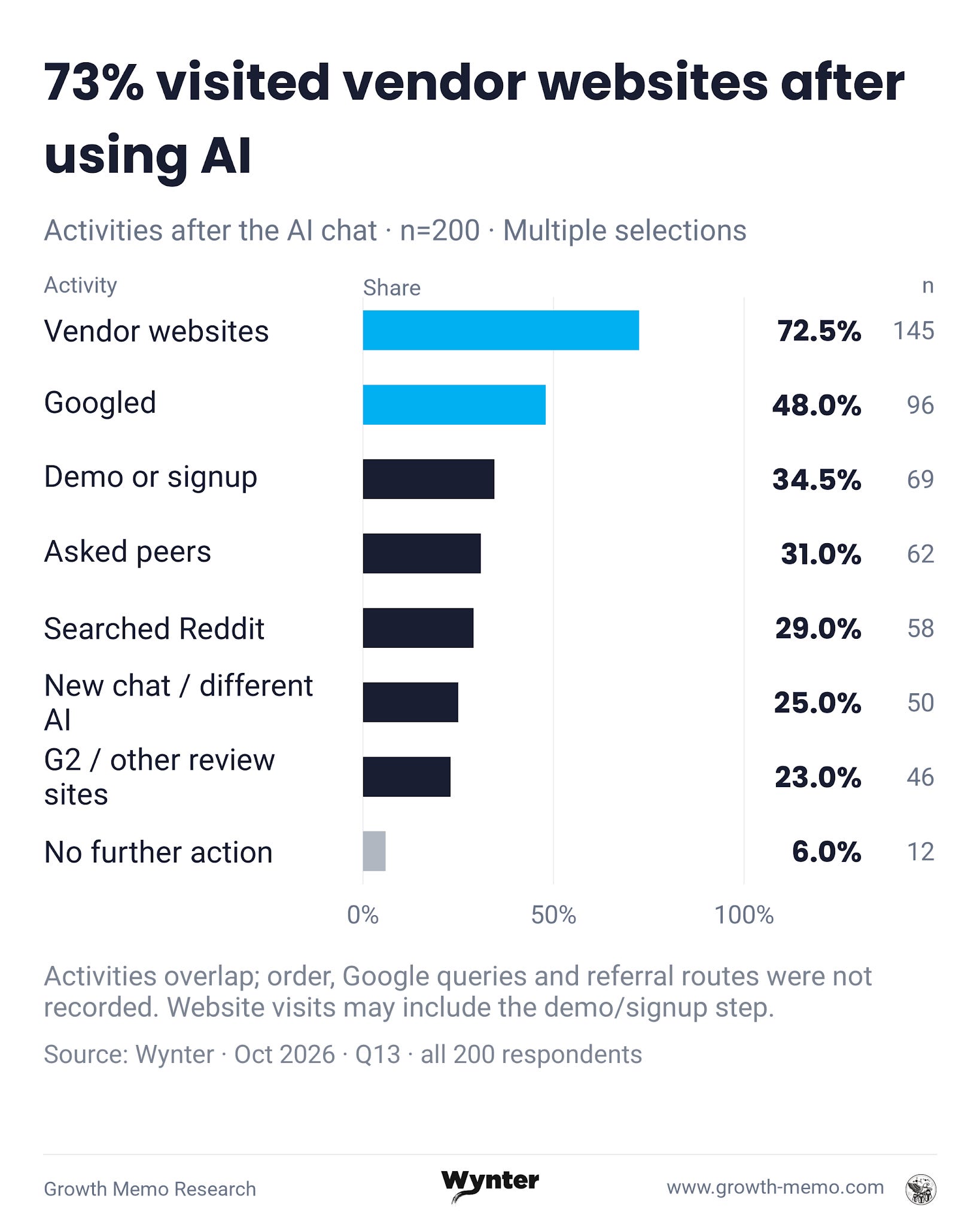
After the AI chat, 145 of 200 respondents (72.5%) visited vendor websites and 96 (48.0%) Googled. Other reported activities included asking peers (31.0%), searching Reddit (29.0%) and checking G2 or other review sites (23.0%). AI use accompanied activity across several information sources.
The survey did not record what people Googled, how they reached vendor websites or the order of these activities. A website visit could also have been the booking or signup step itself.
About two-thirds (67.5%) of participants used multiple AI platforms for their research, which goes to show how fragmented the experience is and how important it is to be visible on multiple AI engines. The most used engines were Claude (71%) and ChatGPT (62.5%), followed by Gemini (38.5%) in a distant 3rd place. 15% of respondents selected Google’s AI Overviews or AI Mode.
Win the buyer before the chat starts
The most surprising insight from this qualitative data is that AI reopens the shortlist. 63% of respondents who already had vendors in mind added another through AI.
Early inclusion was common among eventual choices, but evaluation continued: 62% of respondents who chose a vendor selected one mentioned in the first answer, and 75 of those 78 still asked follow-up questions.
After the chat, 73% visited vendor websites and 48% Googled. For marketers, that means building familiarity before buyers open a chat, earning consideration in AI answers, and making pricing, integrations, and product fit easy to evaluate as the research continues.
The data reflects the essence of the retrieved -> cited -> trusted framework I introduced earlier this year.
Optimize for AI Search Visibility follows a pipeline similar to the classic “crawl, index, rank” for search engines:
Retrieval systems decide which pages enter the candidate set
The model selects which sources to cite
Users decide which citation to trust and act on
Being visible and recommended in AI answers is not enough. You also need to be in the mindset before buyers are ready.
Getting onto the shortlist before a buyer opens a chat takes off-site authority work, and that work needs budget. The Brand Authority Multiplication Training Deck makes the leadership case for authority-building investment in 27 slides, then trains your team on the 4 levers behind it. Find it in the Premium Subscribers Resource Library.