


Tanking SEO traffic can feel hopeless. I have no doubt AI reduces SEO traffic, but some data I just analyzed makes me believe the story is much more nuanced.
Exclusive data from Similarweb containing the traffic channel mix of 10,000 domains in both the US and France over the last 3 years shows us a 30,000 foot view of how the traffic channel mix changes over time. Other studies have looked at similar angles, but I haven’t seen one that compares countries and spans 3 years.
Data & methodology
Dataset:
The data is based on Similarweb’s monthly traffic estimates for 10,000 domains in each of the US and France, covering September 2023 through August 2026. The countries contain different website lists, and coverage varies by month, so these samples do not represent the entire national web.
The dataset contains 663,861 country-domain-month records and 17,863 unique domains across ten channels: organic search, paid search, Direct, referrals, organic social, paid social, email, display, AI and affiliates.
Methodology:
I compared traffic volumes and channel shares while holding website lists constant within each comparison, then checked sensitivity to site selection, missing estimates and the largest domains.
Most channel comparisons use January–August 2026 versus the same months in 2025; the two-year organic-search headline compares August 2024 with August 2026 across 8,658 US sites and 7,730 French sites with complete organic estimates throughout the dataset.
Industry breakdowns use provisional analyst classifications.
The findings describe modeled visits, not unique people, spending or revenue, and do not establish whether AI or paid search caused organic-search losses.
Organic is down, but less than I expected
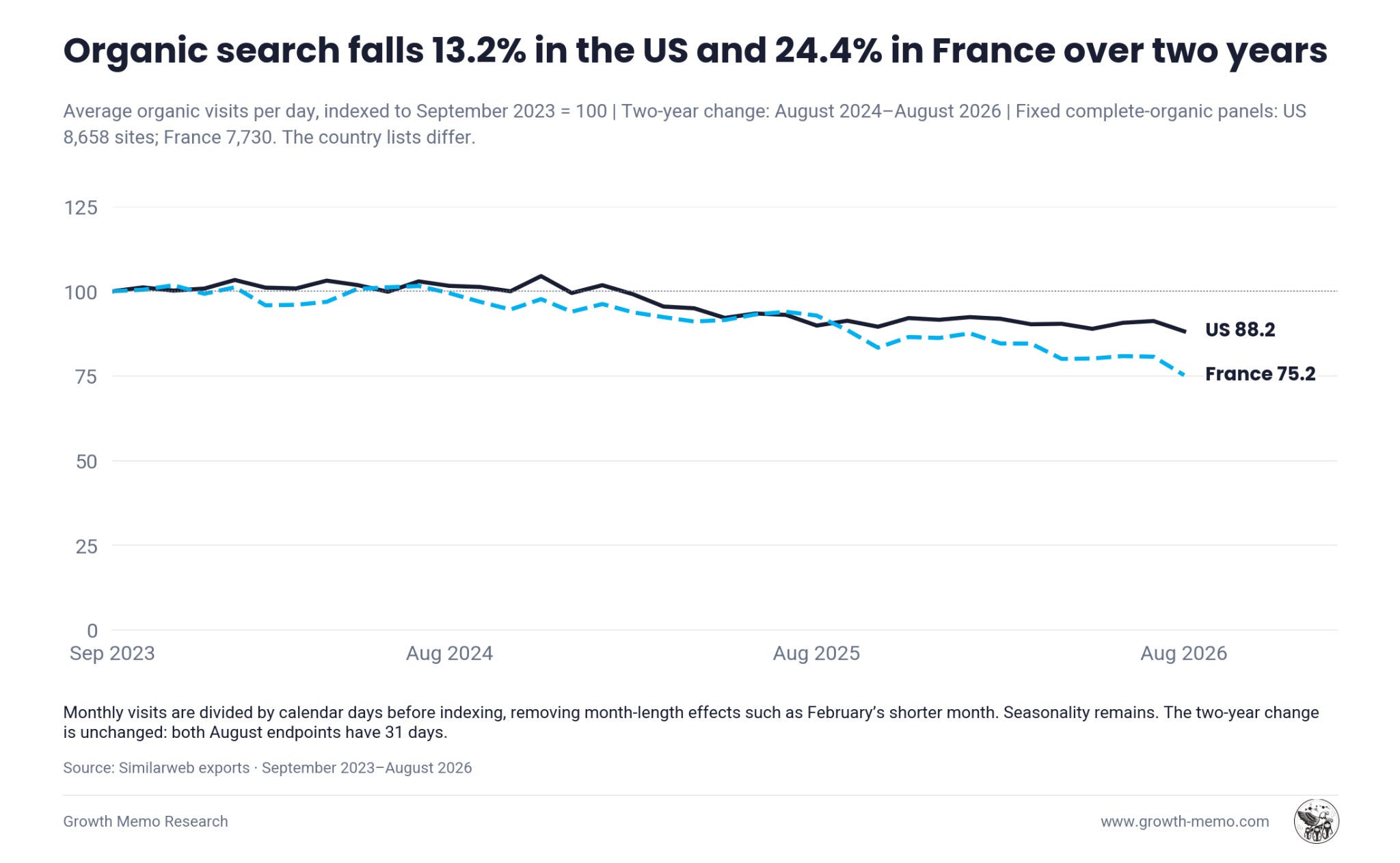
Visits from organic search are down -13.2% in the US (19.9b -> 17.3b) and -24.4% in France (4b -> 3b) over the last 24 months (August 2024 -> August 2026).
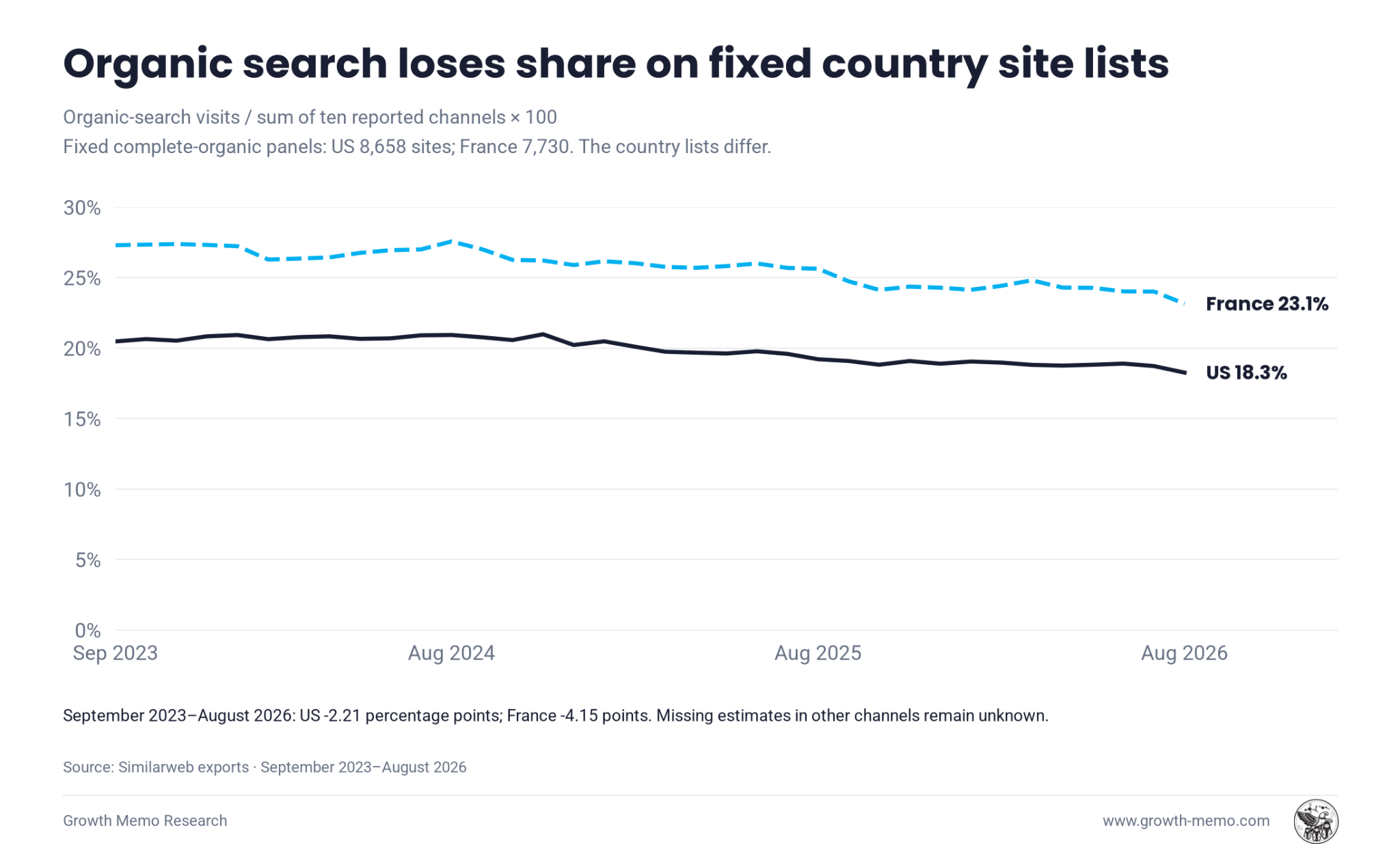
Another way to look at this is to ask how the share of organic from total traffic has changed during that time. The answer: US organic traffic dropped from 20.5% to 18.3% since September 2023 (-10.8%). In France, it dropped from 27.3% down to 23.1% (-15.2%).
Not a great prospect for SEO, but the decline is admittedly slower in aggregate than what I see in Search Console or GA4 on the site level. The reason is that the aggregate view here in this Memo simply combines websites with very different outcomes. Only when we segment the aggregate can we see the patterns.
3 forms of concentration
Any aggregate metric across a vast sample set usually holds concentration. You know, Pareto ‘n stuff. Losses are widespread across sites, but concentrated in traffic volume. 62.5% of US sites and 66.6% of French sites declined; about 1% of domains account for 40.2% / 48.5% of gross lost visits.
The first form of concentration I want to show you is large vs. small sites. Smaller sites have lost substantially less organic traffic than large ones. The gains are still small in the US (+2.7%) and small sites shrank in France (-1.9%), but there is a big gap compared to large sites. I didn’t use a particular threshold here but simply cut the set of domains into quartiles.
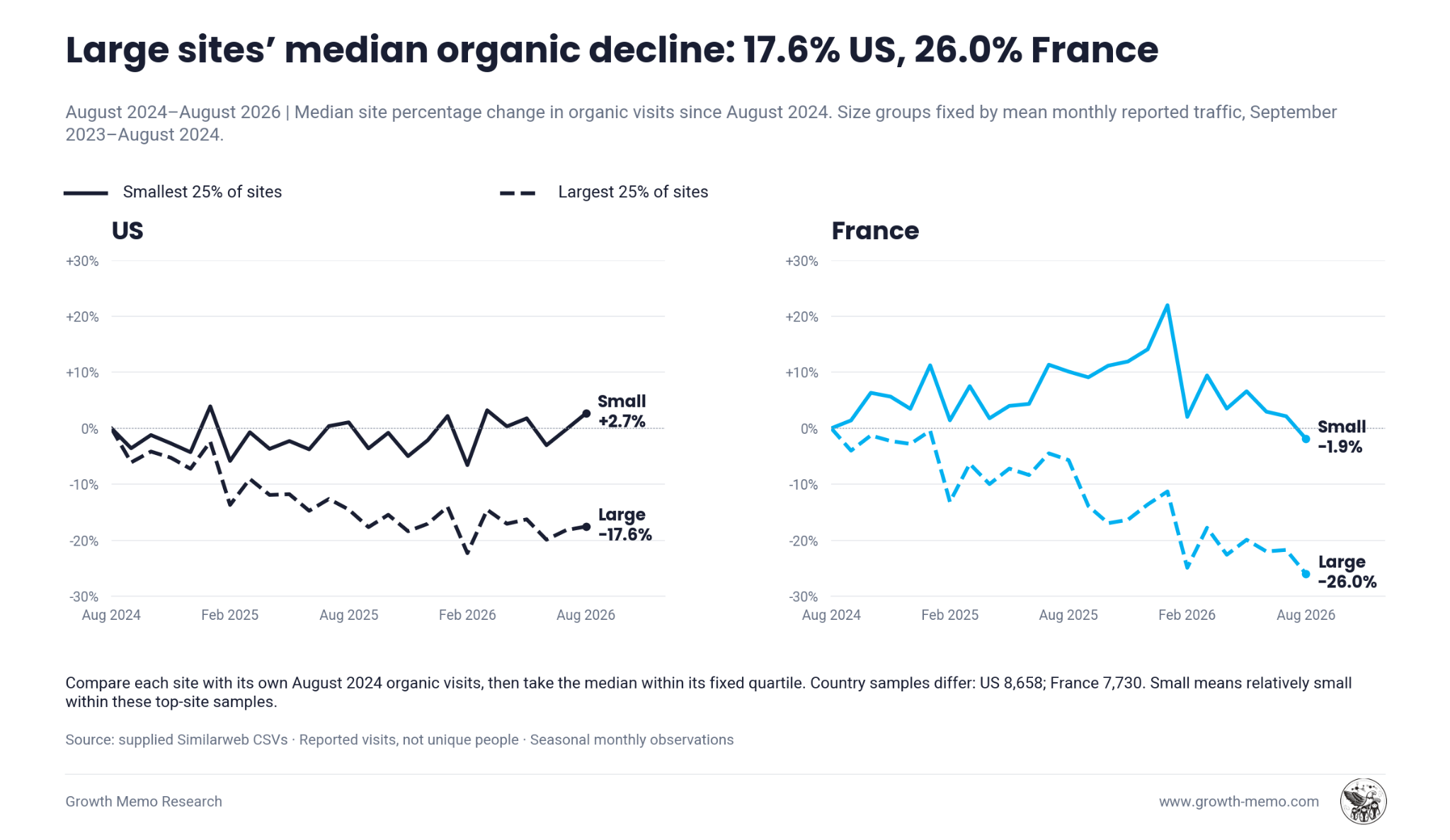
When we use the sumtotal of visits instead of median, we see an even starker picture: small sites gained organic traffic in the US (+19.3%) and France (+42.2%), while large ones lost (-13.5% and -27.4% respectively).
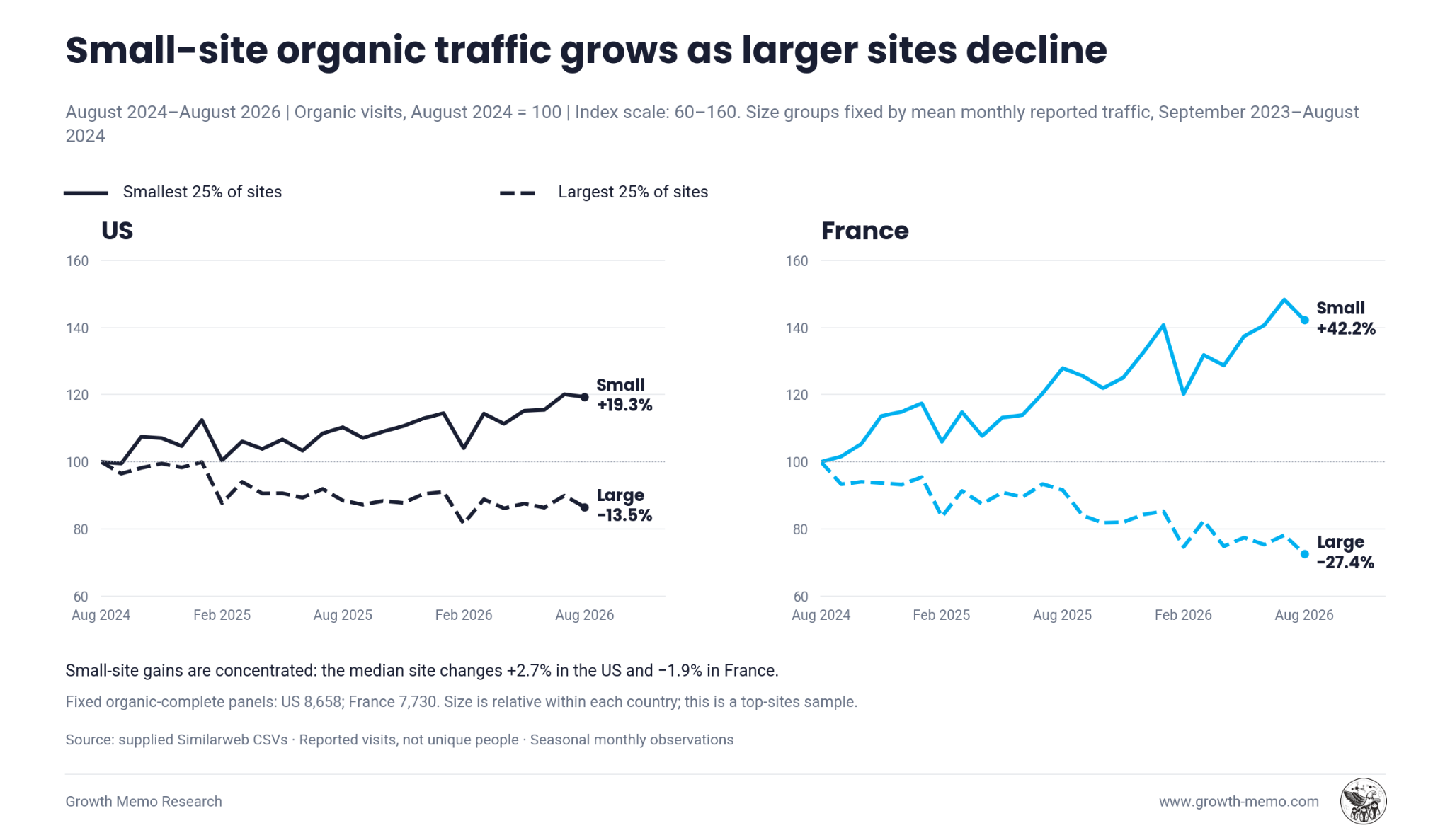
The typical small site was roughly flat: up 2.7% in the US and down 1.9% in France. Their combined traffic grew much faster because a minority of sites made unusually large gains. Remove the 100 biggest small-site gainers in each country, and that combined growth turns negative.
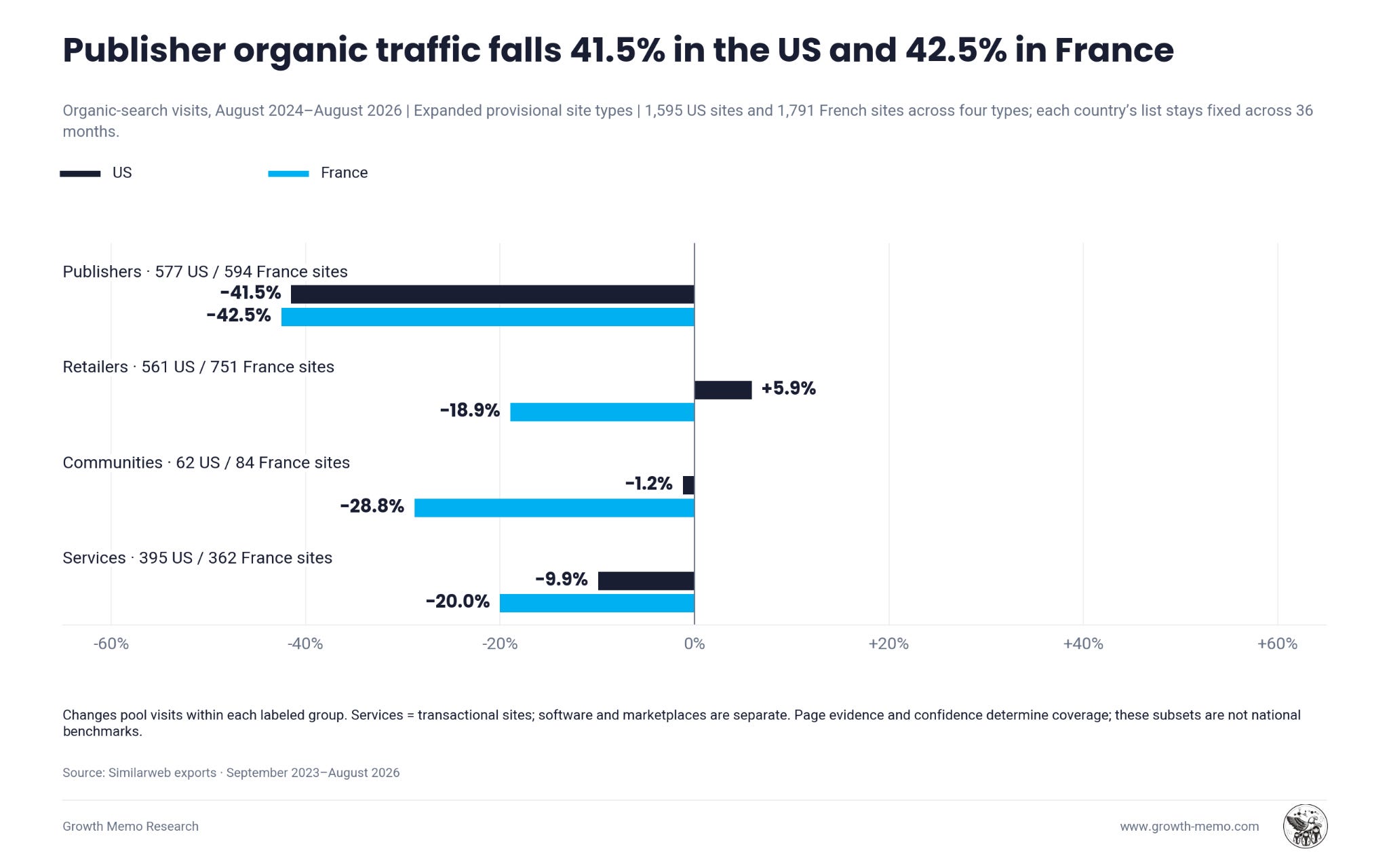
Another form of concentration happens around business models. Here, we see publishers getting hit the hardest because their product, content, directly competes with AI answers. In this sample, publishers lost 41.5% of organic traffic in the US and 42.5% in France over the last 2 years. Certainly devastating losses.
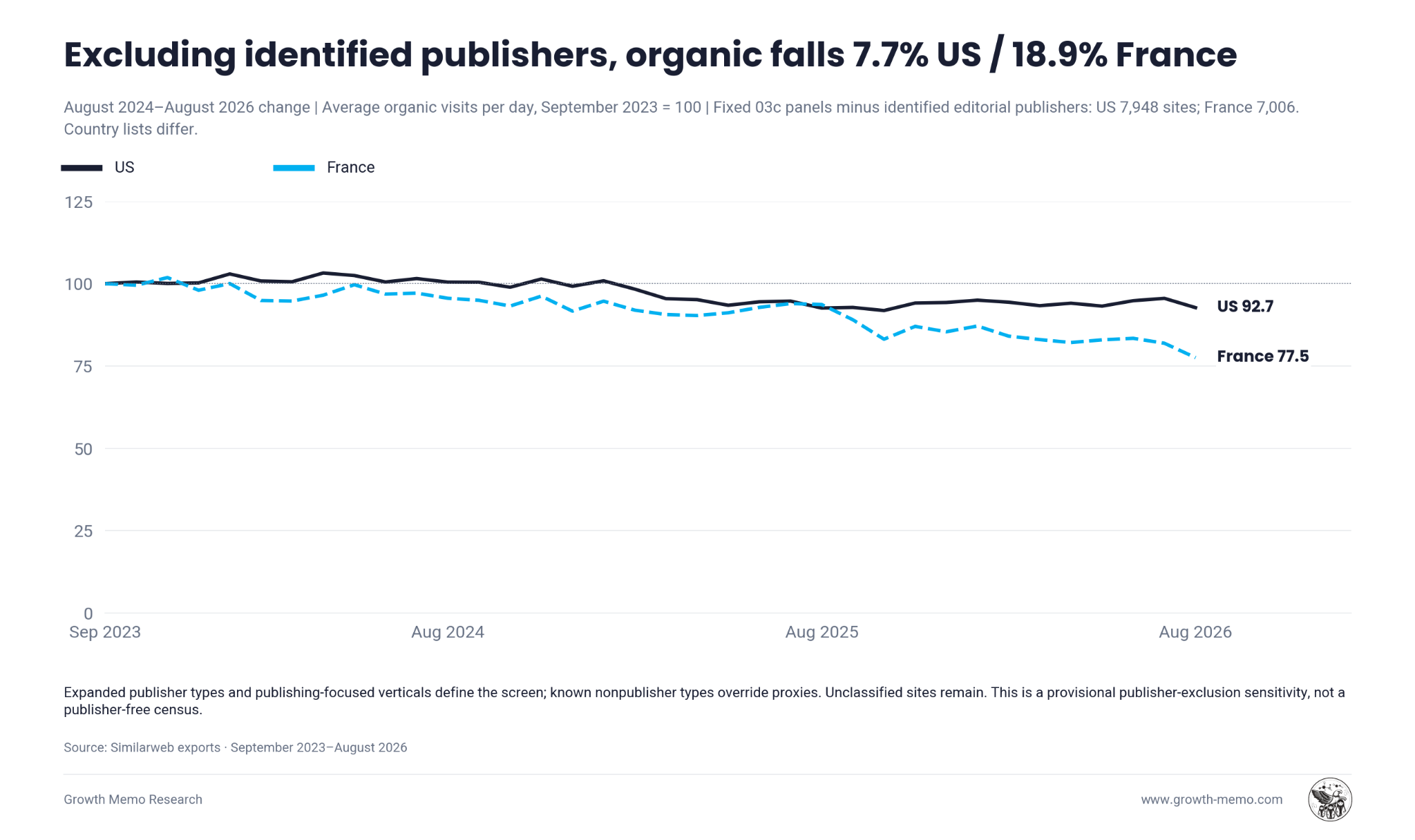
When we strip publishers out, we see an even flatter decline: US down 7.8%, France 22.5%. That’s almost half of the US decline.
The 3rd form of concentration is around topics. Health, food, news and adult-focused sites decline faster than the average in the US and mostly in France as well, with the exception of news. Entertainment and gaming declines a lot slower in the US.
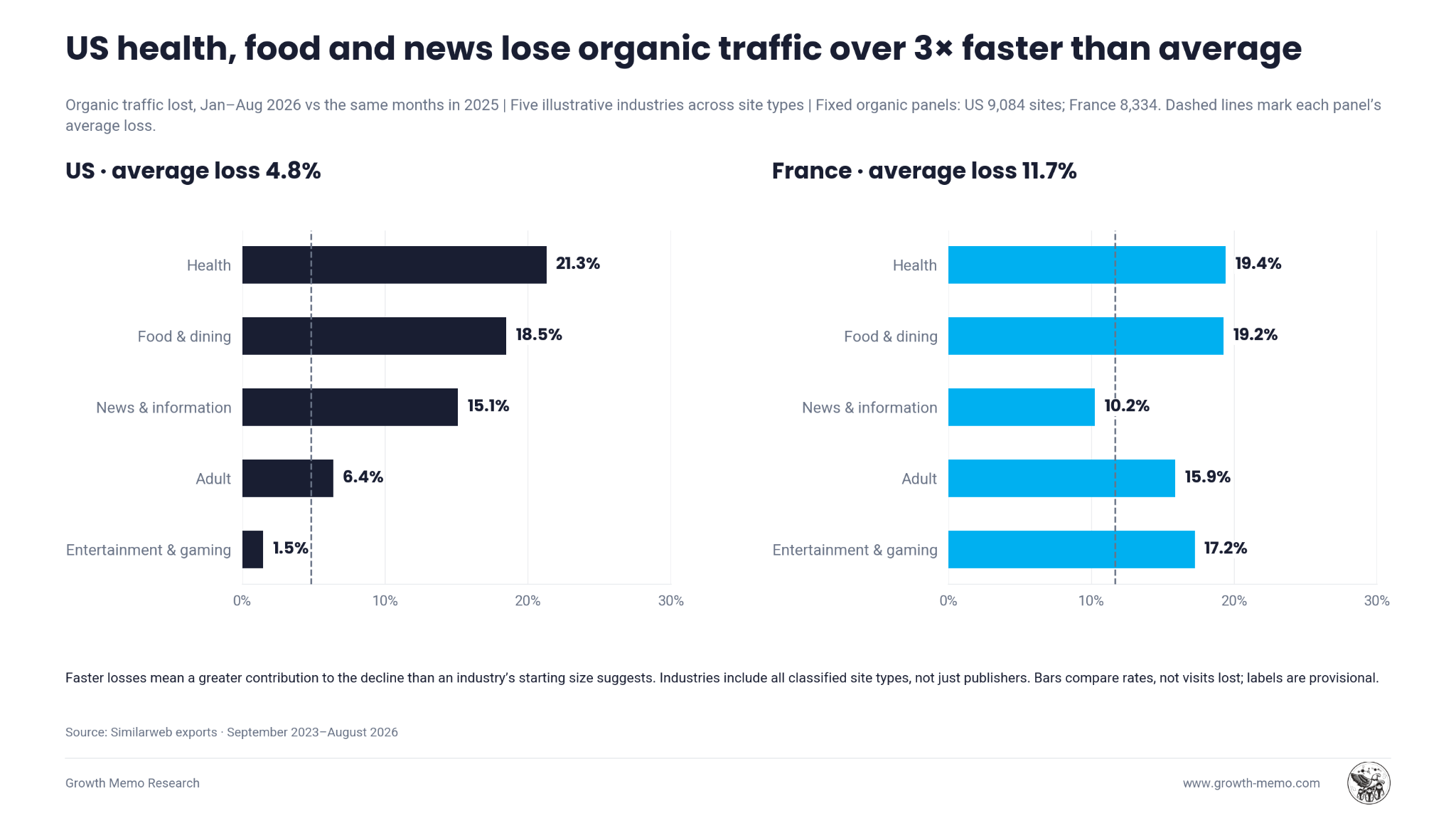
Organic search shrinks unevenly across domain sizes, business models and industries. The median site in the smallest quartile is roughly flat, while publisher traffic has fallen about 42% in both markets. Strong gains at a minority of small sites lift their combined traffic totals. The country average provides context, but comparable websites offer a more useful benchmark for an individual business.
Country-level differences disappear when accounting for mix shift
I compare the US against France because I wanted a control mechanism for AI Overviews and regulation. Google just launched AI Overviews in France in July 2026 and European legislators have forced Google to avoid some SERP Features that impact clicks.
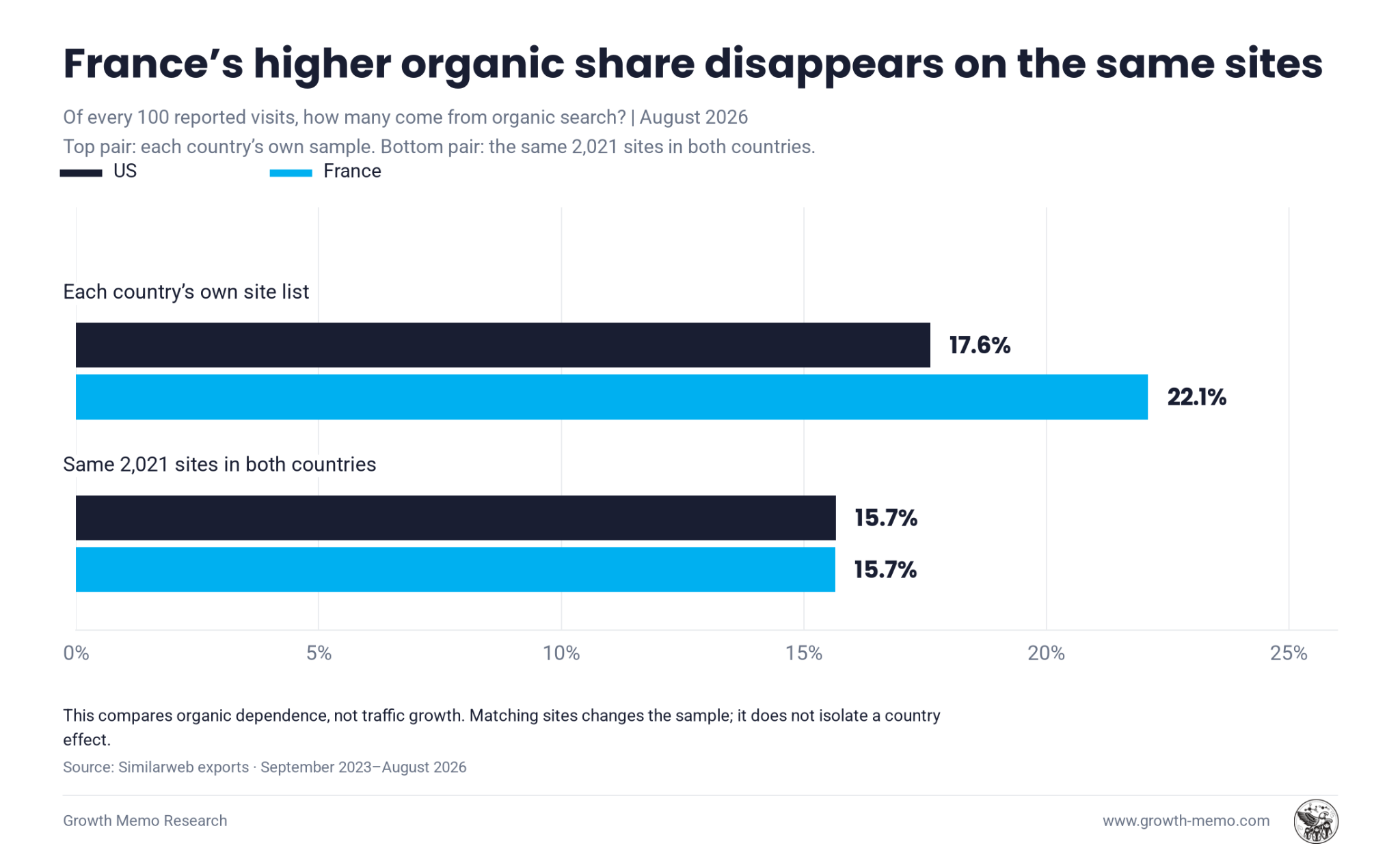
Why is France losing organic traffic faster, especially given Google only rolled AI Overviews out there in July of this year? It’s mostly a matter of site selection. When we compare ony the same sites in both countries the gap narrows substantially.
Across the same 1,725 sites, average organic visits per day fell 5.1% in France and 3.6% in the US between June and August 2026. France weakened more around the launch, but this comparison cannot isolate how much of that change came from AI Overviews.
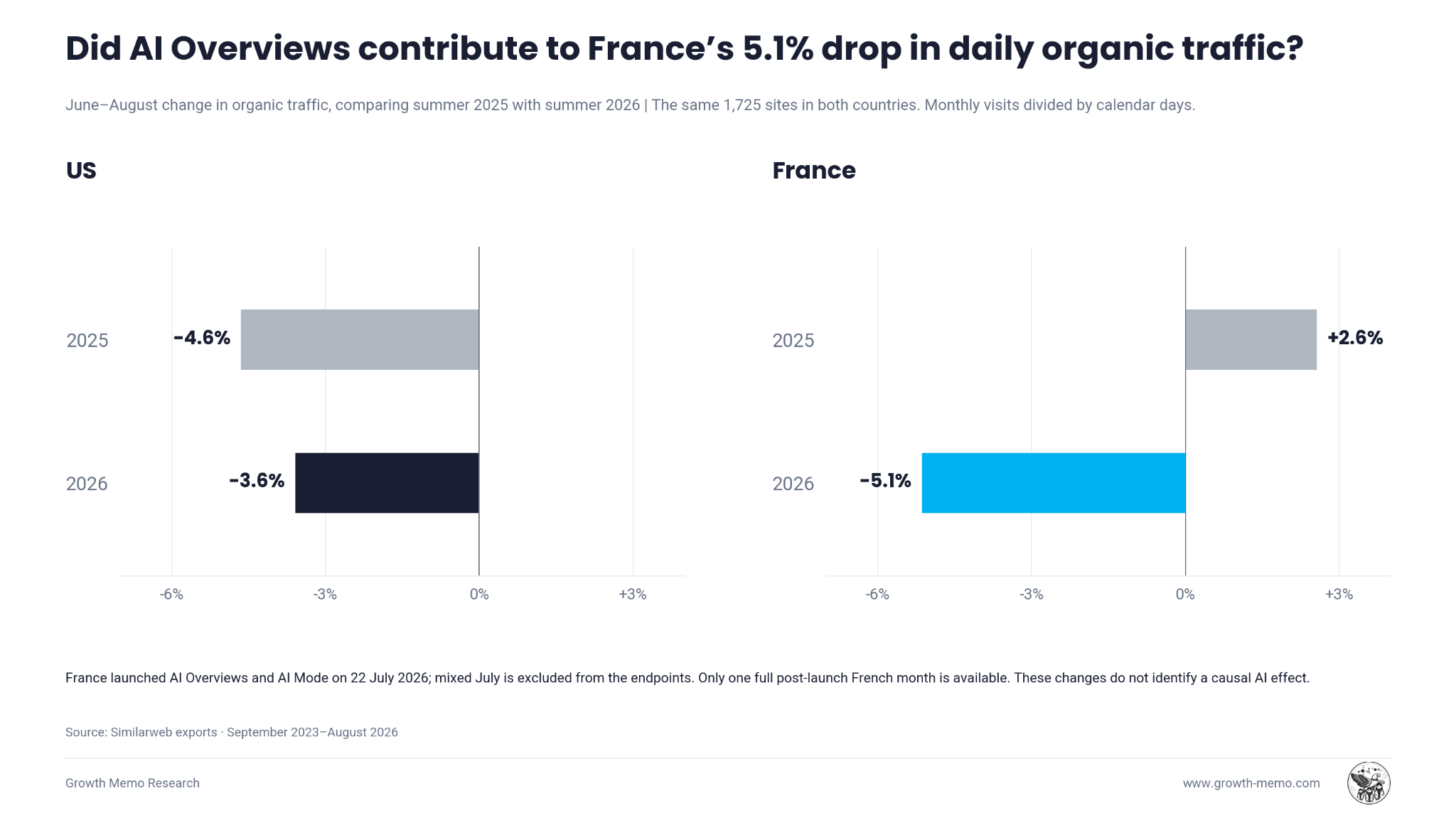
The same happened when AI Overviews launched in the US: while organic traffic in France was up 2.4%, it was down -0.6% in the US (keep in mind Google rolled AIOs out slowly in the US).
It’s not all AI
How can it be that Google still makes so much money from ads ($63.3b,+16.8% YoY, in Q2 2026) while AI answers a lot of questions? 2 reasons!
One, because Google shows ads before it shows AI Overviews. Two, search ads take up a lot more space and are harder to distinguish from organic results (my opinion - wonder if you agree?).
On Oct 13, 2025, Google started grouping up to four text ads under a sticky “Sponsored results” header with a “Hide sponsored results” button. It rolled out worldwide on desktop and mobile, and Google said at the time that ad size would stay the same. https://blog.google/products/ads-commerce/google-search-sponsored-results-label/
Tom Capper from Stat found that since June, the average organic result sits below the common desktop viewport, “aka under the fold”, and ad blocks have doubled in size in a sample of 46k head terms. https://getstat.com/blog/paid-search-getting-bigger-how-to-respond
Google reports paid clicks up 13% and average CPC up 3% in its Q2 2026 earnings.
In other words, ads eat into organic clicks as well and I think we massively underestimate the impact and misattribute it to AI Overviews. The Similarweb data shows clearly that paid search traffic grows while organic tanks:
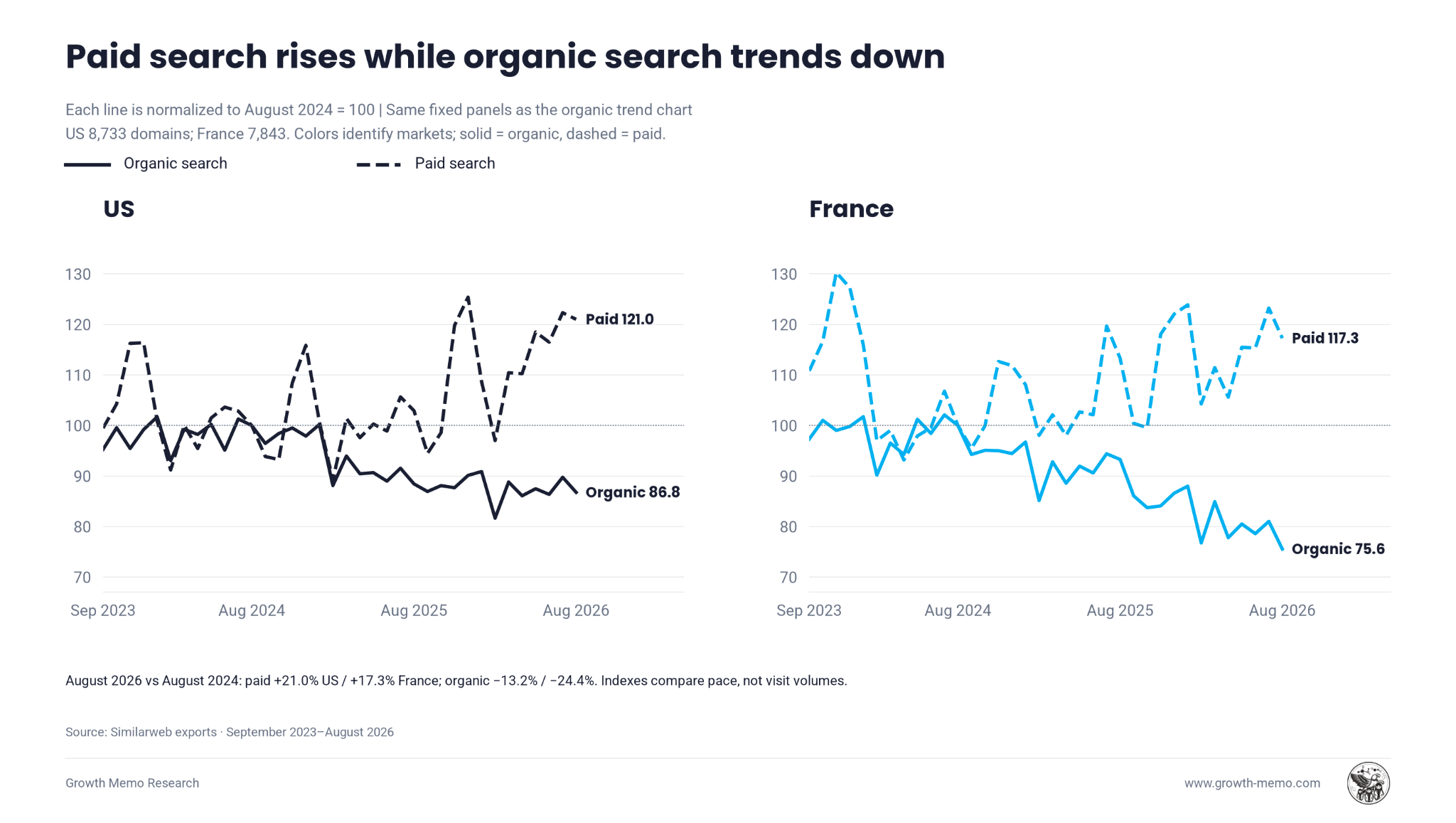
The chart above indexes the baseline in August 2024 at 100 and shows the change over time. In the US, paid search traffic has gained 21% and organic lost 13.2%. In France, paid gained 17.3% and organic lost 24.4%.
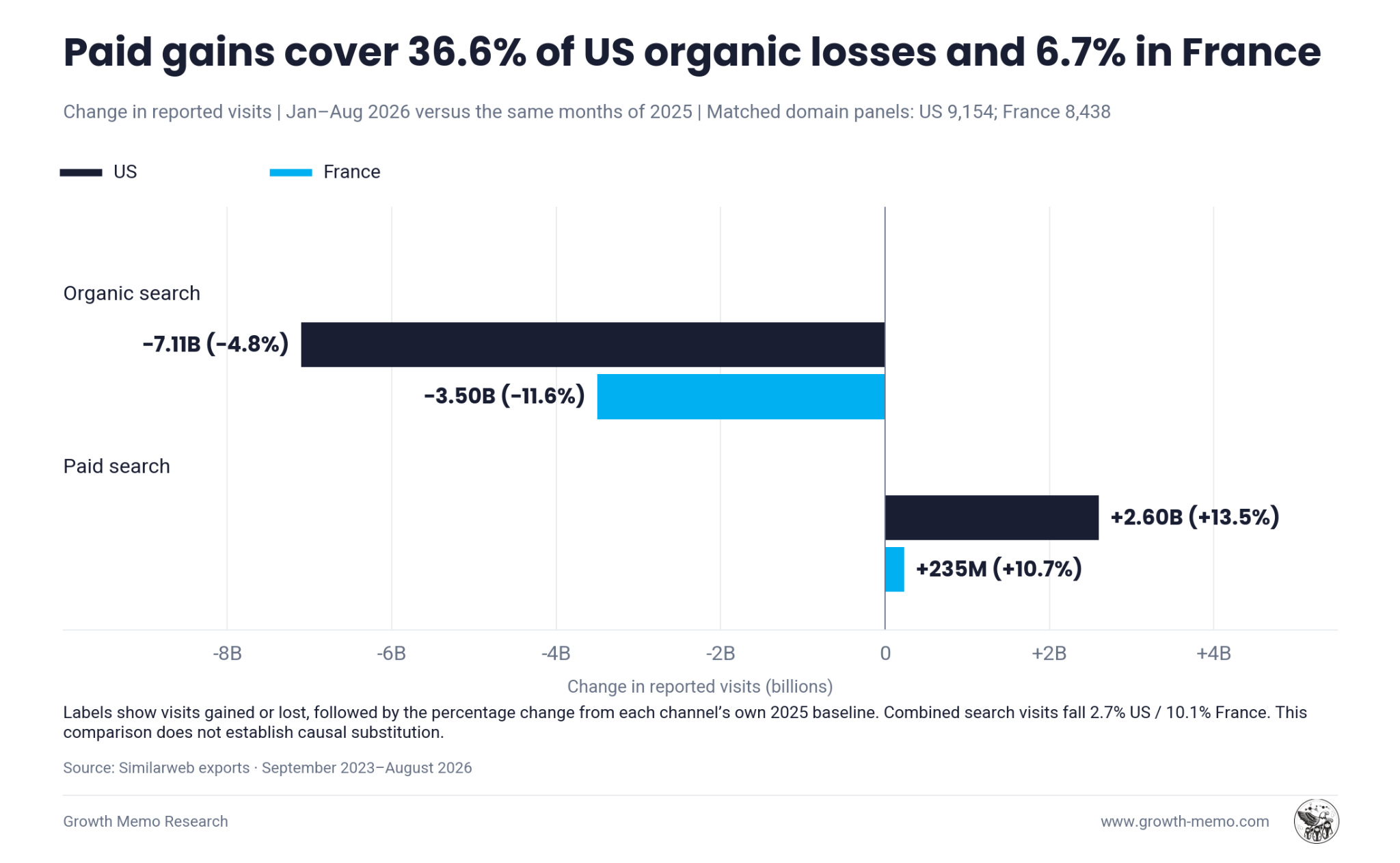
But, paid search growth doesn’t completely offset organic losses. If I were to take just the absolute traffic numbers from the chart below, paid makes up about 36.6% of organic losses in the US and 6.7% in France. The reality is probably a lot more nuanced and differs by industry, business model and time comparison.
I also find it important to call out that Google’s algorithm updates are quite aggressive. For example, the unnamed January 2026 update wiped out tons of ranks for some sites, and I think this is somewhat visible in the aggregate organic traffic chart from the beginning. Some algo updates lead to a different site type mix, meaning Google might prefer to show more personal blogs rather than large aggregator sites, as I’ve recently seen it for many travel queries.
Before shifting more budget to paid, compare the alternatives. Premium subscribers get the AI SEO Budget Reallocation Planner to work through five growth-priority scenarios.
AI traffic is still a drop in the bucket
Spoiler alert: AI referral traffic has the strongest growth rate of all channels and reaches 2.85% of SEO traffic in the US and 2.44% in France. In other words, AI referrals account for roughly one in 200 visits.
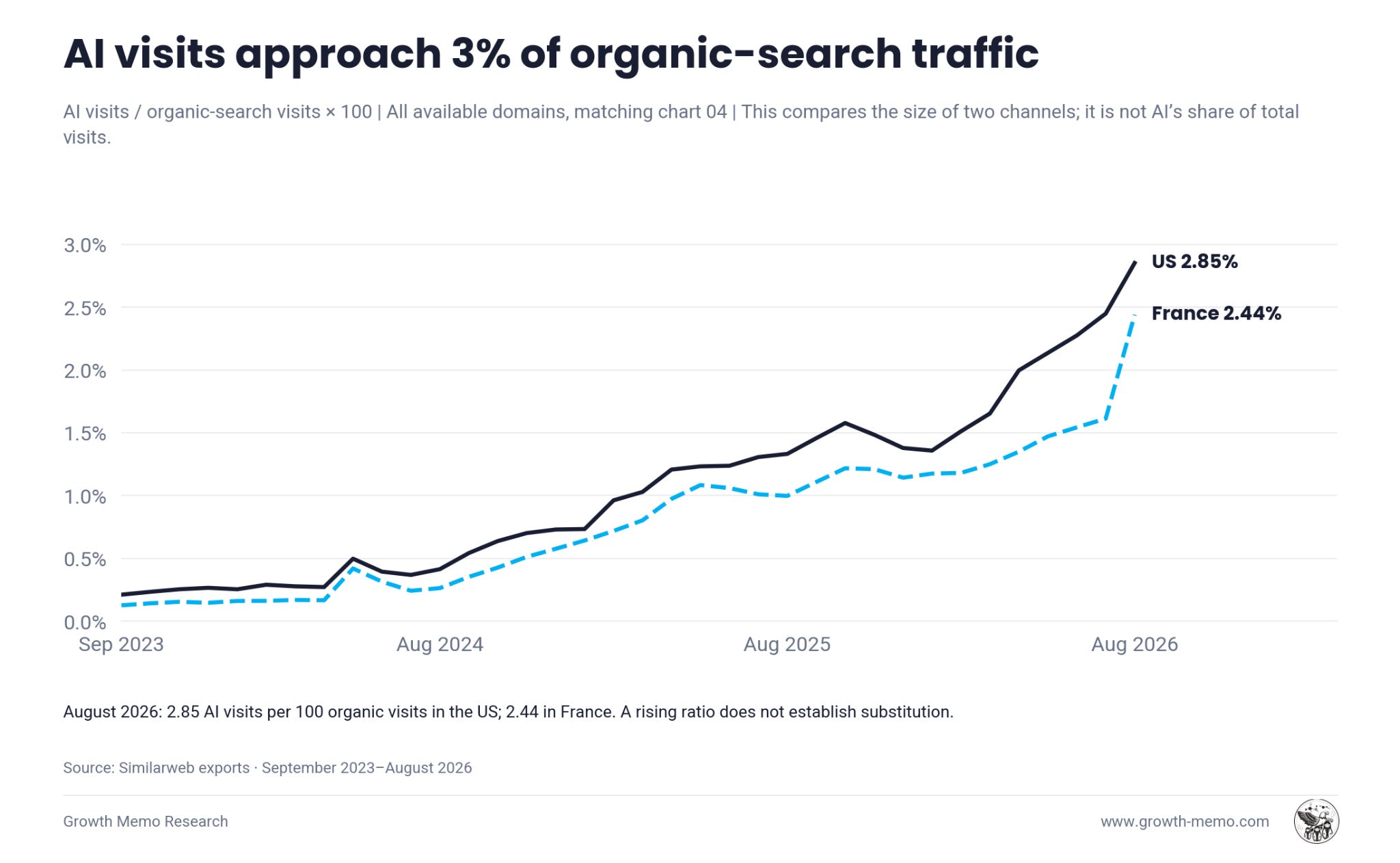
And yet, it’s a drop in the bucket, even if AI traffic converts much higher than organic. AI traffic reaches only 0.5% of total visits. Even if it doubles or triples over the next 12 months, the impact is negligible.
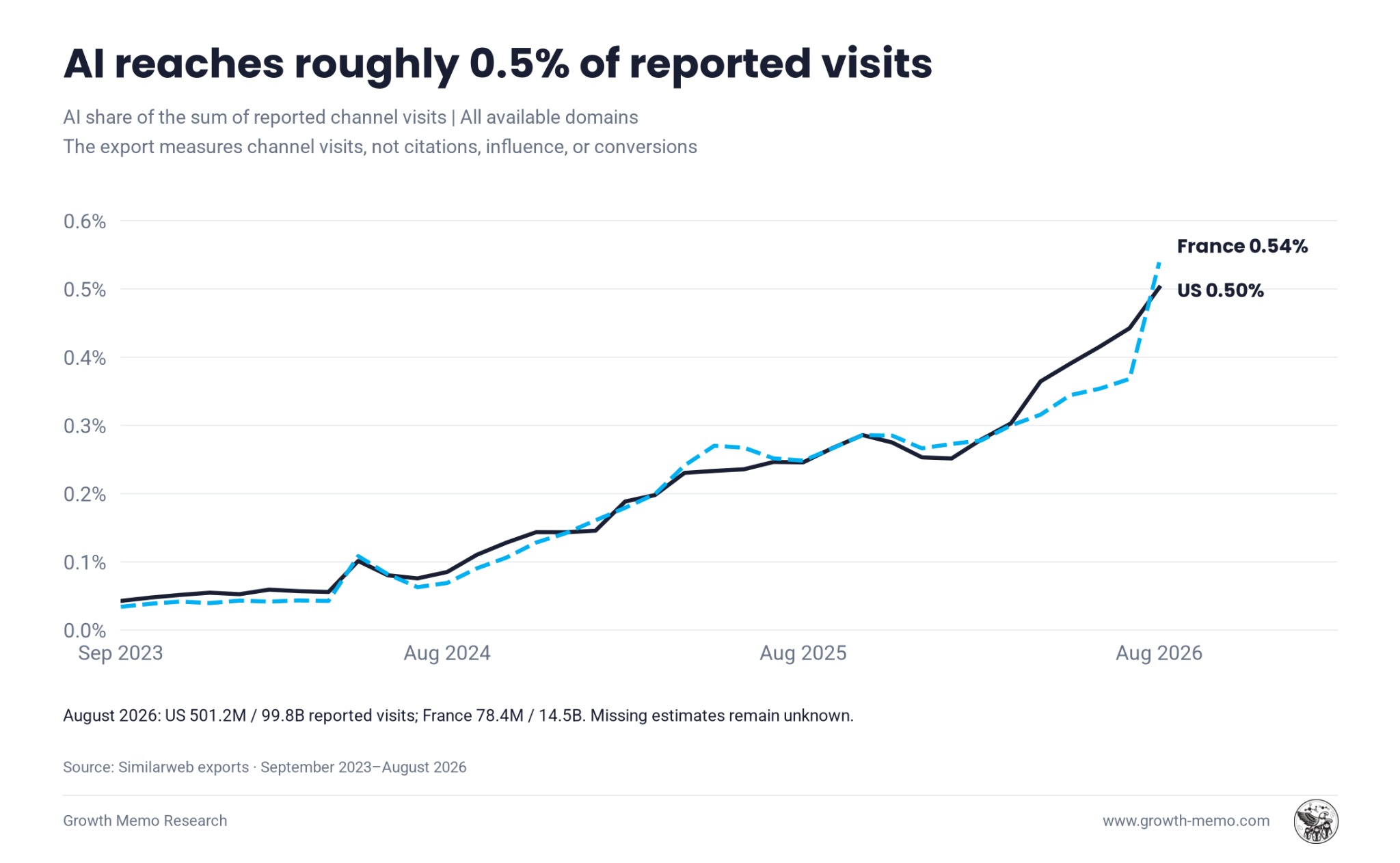
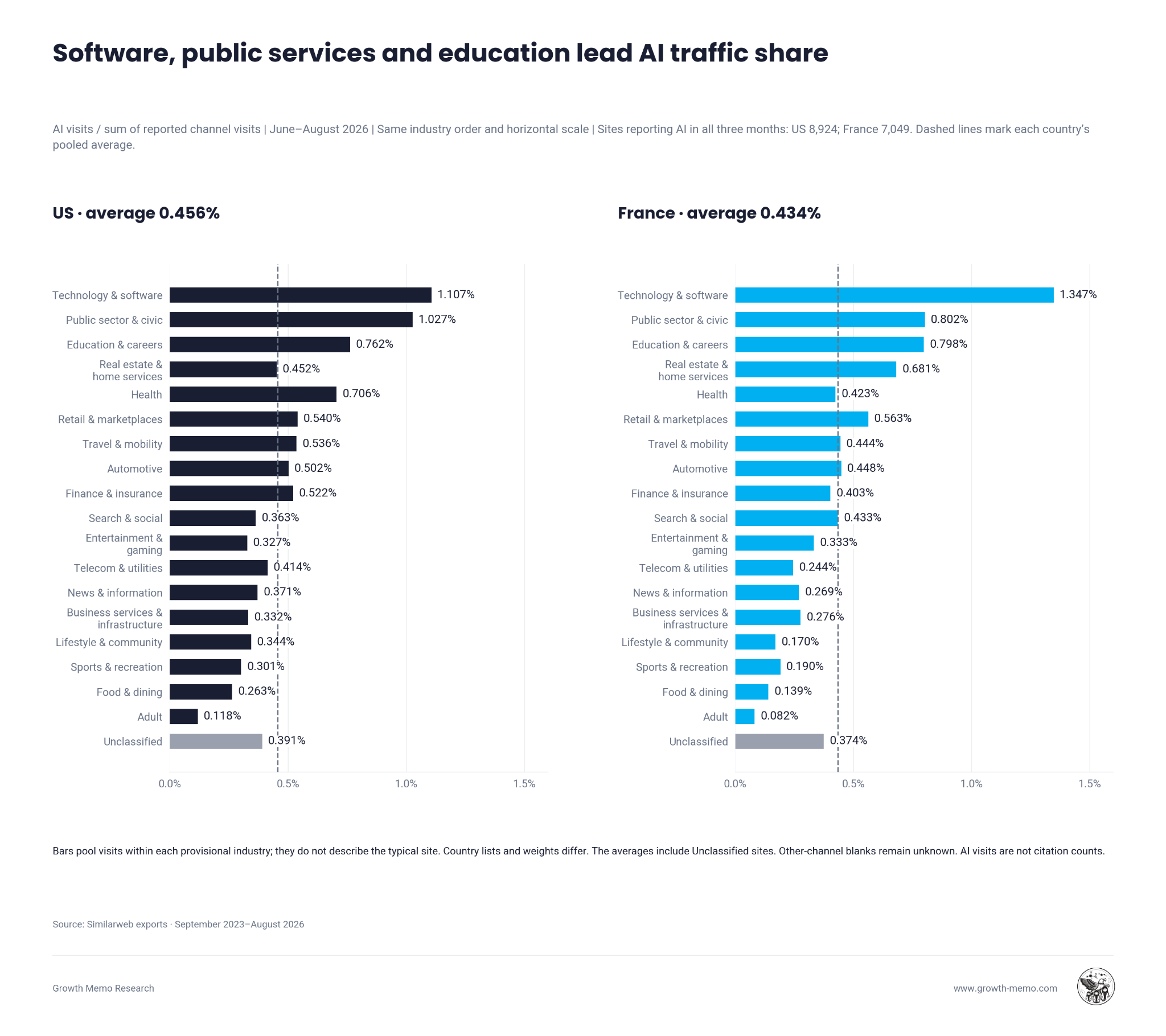
We’re also seeing forms of concentration in AI traffic. Some industries get a lot more than the average. For example, in both countries:
technology, civic services and careers outperform
Entertainment, food, sports and adult underperform
Real estate does better in France, Health does better in the US
I have low hopes that AI referral traffic could ever offset loss of organic traffic. Last week, I wrote about how hard it is to detect hidden AI traffic. But, to be clear, my opinion is that AI traffic is a red herring. I’d focus on whether your brand appears when buyers research your category, then connect that visibility to business outcomes. And just as we’ve seen with traffic, the benchmark needs to fit your industry and market.

This week’s sponsor is Semrush, whose latest AI Visibility Index helps you make that comparison. The study examines which brands and sources appear across four AI platforms in the US and UK, using seven months of data across 22 industries. It shows how those patterns differ between markets, giving you a starting point for deciding where to focus your visibility work.
Don’t pour the baby out!
The way I make sense of all this data is this:
Some decline of organic traffic comes from people using AI Chatbots like ChatGPT or Gemini to solve tasks they previously used Search for. For example, our AI Mode study shows an average zero-click share of 64%. So, some organic traffic loss could be simply people searching less (this analysis didn’t look into causality behind this claim).
AI Overviews reduce clicks but not as dramatically as AI Chatbots. Users still click on blue links to some degree even when Google shows AI Overviews in our AI Overviews study.
Higher ad load on Google and more aggressive algorithm updates cause severe damage to SEO clicks that are often underreported because it’s easier to explain drops with AI.
In some cases, like publishers, the SEO traffic loss is clear, global and painful. In other industries and even countries, it’s a lot more nuanced. Here is the big problem: A lot of people pour the baby out with the bathwater by adopting the simplistic mindset of “AI is killing all of our traffic and SEO is dead”. That might be true in some cases, but often people miss impact from advertising and algorithm updates. In other words, most companies can remedy some SEO click loss. Whether the unit economics still make sense is a different question.
If your leadership team reads declining traffic as a reason to abandon SEO, the AI Search Strategy Pitch Deck helps you structure the investment conversation around business priorities, experiments, and what you need to learn. Available in the Growth Memo Premium Resource Library.
The CEO of a large company recently used an analogy I like: SEO is like a melting ice cube. How fast it melts is not completely out of our hands.
Humbly,
Kevin
Google's sponsored results are much harder to distinguish. Personal and acquaintance anecdata, sure, but it's a clear trend in my opinion.
A good chunk of my non-tech savvy acquaintances don't know the difference between organic and sponsored and I think these people make up a much bigger part of the search ecosystem than we give them credit for.
The split between median and total visits is the part I will take away from this. It is easy to read an aggregate decline and assume every site is falling at the same rate, but your breakdown shows small sites holding up much better in total, while publishers carry a very large share of the loss. The paid search point also deserves more attention: if ads are taking more space and clicks at the same time, blaming AI alone will lead to the wrong budget decision. I found the AI referral share especially useful for keeping perspective, since rapid growth from a very small base still leaves it a minor share of total visits for now.