


Some brands get away with broad topical focus. Forbes, for example, ranks well for everything from “bitcoin price” to “best pillows for neck pain.” But most brands are more visible in search when focusing their content strategy on core topics.
Topical Authority is one of the most used concepts in SEO to justify content creation. It’s gone so far that swinging too far from the base can lead to algorithmic demotions (Hubspot and Clickup, to name a few significant ones). But does it translate to AI Search? Or are LLMs such a new playing field that brands can really swing big?
Imagine a payroll software company planning its next 20 articles. It can chase broad, high-volume finance topics, or build out the payroll questions it wants to be known for: W-2 deadlines, contractor classification, payroll-tax errors, overtime rules, and state registration.
The topical-authority bet is to choose the second path, even when ChatGPT can answer some of those questions without sending a click. The goal is not traffic from every glossary page. It is to become a brand that appears consistently when people ask related questions, including the eventual “Which payroll software should I use?” question.
Topical authority matters in AI search, and the reason is durability. This study shows AI answers develop topic owners: Once a brand earns an outsized share of mentions in a category, it usually keeps it.

Build your strategy with the definitive study into AI visibility

AI visibility isn’t uniform. Performance diverges sharply across platforms and industries, meaning a strategy built for one environment can fail to perform in another.
Semrush’s AI Visibility Index tracks 126 million prompts across 22 industries and ChatGPT, Google AI Mode, Gemini, and Google AI Overviews. It’s our biggest ever piece of research into AI visibility, complete with playbooks, expert guidance, and deep-dives into the winning brands.
Build a strategy that wins across where your audiences search. Start with the AI Visibility Index.

Method and limitations
To find out, the Semrush team gave me access to a big dataset based on the Semrush AI Visibility Toolkit.
Scope: 1,094 US categories, 5 prompts per category, and monthly snapshots from January through June 2026 in ChatGPT, USA only.
The study covers +220,000 domains and +50,000 brands, +600,000 citations and +220,000 URLs
This study tracks which brands ChatGPT mentions most often across 5 prompts per category. It does not measure sentiment, recommendation quality, user trust, or purchase impact.
The study has no topic-level organic rankings, organic visibility, or SEO share-of-voice data.
Semrush’s export records whether a brand appears in an answer, not the surrounding text or sentiment. A mention can be positive, neutral, or negative.
Definitions:
Owner: The brand with the highest share of brand mentions, named in at least 4 of the category’s 5 prompts, and at least 5 percentage points ahead of the runner-up.
Emerging leader: The most-mentioned brand appears in at least 3 prompts but does not meet the clear-leader threshold.
Unsettled category: No leading brand appears in at least 3 prompts.
Important note: The definition for unsettled category makes sense based on the threshold we’ve seen in this specific study, but don’t treat it as a universal truth at this time.
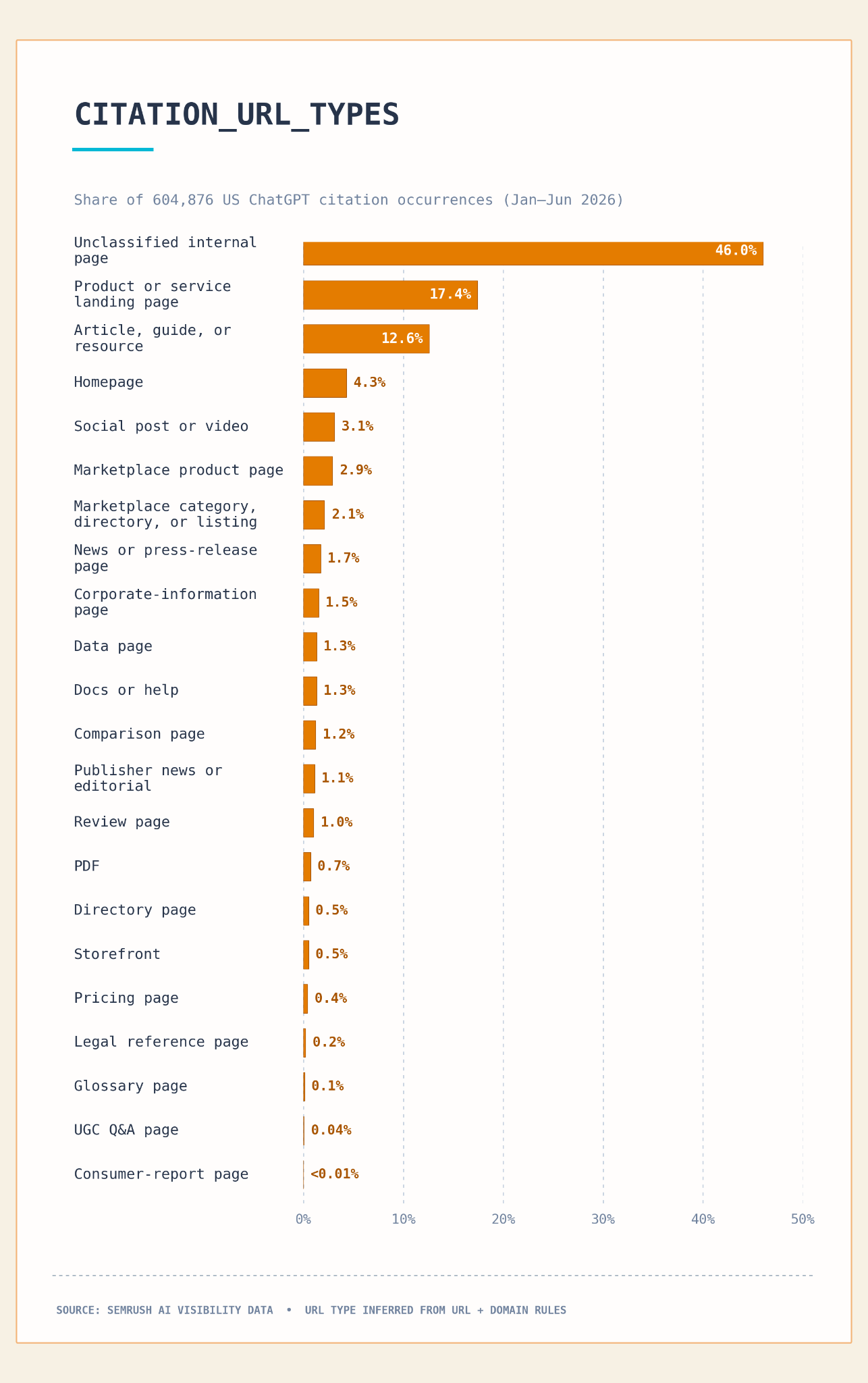
While almost half of cited pages in the study were hard to classify (a mix of cryptic URLs like “examplesite.gov/0982349” that don’t have common/standard page types), we found that the most cited page types are product or service landing pages, followed by classic editorial content. Homepages were only cited 4% of the time.
1. Most categories have a leader, but some have an owner
Category owners dominate the category, of course. We defined them as +80% Share of Voice (available brand mentions in AI answers) and at least a 5 percentage point lead to the 2nd place.
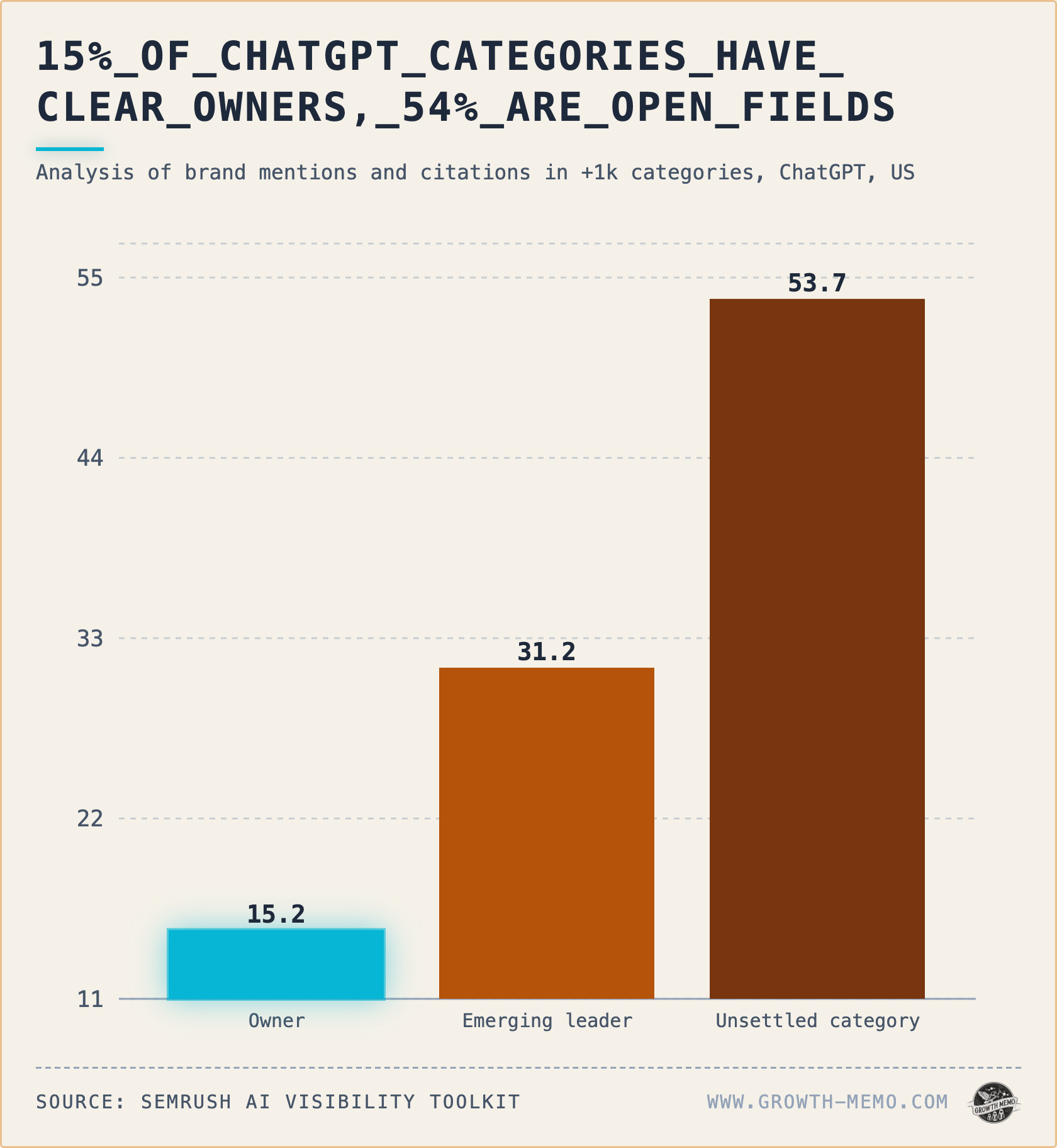
Most categories that we analyzed in ChatGPT have not yet settled on an owner. In June 2026, only 15.2% of categories had a clear owner, while 53.7% were open fields with several contenders for the top. Over half of the +1,000 categories we analyzed have a leader that can be dethroned by a challenger. Plenty of opportunity, which I personally don’t think is true in classic Google Search.
When we look at AI (search) volume, which describes how many people might prompt in a given topic*, we find that the biggest categories by volume do not have an owner.
*Yes, I’m aware that AI (search) volume is not perfect, but when we abstract search keywords and prompts into topics and look at aggregate search volume, we can at least guess how big a topic in AI Search is.
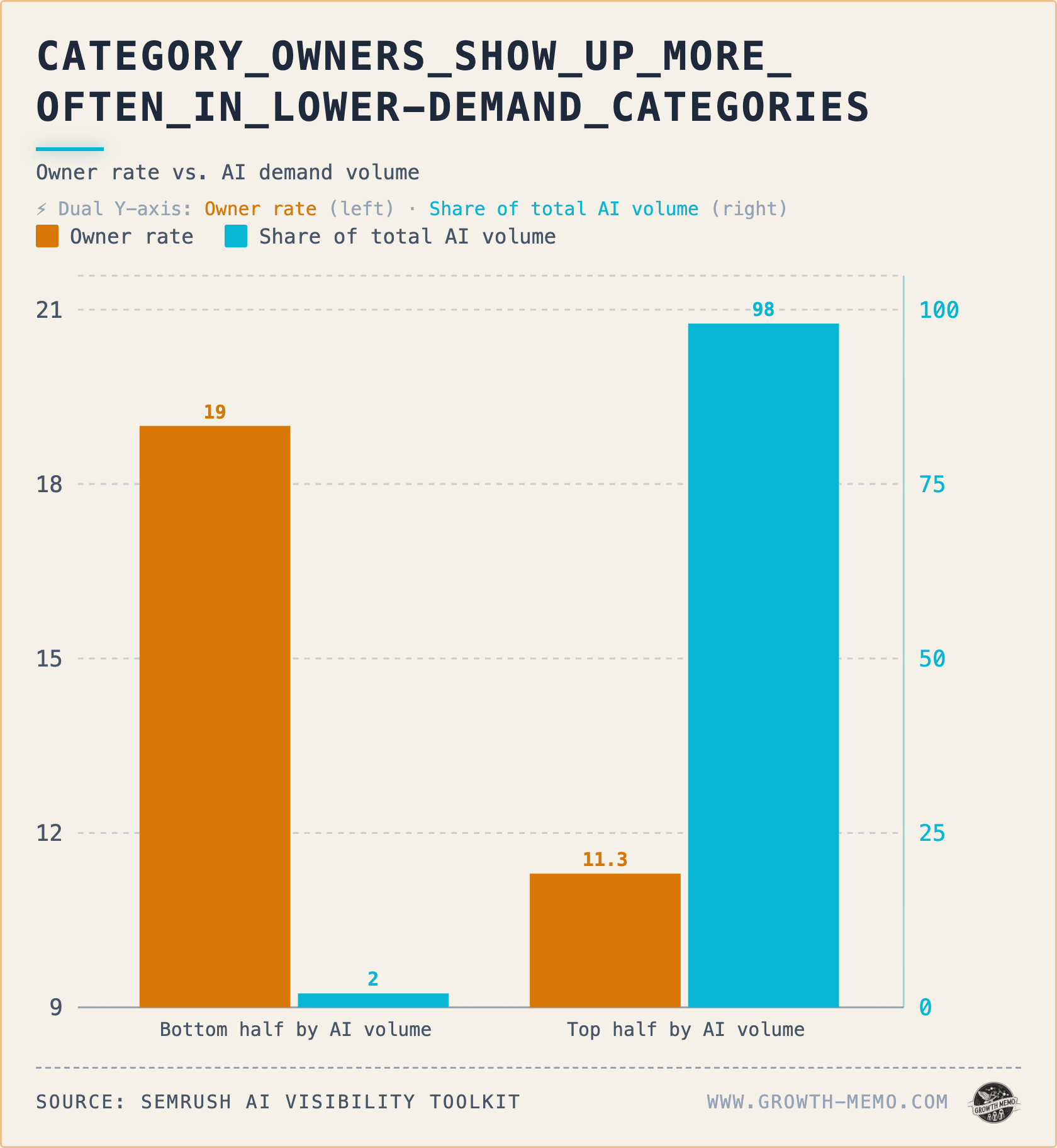
In Semrush’s US sample for our study, the biggest topics are the least likely to have an owner.
We ranked all 1,094 categories by AI-search volume and split them into 2 groups of 547.
The top group holds 98% of all volume-based AI-search demand in the sample. It also has the lowest owner rate: 11.3%, versus 19.0% in the bottom group.
Stack those up and 89.3% of estimated AI-search demand sits in categories with no clear owner. Demand concentrates, but in this dataset, ownership does not.
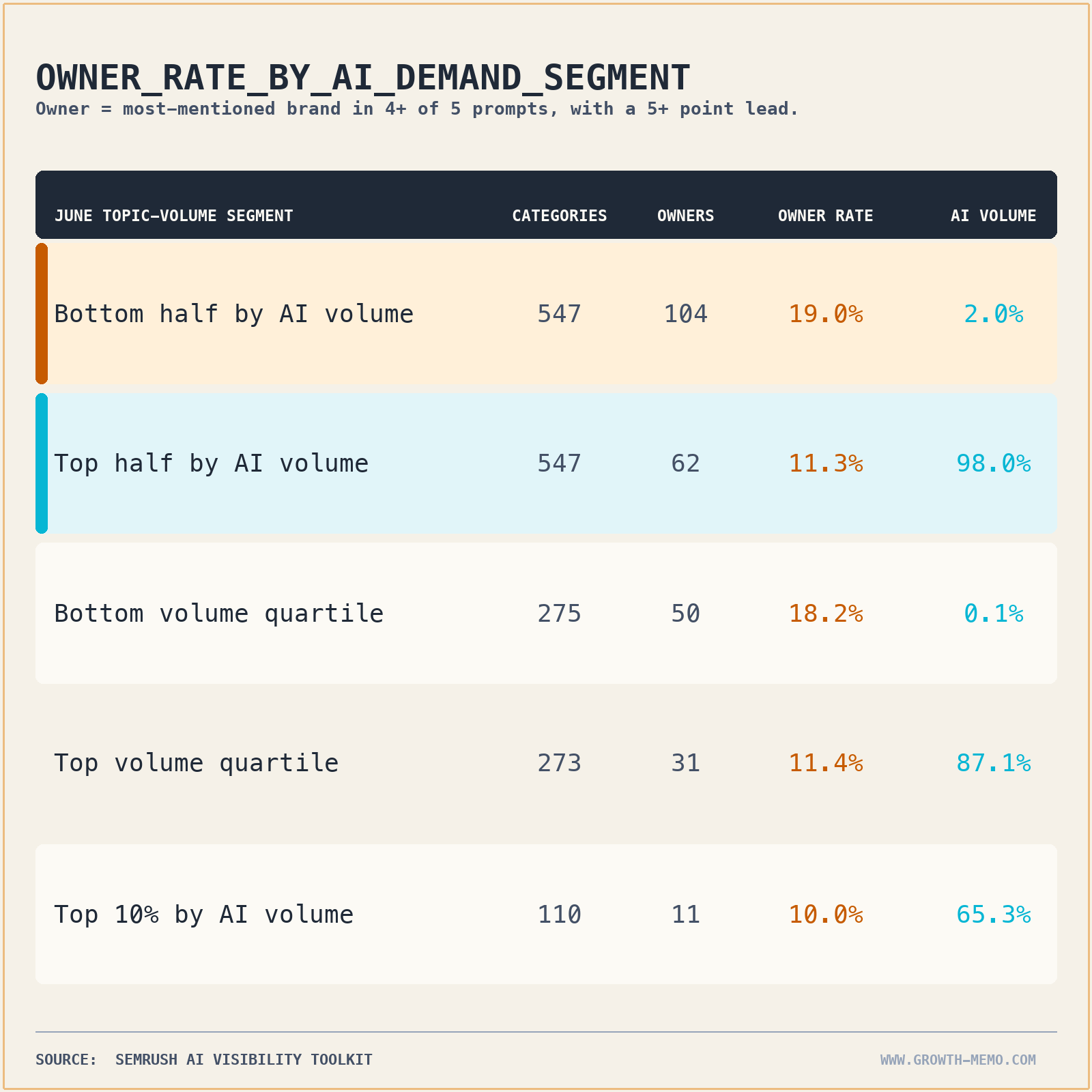
When we split the data out by quartiles or deciles, we see the same trend of top-heavy categories being more open-field opportunities than smaller ones.
A category with no owner is an open budget conversation waiting to happen. The AI SEO Budget Reallocation Planner generates 5 growth-priority scenarios and a screenshot-ready visual in under 7 minutes, so the categories you choose to attack come with a number attached. Find it in the Premium Subscribers Resource Library.
2. Owners win on brand mentions, not citations
This study counts whether a brand appears in an answer, not how prominently it appears or whether it is recommended. A category owner is therefore the brand named across the largest share of its tested prompts.
Previous Growth Memo user-behavior studies have repeatedly shown that users pay little attention to citations and most to brand mentions. In shortlists, users demonstrate strong preference for the top results for purchase decisions (75% of users pick the top brand). In other words, brand mentions are AEO gold. I applied this lens to this data as well.
From How Consumers Navigate High-Stakes Purchases in AI Mode:
In classic search, 56% of participants built their own shortlist from multiple sources. In AI Mode, only 8 out of 147 codeable tasks produced a genuinely self-built shortlist. The user’s comparison process didn’t just shrink when using AI Mode. For most participants, it didn’t happen at all.
64% of AI Mode participants clicked nothing at all during their task. They read the AI’s text, sometimes scrolled through inline product snippets, and declared their finalists. The no-click rate varied by category.
Just like in classic search, the top answer carries outsized weight. 74% of participants chose the item ranked first in the AI’s response as their top pick. The mean rank of the final choice was 1.35. Only 10% chose something ranked third or lower.
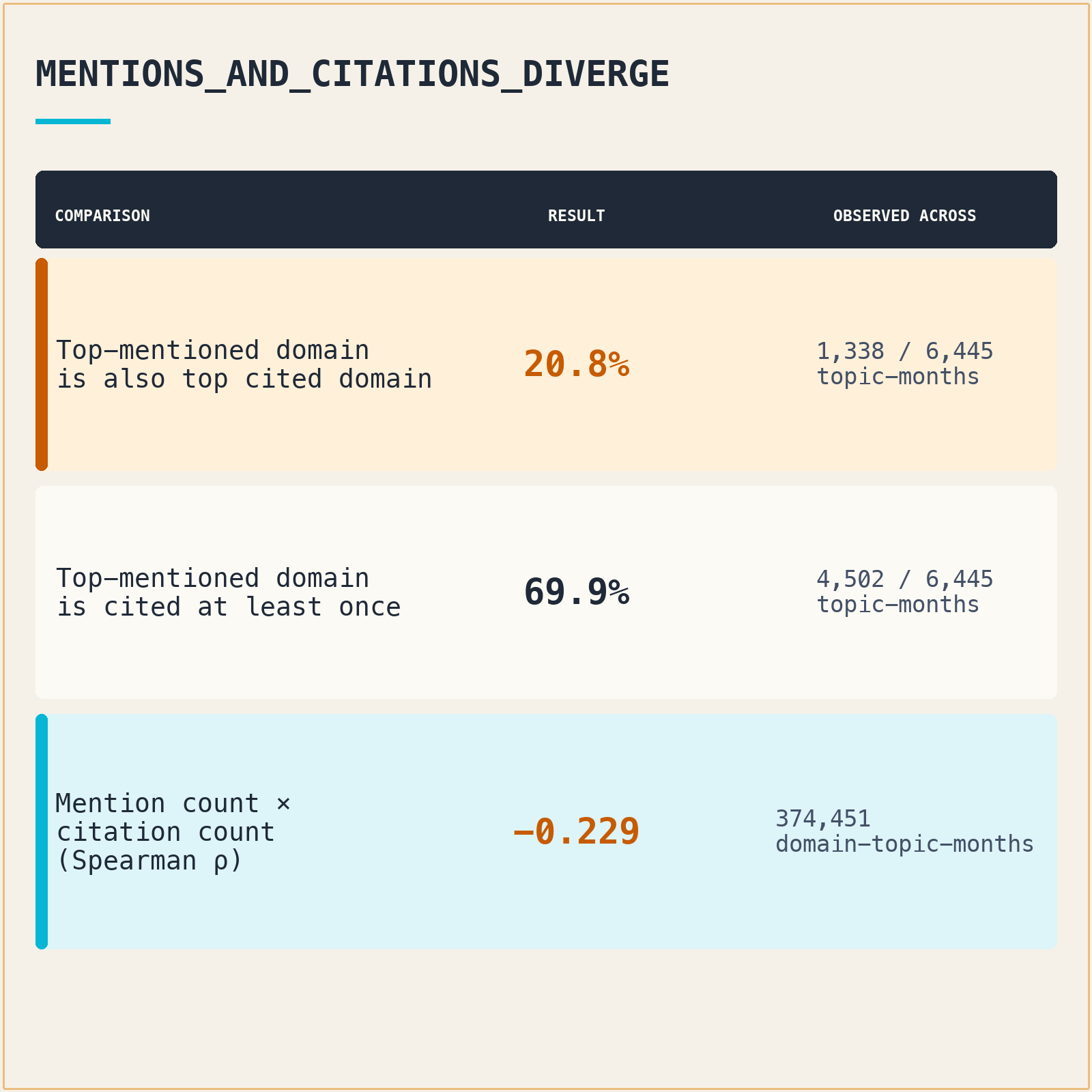
While citations influence the AI answer to a prompt, the relationship between citations and brand mentions is slightly negative (-0.229). In the study, the most cited domain was rarely (20.8%) the most mentioned. But the most mentioned brand was often cited (69.9%) at least once.
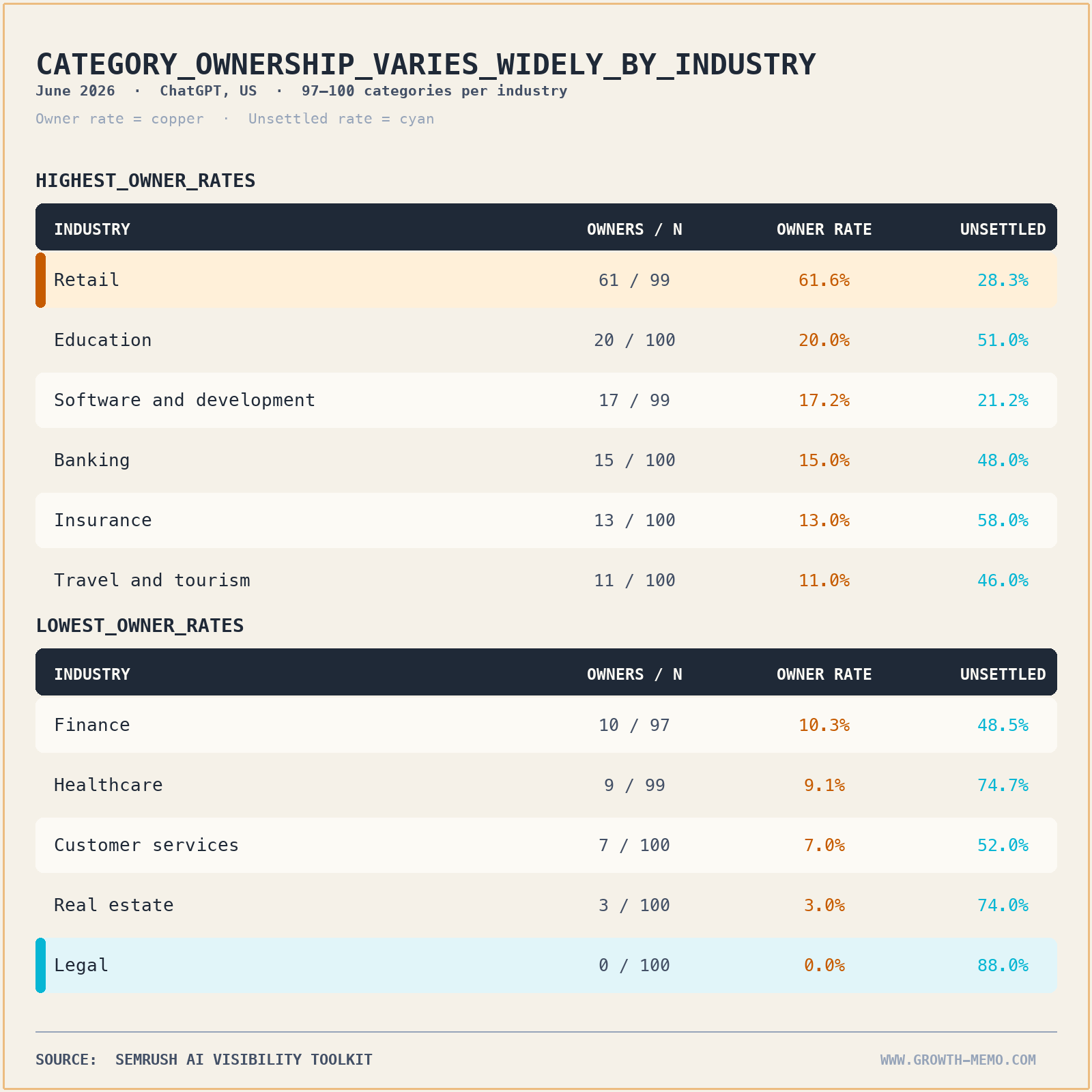
All industries exhibit clear owners, except for legal. In retail, we see the highest owner rate with 61.6% (meaning 61 out of 99 categories we analyzed have a clear owner).
3. Characteristics of category owners
The available data lets us identify traits associated with ownership, but not prove how ownership was created. When compared to the the 2nd place in a category, we do see that owners have:
Higher brand search volume (55.7%)
Higher organic traffic (48.4%), and
Higher authority (52.5%, as measured by Semrush’s Authority Score)
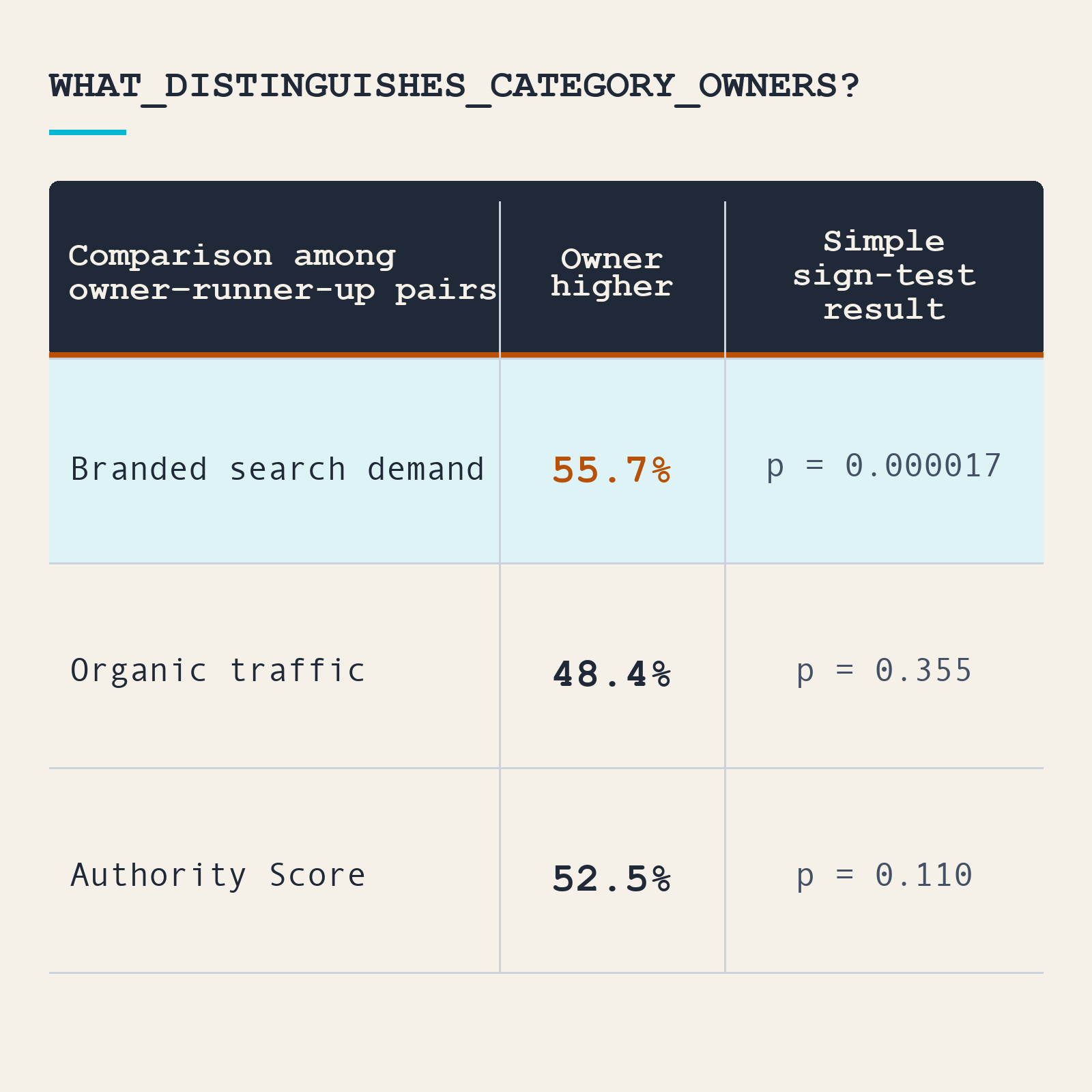
The branded-demand result means that, in 577 of 1,035 owner-runner-up pairs, the owner had higher branded search volume.
It does not mean branded demand explains 55.7% of ownership. These are useful clues, but not a recipe. The better working hypothesis is:
Brand strength may help a domain enter the answer set. Category ownership is more likely determined by unmeasured topic-specific factors, including source relevance, cited content quality, reputation, and how well a domain fits the prompt.
4. Can a challenger win a category?
Category owners are defined by their position. They’re hard to dethrone.
It’s not impossible to dethrone them, but the odds depend heavily on how settled the category is. A clear owner retained first place in 90.4% of next-month (or month over month, MoM) comparisons. Emerging and unsettled leaders change much more often.
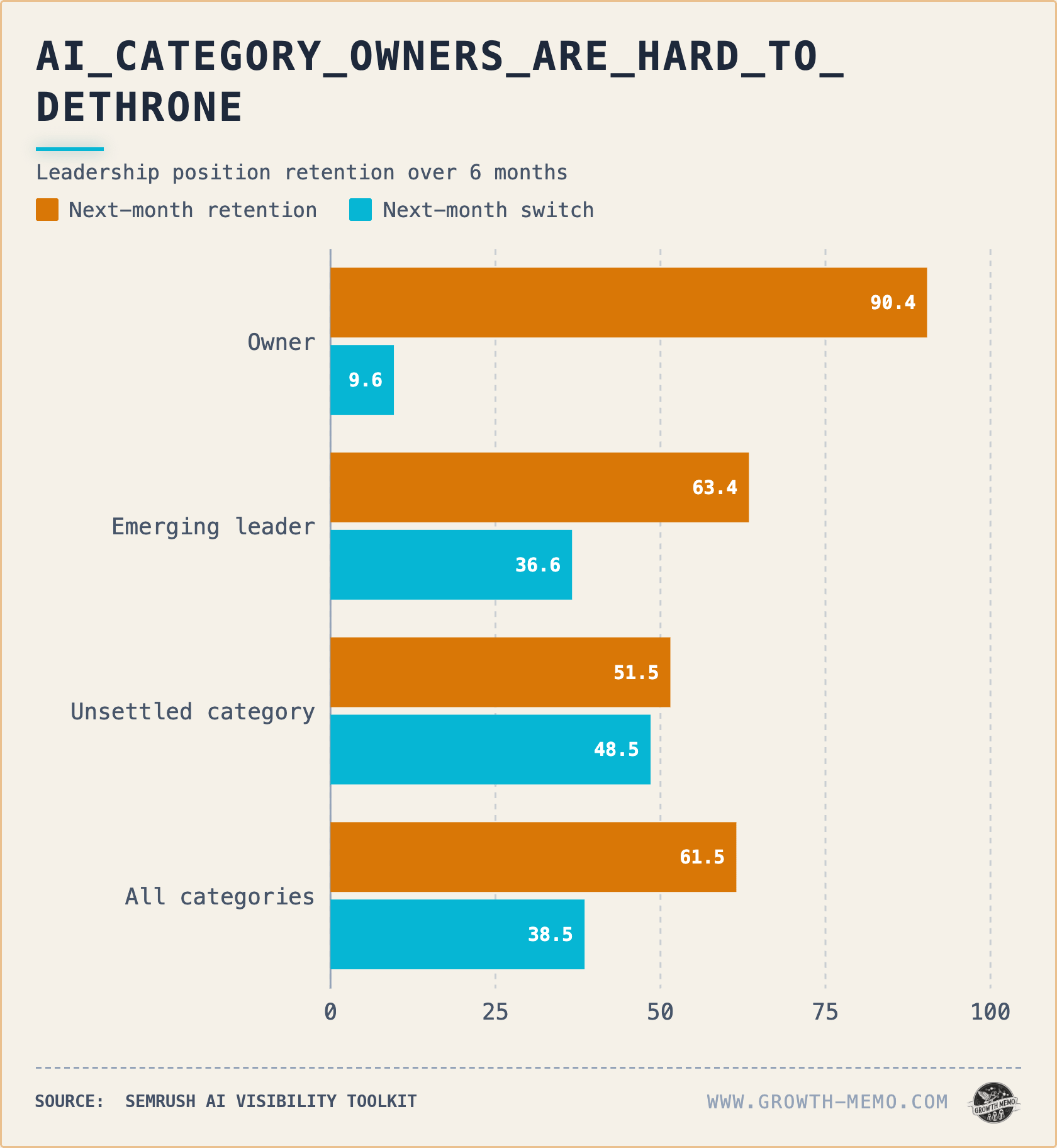
Leaders switched in 1,950 of 5,470 MoM comparisons. But those changes were concentrated in categories where the initial lead was narrow: Switching leaders had a median 1.3-point lead, versus 2.9 points for leaders that retained first place.
3 examples where a clear leader was replaced by the previous month’s runner-up:
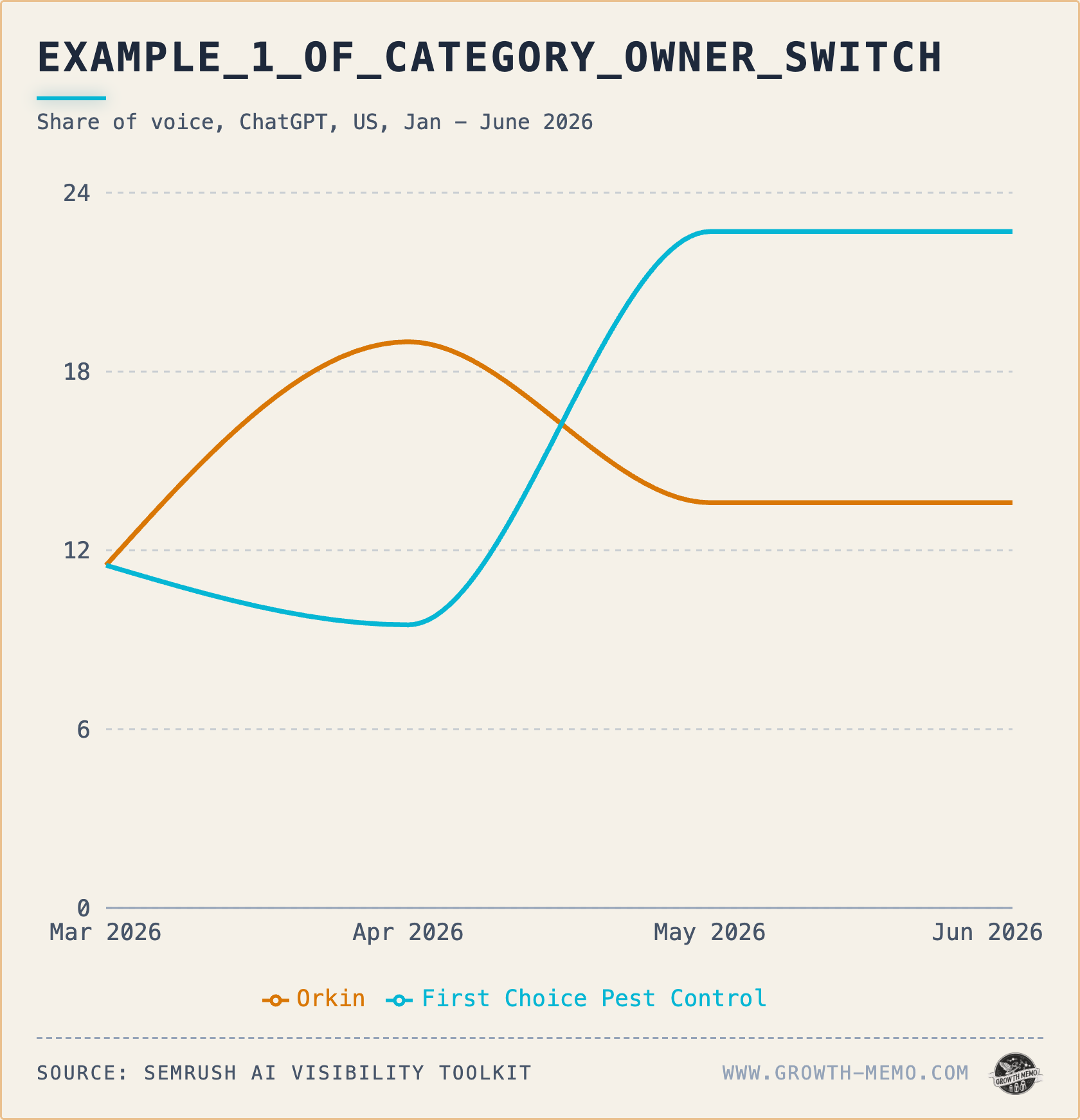
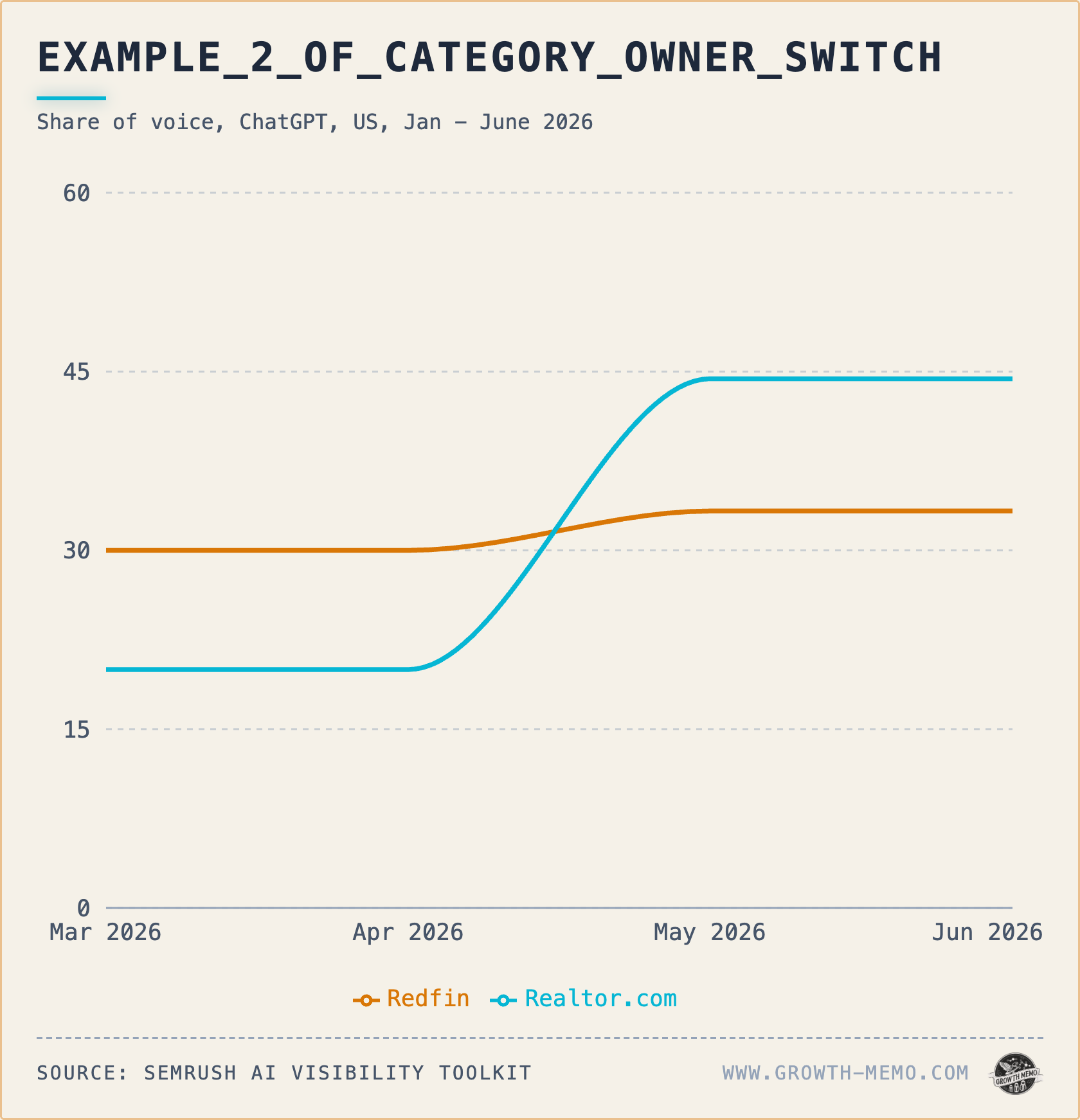
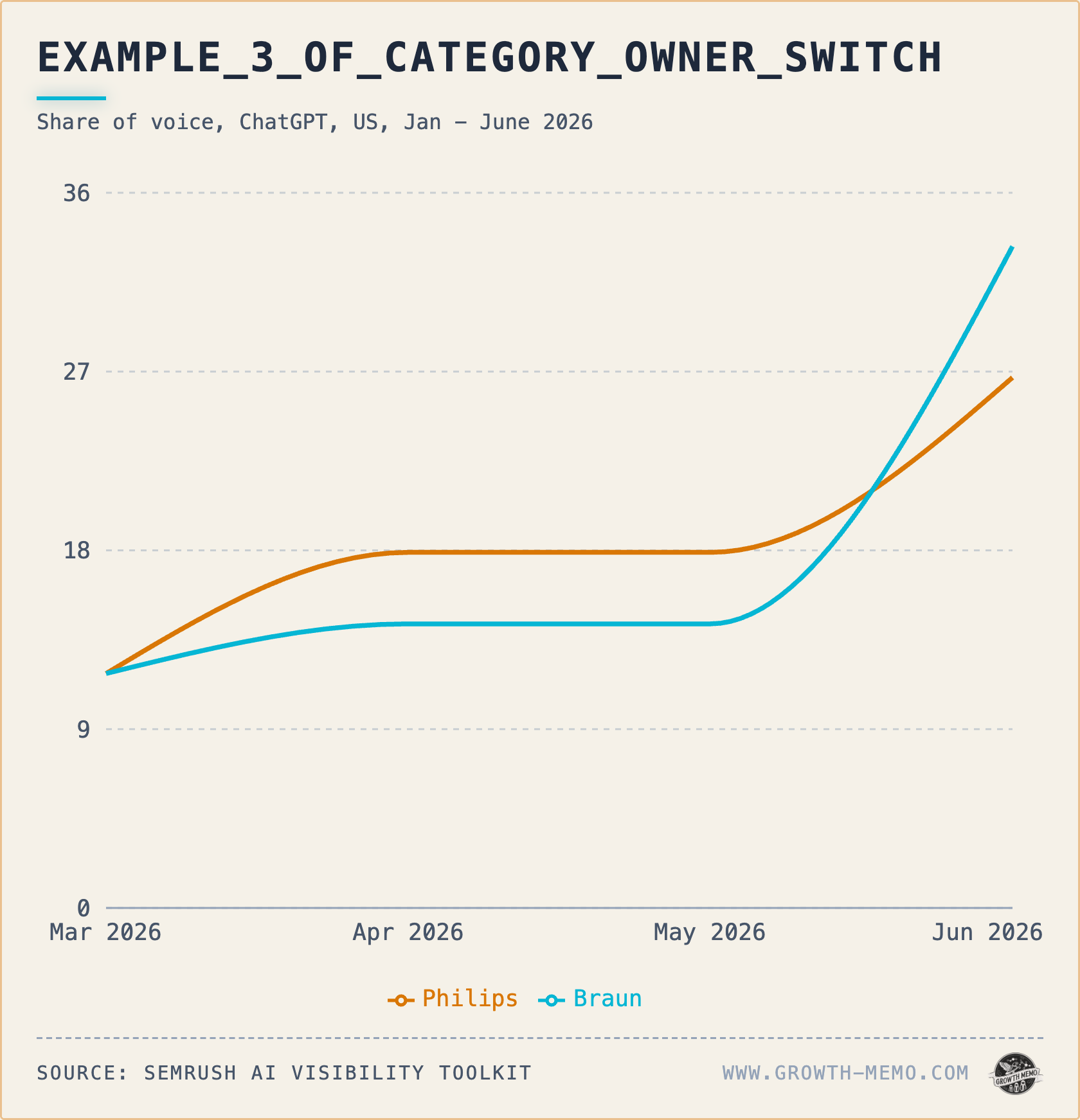
As you can see in the examples, you can trend up but reverse course (example 1), be flat and overtaken by a competitor (example 2) or grow and still be overtaken by a competitor that grows faster (example 3). Your trend line says little about your safety. You need a big enough margin (at least 5%).
We cannot say why these switches occurred from this dataset alone. They could reflect changes in sources, answer generation, prompt interpretation, or real changes in each brand’s underlying relevance.
What the data does show is the condition for disruption: Narrow-lead categories are contestable; wide, sustained ownership is much harder to displace.
5. How to compete for category ownership
Use topical ownership to decide where to focus, not to declare that more content will make ChatGPT mention you:
Watchlist. List 10 to 20 commercially important categories for your brand. For each, track at least 5 representative prompts: a definition, comparison, alternatives, use case, and buying question. Read more about how to make your prompt tracking more accurate here.
Classify. A clear owner is the most-mentioned brand with a strong majority of prompts and a clear lead over the runner-up. Everything else is either an emerging-leader category or an unsettled category.
Invest. Prioritize commercially valuable categories with no clear owner, or a small gap between the leader and runner-up. Defend categories you already lead. Be more selective about attacking a category where an established brand leads across nearly every prompt.
Gaps. Close gaps across the prompts where competitors appear and you do not. That can mean clearer product positioning, comparison pages, documentation, expert guidance, proof points, and credible third-party coverage. The study does not show which of these creates ownership. It gives you a disciplined place to test them.
Measure. Track brand mentions as the ownership metric, citations as a source-authority metric, and referrals, self-reported pipeline, or revenue as the business metric. A monthly change in the most-mentioned brand is a reason to investigate, not proof that a competitive win created demand.
Closing prompt gaps starts with knowing which pages AI systems already rely on. The AI Citation Audit saves a junior analyst about 2 hours of manual checking per cycle and tells you which cited pages are carrying your category. Premium is only $150/year for now. See the full library.
Topic focus is worth the “content constraint” because ownership compounds over time. A category you win in is a category you tend to keep, and the brands that spread their content creation across every topic that’s semi-adjacent to their core offering rarely reach the mention share that makes a lead stick.
The Semrush data shows that, currently, the window is open… and it will not stay open. 89.3% of AI-search demand sits in categories with no owner (as defined by this study), which means the cost of picking the wrong 5 categories today is lower than it will be in 12 months.
Pick the categories you want to be the answer to. Defend the ones you already lead. Skip the ones where an established brand appears in every prompt. Broad coverage still has a job in marketing, but it does not build the position that makes ChatGPT name you.
Premium: Topic category defense playbook
Clear topic category owners held first place month over month in 90.4% of the observed comparisons. That makes ownership durable, but not permanent.
This playbook explains how to protect your category lead before a close challenger turns into the new default answer.
Important: In this study, ownership means brand-mention leadership, not citation volume. A category owner appears in at least 4 of 5 representative prompts and leads the runner-up by at least 5 percentage points.
Citations matter because they help shape AI answers. Brand mentions matter because they are what users see and act on.
What this playbook covers
Protecting a lead in topic categories your brand already owns
Finding weak prompts before competitors take them
Strengthening the pages and third-party sources that support AI answers
Building external proof that makes your brand harder to displace
Setting an operating cadence for competitive response
This is not a claim that any one tactic creates topical ownership. The study identifies the conditions worth defending. Teams still need to test which actions change mentions in their category.
