How to build an AI SEO strategy that outlasts tactics
A tactic list isn't a strategy. Here's the difference and how to fix it.
This Memo was sent to 24,956 subscribers. Welcome to +149 new readers! Get the free memo weekly. Upgrade to Premium for the full archive, research, frameworks, and templates.
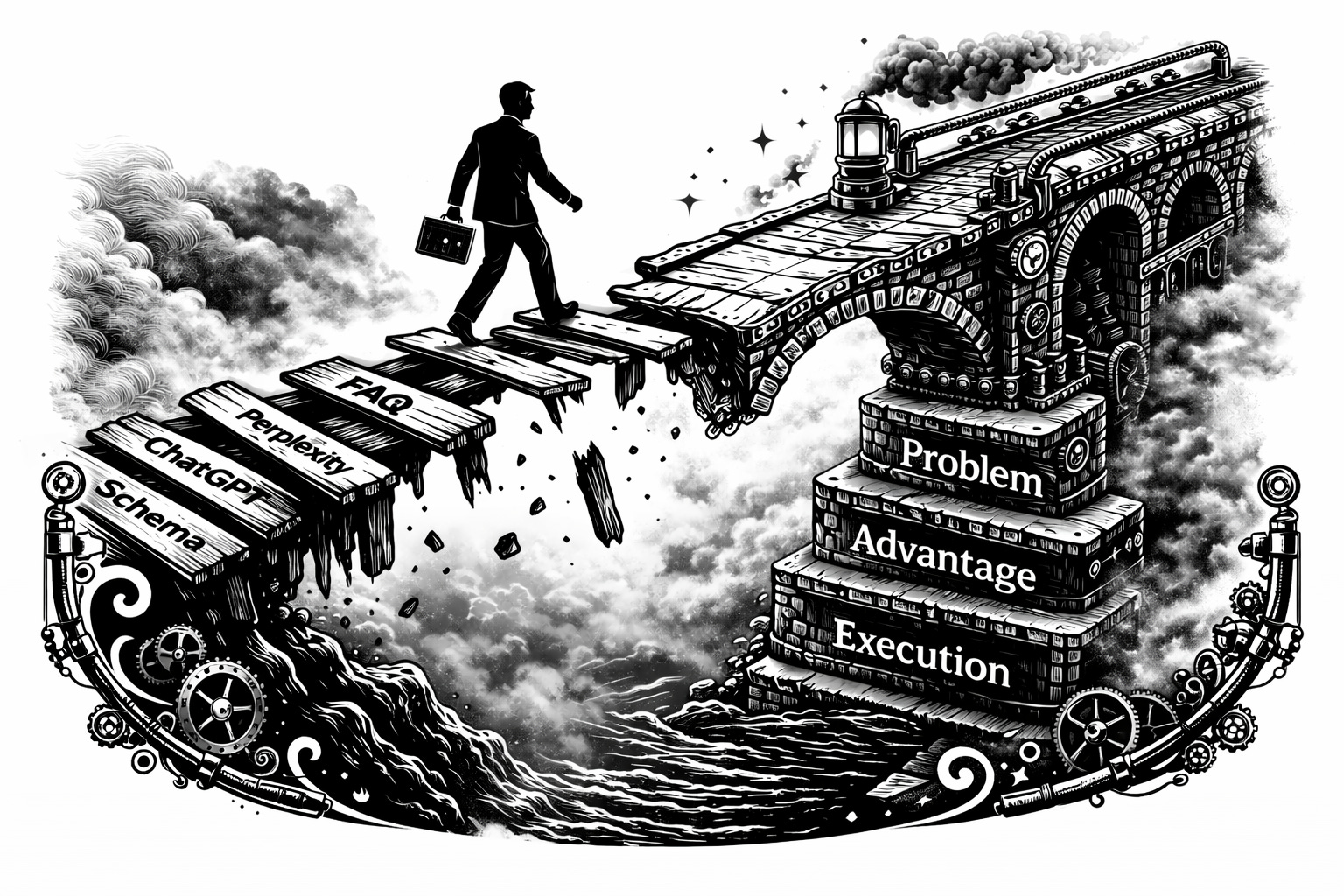
Most AEO “strategies” are tactic lists dressed up as long-term direction. They often break the first time a platform changes or leadership asks questions. A real AI SEO strategy starts with the business problem, builds on your brand’s unique advantages, and lets tactics come last.
This week, we’re covering:
How to identify your actual AI SEO challenge (it’s a business problem, not a channel problem)
A 3-part strategy document structure that survives leadership scrutiny and platform shifts
How to present AI SEO investment using scenario planning instead of traffic forecasts
Premium subscribers also get an interactive strategy builder tool to create your AEO strategy document.
Which brands are winning in AI visibility?
Semrush’s AI Visibility Awards reveal the brands that are leading their industries in AI visibility. We’re recognizing those with the highest visibility overall, the fastest risers, and the fresh names who are overachieving.
Get insights into what sets brands like Patagonia, Anthropic, and Nothing Technology apart from their industry competitors. Then dive into the complete AI Visibility Index for more learnings, refine your strategy, and power your climb up the rankings.
1. Tactics without a strategy waste quarters of work
Strategy as a concept is even more misunderstood in the AI SEO era than it was in traditional SEO. Most “AEO/GEO strategies” I see are actually just tactics: optimize for long-tail queries, add structured data, create FAQ content. These might be part of your execution, but they’re not your strategy.
The result? Teams chase citations in ChatGPT without understanding if that’s a solution to an actual business problem. They optimize for Perplexity when the real challenge is protecting branded search volume. They copy competitor tactics instead of building on their unique advantages.
When you set out to build (or repair) your AI SEO strategy, distinction matters because a tactic list can’t answer the one question strategy exists to answer: What problem are we solving?
2. Start with your brand’s unique challenge
Your strategy must answer one question first: What business problem are we solving?
This sounds obvious. Most teams skip it. They see “AI search is growing” and immediately jump to “we need to rank in ChatGPT” and start trying new tactics. That’s a reaction, not a clear strategy.
Use the same approach I outlined in creating an SEO strategy from scratch: identify your actual challenge through research, then build your approach around solving it.
Common AI SEO challenges I see:
Brand visibility erosion. Branded queries get answered by AI without attribution, bleeding awareness over time.
Pipeline protection. Qualified traffic is shifting to AI Mode, but your brand is invisible in those results.
Category definition. AI models cite competitors as the category solution. Your brand doesn’t appear.
Conversion influence decay. Users research in ChatGPT, arrive at your site decision-ready, or don’t arrive at all. The pre-site journey now happens inside an AI interface - and you can’t see your target audience’s detailed behaviors via analytics.
These are business problems, not channel problems. Your challenge should connect directly to revenue, market share, or competitive position. If it doesn’t, you’re optimizing for a metric that can’t survive a budget review.
3. Do your research first to kill your own incorrect assumptions.
You can’t build an AI SEO strategy on assumptions. What works varies by industry, query type, and user intent… and the platforms are moving and shifting fast.
Your research phase should answer 4 questions:
1/ Where is your audience using AI search? Don’t assume. Survey customers, analyze referral data, review session recordings. ChatGPT usage patterns differ from Perplexity and Google AI Overview usage. Our AI Mode user behavior study showed that 250 sessions of real behavior look nothing like what most teams expect.
2/ Which queries drive the pipeline? Map the queries that connect to revenue, not just site visits from AI Mode, Gemini, or ChatGPT & Co. In zero-click environments, you need to understand which visibility opportunities actually influence buying decisions. Start with pain points your sales team hears on calls. Turn those into the questions buyers type into ChatGPT or Google. Then check which of those questions generate AI answers where your brand does or doesn’t appear. That’s your revenue-connected query set.
3/ What kind of site content or external third-party mentions drive visibility in your category? Test which internal content structures (like types of blog posts and landing pages) and external-third party sites that mention your brand (like reddit and G2) earn citations in your category for revenue-connected queries. For your internal content that you have more control over, the ski-ramp data from The science of how AI pays attention shows 44% of citations pull from the first 30% of a page, which means front-loading claims, definitions, and data changes citation rates more than adding depth at the end. Run one test: rewrite the first 3 paragraphs of your top 10 pages to lead with the answer, not the context.
4/ What’s your citation baseline? Use tools like AirOps, Profound, or SearchGPT to map where you currently appear. Track competitors. Measure the gap.
Compare your current performance against where you need to be. Use 5x Why analysis to identify root causes. If you’re not being cited, the problem could be content depth, authority signals, or technical accessibility. Each requires a different approach.
4. Your strategy document has 3 parts
An AI SEO strategy document should include 3 components. No more.
Part 1: The challenge. State the core business problem in one sentence. Example: “Our brand is invisible in AI-generated answers for category-defining queries, allowing competitors to own mindshare with buyers before they reach a search engine.”
Part 2: The approach. Explain how you’ll address the challenge. This is where your unique advantages matter. Your approach should be something only your brand can do, or something you do better than competitors.
Example approaches:
Authority multiplication. Leverage your executive team’s expertise through strategic bylines, podcast appearances, and research publications that AI models pick up as authoritative sources. Third-party authority signals influence brand mentions and citation selection.
Product-led content. Use your product data to create depth that competitors can’t replicate. Apply product-led SEO principles to AI SEO by building content assets that only your data can produce.
Community signal amplification. Build visibility through customer stories, case studies, and user-generated content that demonstrates applied expertise. Personas built from real customer data sharpen this work because they tell you which community signals actually match how your buyers search.
Part 3: The actions. Now - and only now - list your tactics. These should flow directly from your approach:
Create conversational-query content (or update existing content) that addresses hyper-specific buyer contexts
Optimize technical accessibility for LLM crawlers
Build systematic digital PR to drive third-party citations
Develop persona-specific content that matches AI search patterns (using synthetic personas to scale prompt tracking)
Reinforce internal linking as entity maps, not just crawl paths
Include resource allocation: What percentage of capacity goes to each action area? Include success metrics tied to business outcomes, not just “track citations.” Read Budget for capacity, not output to learn more about how to do this.
At the end of this memo, premium subscribers get deeper guidance on how to define your brand’s challenge, what approach to take, and what actions to pair with your brand’s unique needs.
5. Scenario planning sells AI SEO to leadership
Here’s where AI SEO strategy gets difficult. You’re asking for investment in a channel that’s still forming, with metrics leadership doesn’t yet understand.
Don’t present traffic forecasts. They’re fiction in AI search. Use scenario planning instead.
Frame it like this: “If we allocate 30% of capacity to authority building and 20% to conversational content, we expect citation increases of 40-60% within 6 months, which should influence 15-20% of assisted conversions based on current attribution data.”
Include stage gates. Make the investment reversible. Executives are more likely to approve experiments with clear decision points than open-ended commitments.
Present 3 scenarios: conservative, moderate, and aggressive. Show what resources each requires and what outcomes they might produce. Let leadership choose.
The strategy document from section 4 gives you the structure to do this. The challenge statement defines the goal. The approach defines the bet.
6. Review your strategy quarterly or it goes stale
Your AI SEO strategy is not a one-time document. The platforms change, and user behavior is shifting fast. Your own test outcomes should also change your tactics.
Build quarterly strategy reviews into your plan. Each review should answer 4 questions:
What changed in AI search since our last review?
What did we learn from our tests?
Do our tactics still serve our approach?
Is our approach still solving the right challenge?
Your AI SEO strategy should be a decision-making tool, not a task list. Most teams fail at AI SEO because they treat it like traditional SEO with a different name and a slight shift in tactics.
Start with the business challenge. Build an approach around what only your brand can do… let your tactics flow from there.
And make the whole thing reversible and adaptable, because we’re all still learning what works.
Build your AI SEO strategy with the Growth Memo library
Once your strategy document is set, these past Growth Memo posts cover the execution layer. Each addresses a specific capability your AI SEO approach will need.
Plus, this week, premium subscribers get [INSERT HERE FINAL COPY] at the bottom of this memo.
First, know your audience
Personas are critical for AI search covers how to turn in-house data into personas that shape briefs, prompts, and content decisions.
Making SEO personas actionable across teams moves personas from a planning artifact into day-to-day workflows across content, product, and SEO teams.
Synthetic personas for better prompt tracking solves the cold-start problem in prompt tracking by simulating search behavior across segments at 85% accuracy.
Second, understand user behavior in AI search
The first-ever UX study of Google’s AI Overviews tracked 70 users across 8 tasks to map what “visibility” means when AI answers sit above organic results.
What our AI Mode user behavior study reveals analyzes 250 sessions of AI Mode behavior to show how users actually interact with Google’s AI interface.
Google’s AI Mode SEO impact is the second part of that study, covering what’s measurable, what’s guesswork, and what visibility means in AI Mode.
Third, create content that builds long-term topical and brand authority
Topic-first SEO explains why keyword-first SEO creates surface-level content and cannibalization, and how topic-first thinking fixes both problems.
Operationalizing your topic-first SEO strategy is the execution blueprint for running topic-first across your team.
How to measure topical authority offers a method to quantify topical authority using Google leak signals and competitive benchmarks.
How you can track brand authority for AI search covers the difference between topical and brand authority, and how to measure brand authority with real numbers.
SEOzempic explains how less is more: less low-quality, thin pages, and more sharply targeted website content around the key topics that matter to your brand’s target audience.
And understand how AI reads and cites your content - so it influences how you create it
The science of how AI pays attention is an analysis of 1.2M search results showing exactly where AI pulls citations from and why content structure determines selection.
Internal linking grows up reframes internal linking as an entity reinforcement tool, which directly affects how AI systems understand your site’s authority.
How AI really weighs your links analyzes 35,000 datapoints on backlinks and AI visibility, with findings that should reshape your link building priorities.
The science of how AI pays attention provides data-backed insights for how your content should be written and structured to increase chances of citation.
For premium subscribers: Building your AI SEO strategy doc
Below, you’ll get the process for completing each part along with a light AI SEO Strategy Builder tool that will guide you through building a strategy document you can share with your leadership or clients.