


A quick shoutout to our friends at dofollow.com, whose Visibility+ service helps B2B SaaS brands identify where they’re missing from AI answers and traditional search. If you’re curious how your visibility stacks up against competitors, see where your brand is missing →
Organic search traffic melts 2-4x faster than the US Dollar. Between August 2024 and August 2026, inflation ate away about 6% of what a dollar can buy. Over the same period, organic traffic fell 13% in the US and 24% in France.
But it’s not all due to AI. Google has been showing more and sneakier search ads, plus it’s pickier about which sites it shows. And not every industry is equally affected. For example, publishers have lost ~42% in both markets while the smallest quartile stayed flat. Blaming every lost click on AI is a go-to avoidance mechanism for separating advertising, algorithm changes, and differences between websites instead.
That’s the synopsis of part 1 in this series. For part 2, I’m answering the logical follow-up question: if organic search dries up, what marketing channels are growing?
Email grows almost faster than paid search
Two channels stand out in the Similarweb sample: email and paid search. Comparing January–August 2026 with the same months in 2025, email visits grew 16.3% in the US and 17.0% in France. Paid search grew 20.8% and 20.3%, respectively. Email still added more visits in absolute terms: 3.94 billion in the US versus 3.70 billion from paid search. In France, email added 462 million visits versus 401 million from paid search.
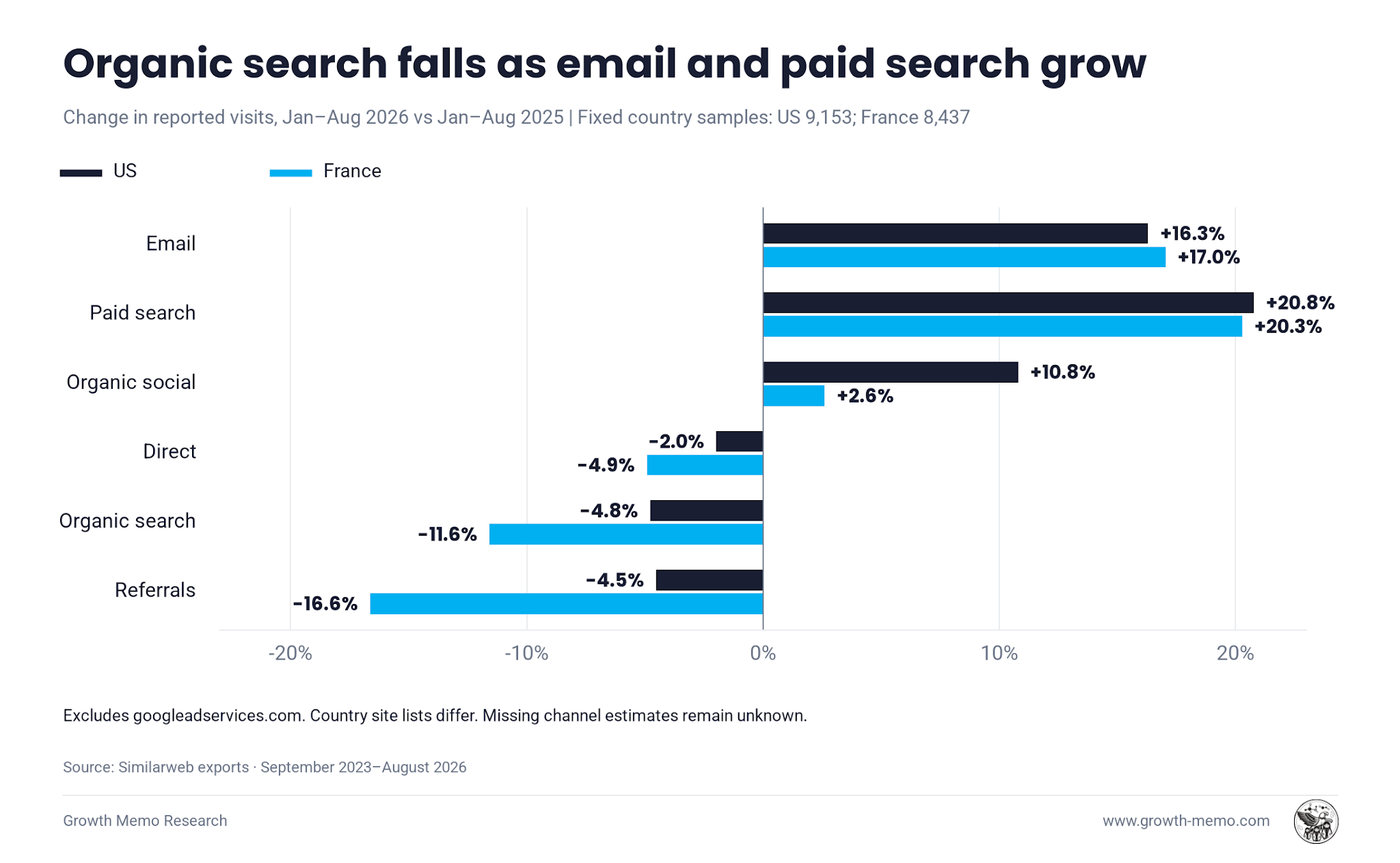
Caption: Same-period matching and strict nonmissing checks preserve these directions. Similarweb’s Email channel captures visits from webmail services like Gmail and Outlook on the web. Data excludes googleadservices.com.
But there’s a wrinkle in the data. One domain has an outsized effect on the paid-search numbers: googleadservices.com. It’s part of Google’s advertising infrastructure. When someone clicks an ad, a Google ad-services URL can help route or measure that interaction on the way to the advertiser’s site.
Similarweb estimates visits to that domain, but it isn’t a conventional website trying to attract customers. I excluded it from the charts above because I want to understand how traffic to websites is changing.
That choice matters. When I include the domain, paid-search growth falls from 20.8% to 13.5% in the US and from 20.3% to 10.7% in France. Similarweb’s estimated paid-search visits to the domain fell sharply, but we don’t know whether the drop reflects a change in ad activity, routing, measurement or some combination.
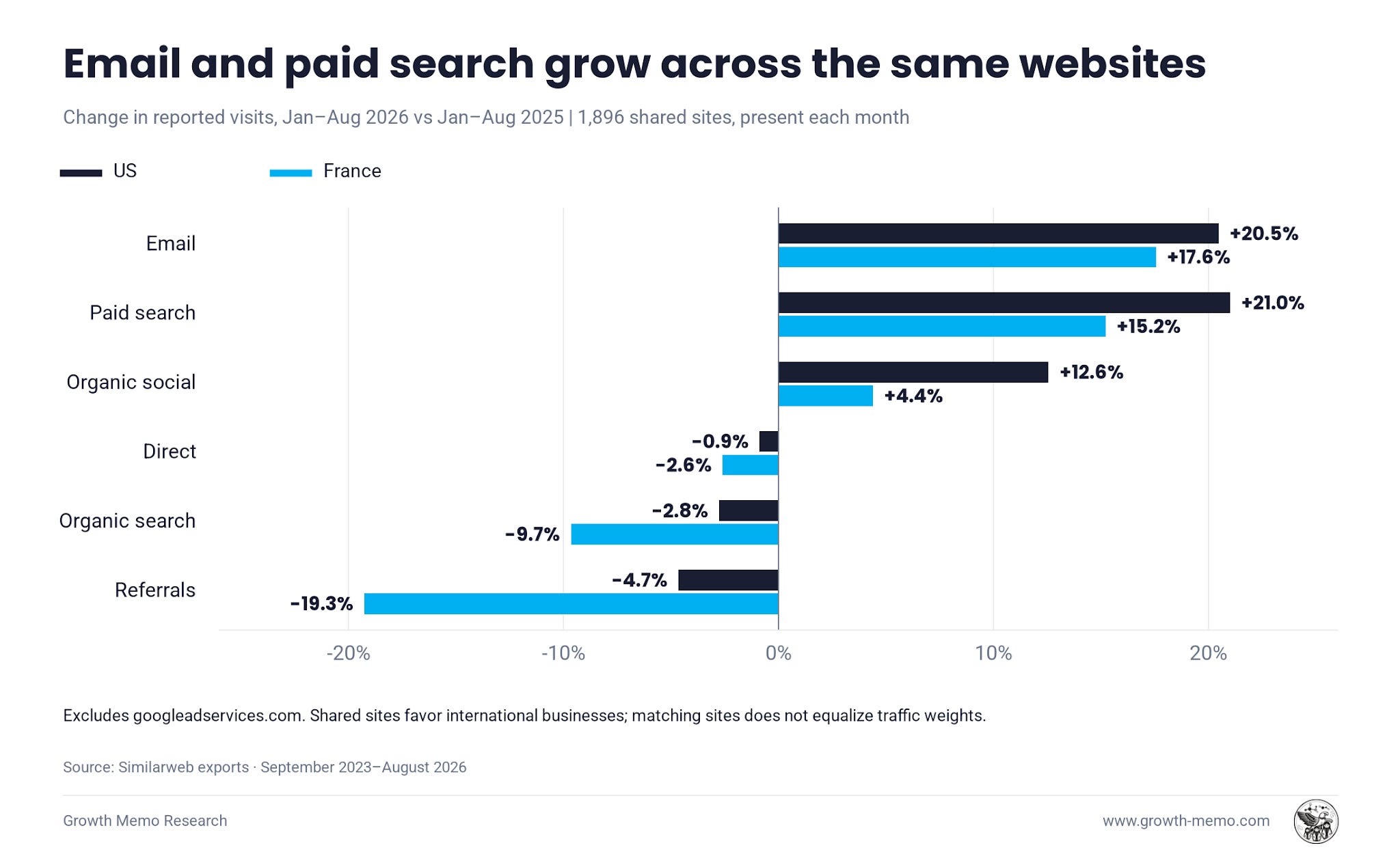
To see whether the pattern holds across the same websites, I narrowed the sample to 1,896 domains present in both countries, excluding googleadservices.com. Paid search grows 21.0% in the US and 15.2% in France; email grows 20.5% and 17.6%. With the domain included, the shared sample contains 1,897 sites and paid-search growth is 2.1% in the US and -7.3% in France.
The aggregate numbers don’t tell every site’s story. Back in the larger country-specific samples, the median site grew email traffic by 14.7% in the US and 17.7% in France. But the median US site grew paid-search traffic even faster: 17.4%. Main takeaway: Email’s growth extends beyond a few giant sites.
Some of the email traffic could come from functional emails like order confirmations or notifications. (And, those are obviously traffic gains that don’t tell us which channel produced more customers or profit.) But overall, I see email as severely underrated and a prime audience-building channel.
I’ve been pushing brands to build audiences on owned land, aka email, because no other asset is that portable and unfiltered than someone’s email address. Not even phone numbers, since most people don’t like to be called by sales reps. Most companies don’t do a good job at nurturing and engaging potential buyers via email, but it’s the least volatile acquisition and retention channel there is.
This memo examines the data when organic slows. Deciding what to do with the budget is a different job. The Annual SEO/AEO Planning Workbook walks your team through 8 decisions, from replacing the traffic target to pitching the plan as risk management, and ends with a 1-page plan. Premium subscribers have it in the library.
Why I’m bullish on direct
Direct traffic is by far the largest traffic channel: 43.5% in the US and 39% in France when we give every site equal weight and look at the median.
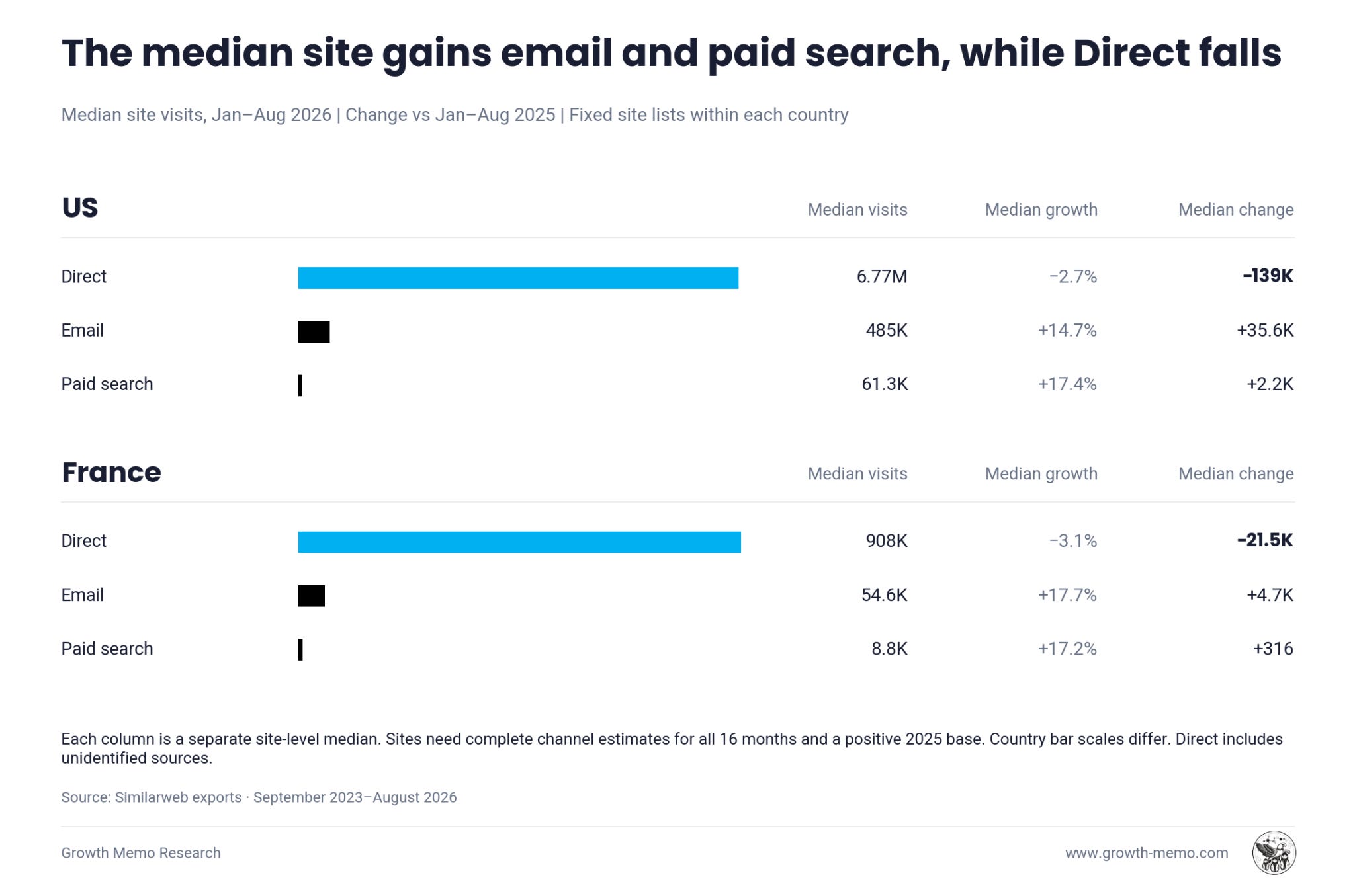
2 downsides to Direct: It’s shrinking (-2.7% US, -3.1% France YoY between January and August) and it’s a kitchen sink, including everything from dark social to non-referral advertising and word of mouth. That makes it hard to optimize, though not impossible.
But Direct has held up better than organic search. From August 2024 to August 2026, combined Direct visits fell 3.4% in the US and 5.3% in France, while organic visits fell 13.2% and 23.4% across the same respective sites. (This comparison uses a fixed set of sites with complete estimates for both channels. Sites with any missing months were left out, so both lines compare the same sites over time.)
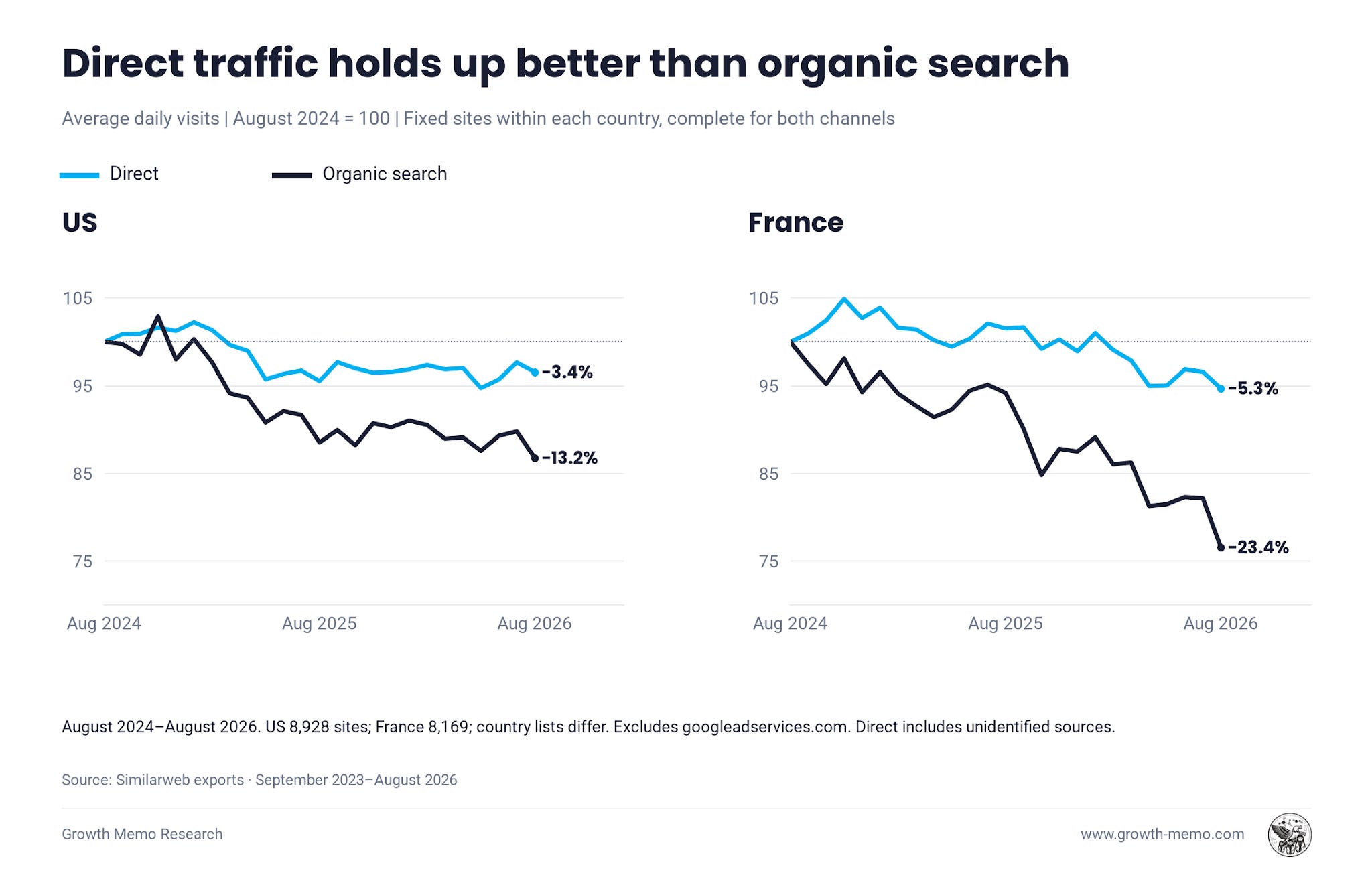
In part 1, I found a split by website size: The median small site’s organic traffic was roughly flat, while the median large site lost 17.6% in the US and 26.0% in France. Direct shows a similar divide. The median small site gained 14.4% in the US and 21.2% in France, while the median large site lost 13.0% and 7.1%. The Direct comparison uses a slightly smaller sample with complete estimates for both channels.
News and information sites show a different side of Direct. Between August 2024 and August 2026, their combined Direct visits fell 30.7% in the US and 4.0% in France. The median French news site fell 20.6%, so the pooled result masks a much larger decline for the typical site. Separately, sites provisionally classified as editorial publishers across topics lost 34.4% in the US and 18.7% in France in combined Direct visits.
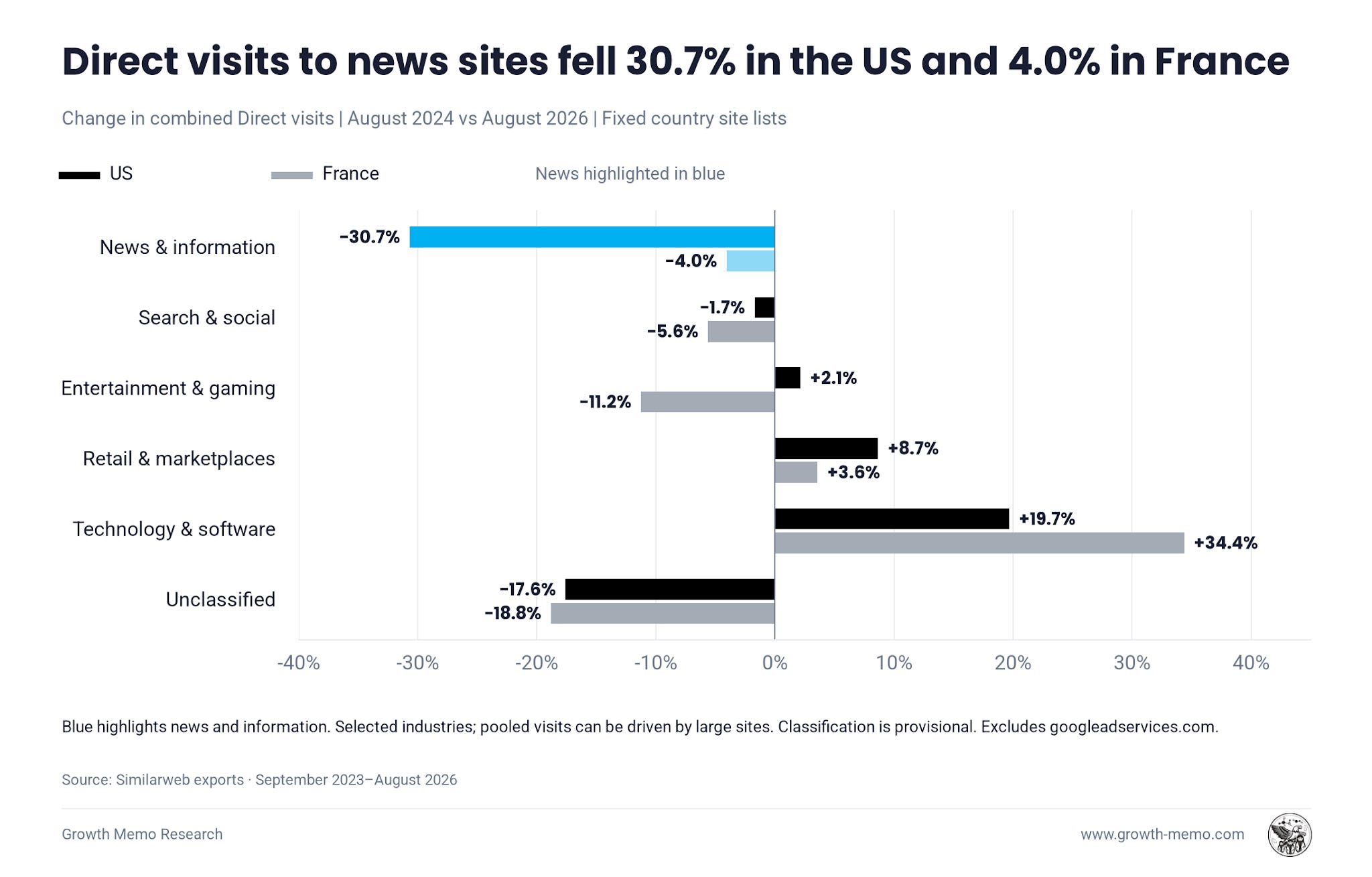
That raises a question about publisher brands. Weaker demand for those brands could be one explanation, but Direct also includes visits with unrecognized sources. The data can’t tell us how much of the decline comes from brand strength, changing habits, attribution, or domain changes.
Changes in attribution can also affect Direct traffic. When OpenAI shipped GPT-6 in early October, links stopped carrying a referrer or UTM tag for about a week. Adobe’s Cedric Huesler measured roughly 31,000 fewer daily ChatGPT visits and 26,000 more daily Direct visits across 500 pages. It was a bug instead of a change in user behavior, but some of that affected direct traffic.
I’m bullish on Direct because a visit from someone who remembers your brand and types in your URL doesn’t pay a search-ad click fee. That doesn’t make it free: Building that familiarity takes investment. It’s love at second sight. When other channels deteriorate, Direct starts to look a little nicer.
Sure, yes, Direct is a messy bucket that includes unidentifiable visits. Still, it’s worth understanding what brings people back on their own and what they do when they arrive.
The first step is to find out what Direct visitors want. Split homepage entrances by the next page people visit: product, pricing, login, support, or content. Then make the most common destinations easier to reach. A returning customer looking for an account shouldn’t have to navigate the same “start an account” page as a first-time buyer.
Rising Direct share might not be the simple success metric you hoped for, BUT The Brand-SEO Scorecard can help. It measures your gap to brand-led outcomes across topical authority, ICP alignment, third-party validation, and positioning clarity, so the brand conversation runs on more than one channel label. Find it in the Premium Subscribers Resource Library.
Industries grow through different channels
Some sites are growing Direct traffic even as the typical site declines. Brave, TikTok, Pinterest, and Canva all grew Direct visits in both markets. Claude.ai grew much faster from a smaller base. These are selected examples, not a ranking of the fastest-growing sites.
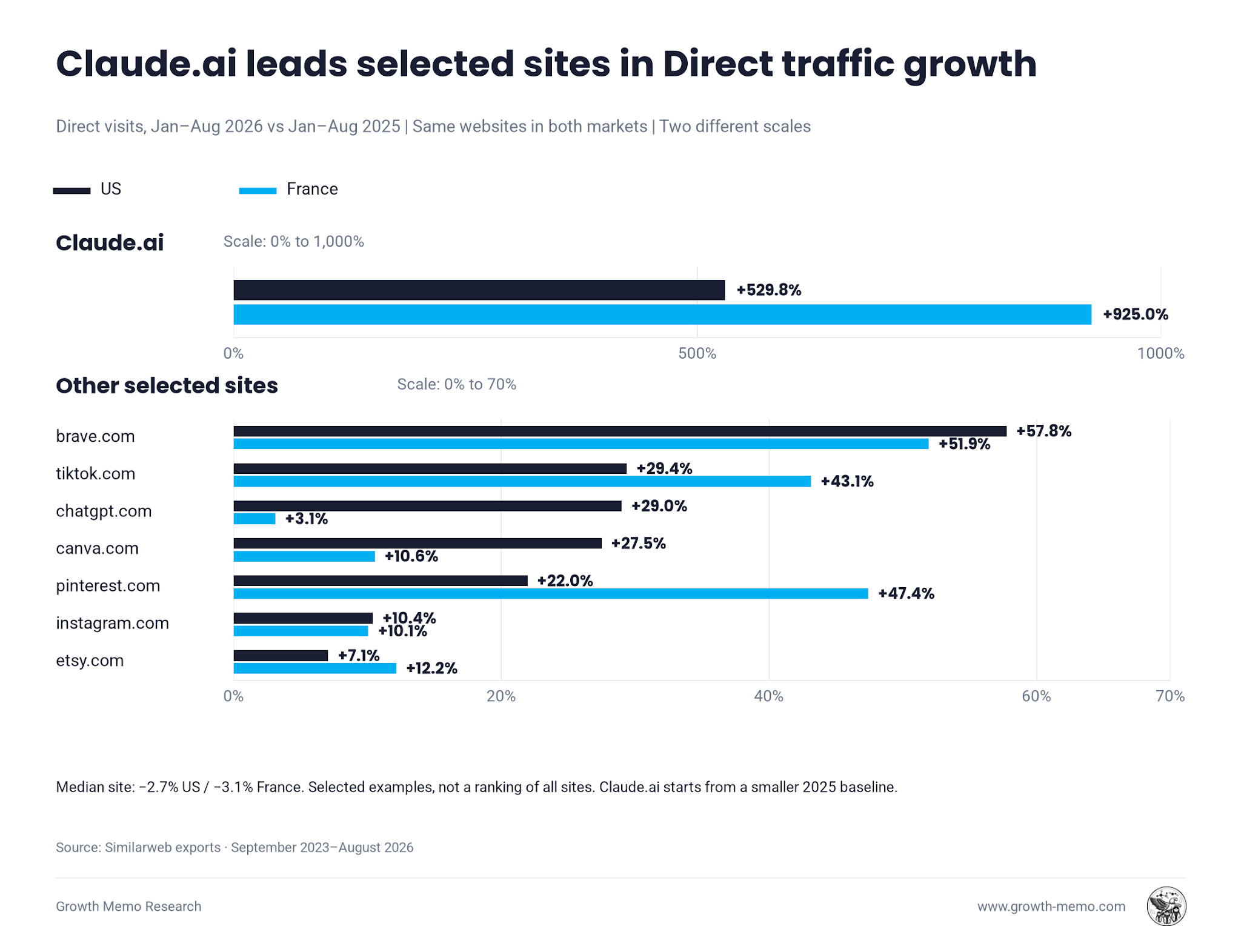
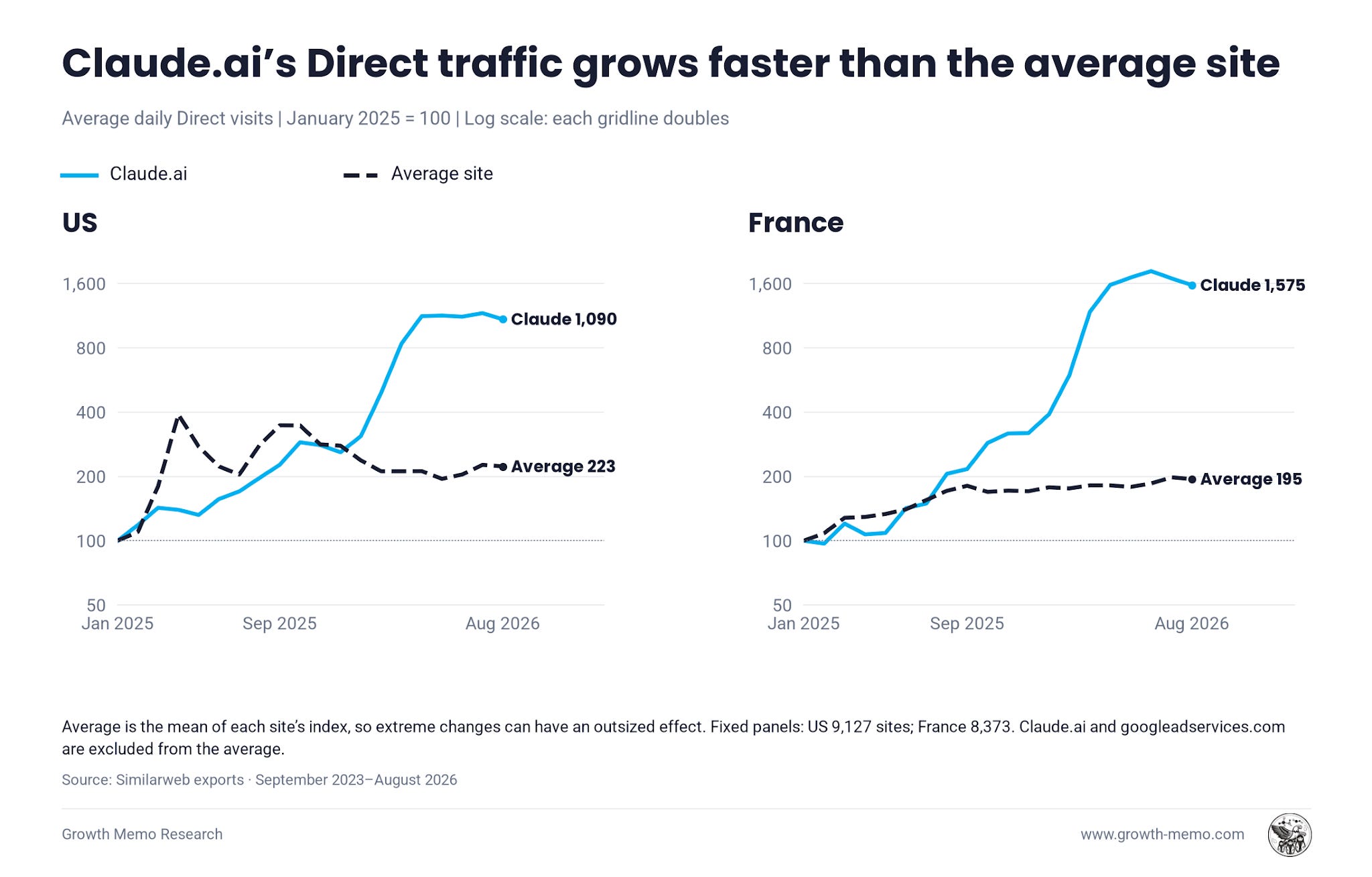
Claude’s growth also outpaces the average across the larger sample. From January 2025 to August 2026, its average daily Direct visits grew 990.0% in the US and 1,474.7% in France, versus average site-level gains of 123.0% and 94.5%. The average gives each site equal weight and is pulled up by extreme gains; the median site declined 9.3% and 14.2% over the same period.
The industry matrices show how the channel mix changes across a wider set of sites. In the US, retail and marketplace sites gained 26.6% in email visits and 24.9% in paid search, while organic grew 7.0%. News and information sites lost 15.1% in organic and 13.6% in Direct, while paid search grew 29.8%.
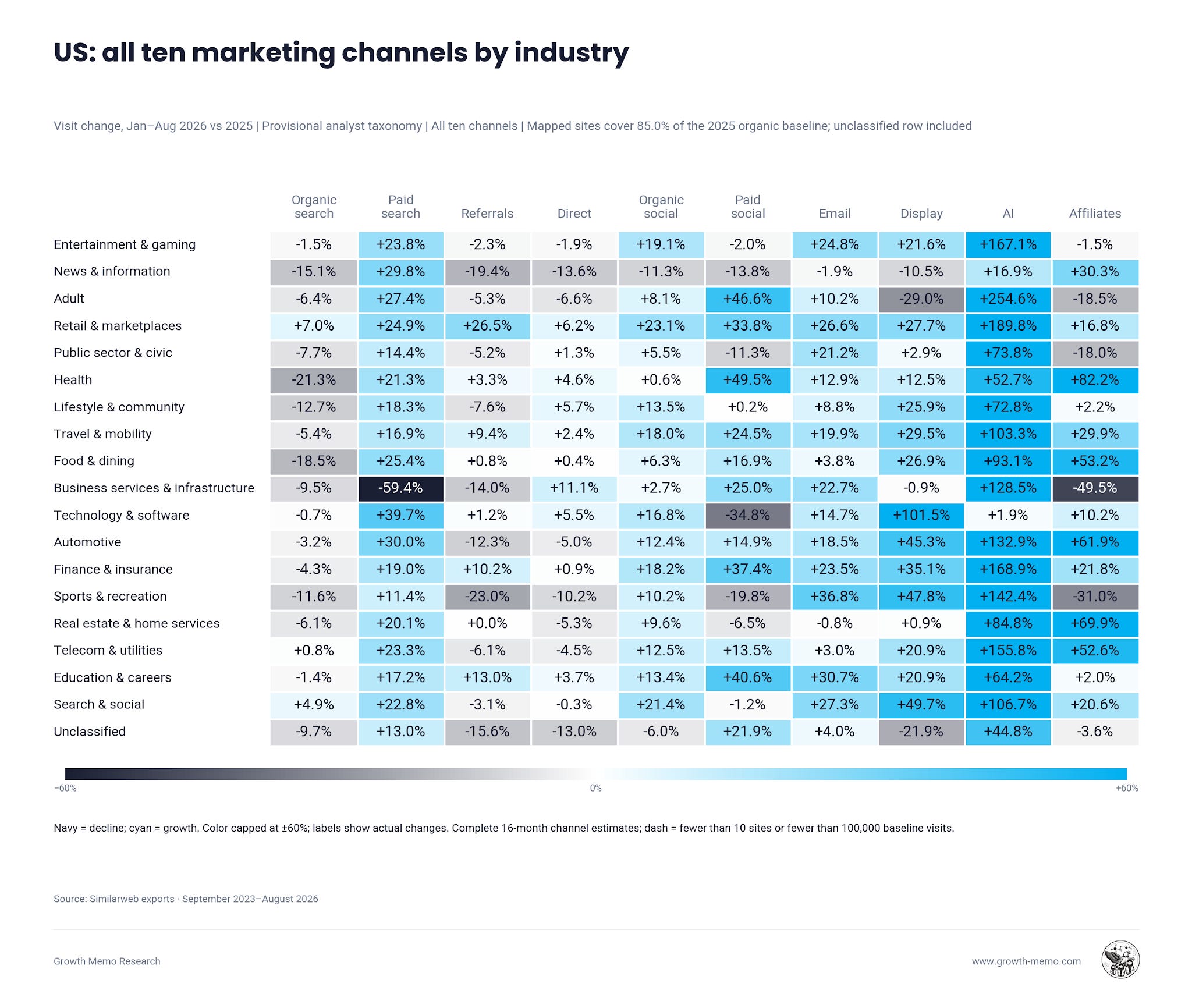
Caption: They compare January–August 2026 with the same months in 2025. Each channel has its own complete-estimate sample, and these matrices include googleadservices.com, unlike the preceding Direct charts.
In France, retail and marketplace sites gained 20.7% in email and 14.5% in paid search, while organic fell 10.7%. The mix is different even within the same industry.
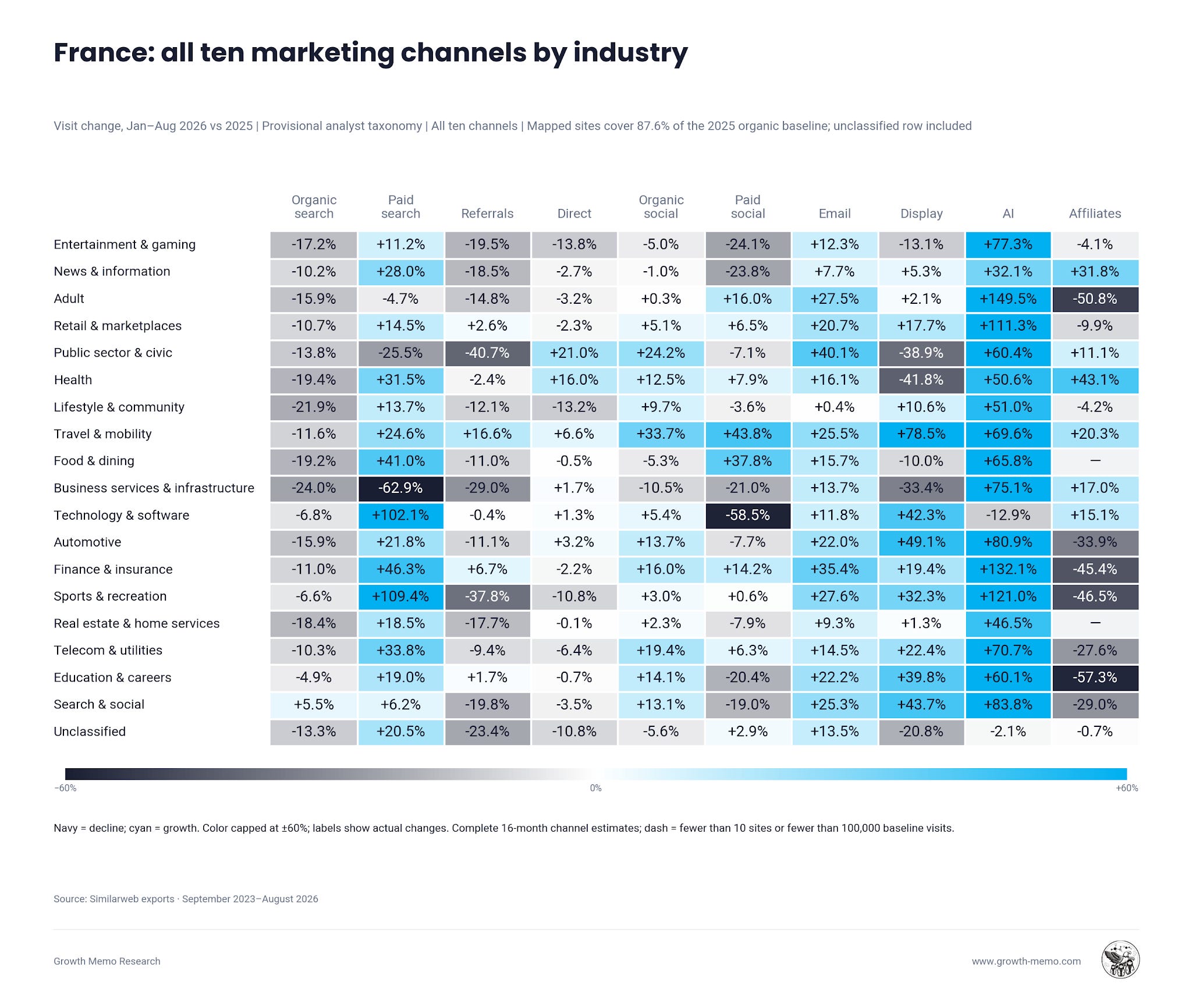
Channel growth differs even within the same industry. One reason could be that the US and French samples contain different websites, and a few large sites can move each country’s result. Consumer behavior, competition, and regulation could also play a role, but this data can’t tell us how much each explains. And traffic growth alone doesn’t tell us what a channel costs or whether it creates customers.
The US and France aren’t the only markets where visibility looks different. This Memo’s sponsor, Semrush’s AI Visibility Index, finds that the brands and sources shaping decisions in AI differ between the US and UK, too.
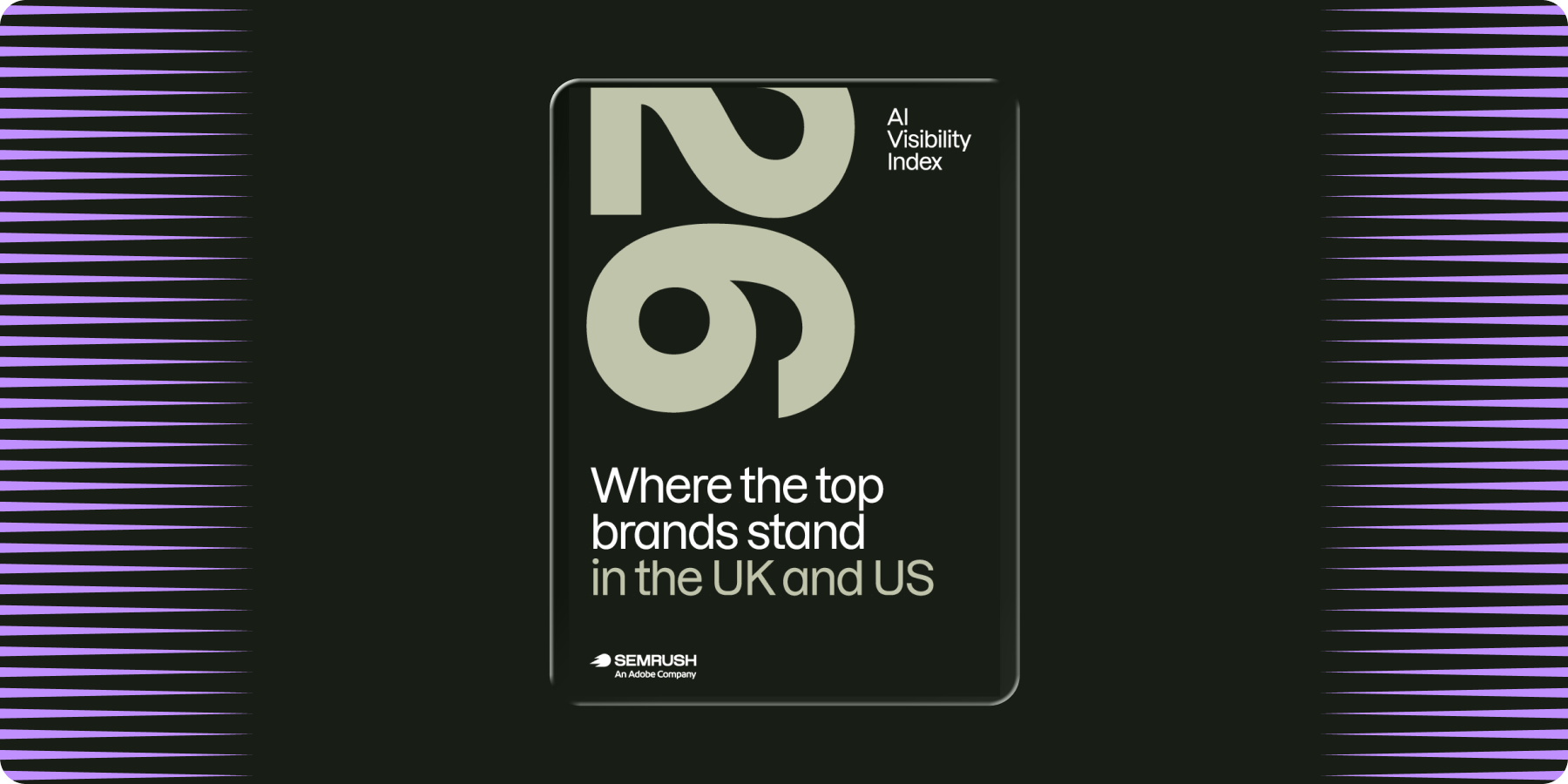
Its latest study draws on seven months of data across 22 industries and four platforms, with a blueprint for building consistent visibility across markets.
The next phase of growth
My goal with this short series is 2-fold: First, I want to show how nuanced the loss of organic traffic is and that we have some degree of agency. Second, while I strongly advise not to confuse traffic with value - as in the case of AI (Search) - it is symbolic of the change in growth marketing.
SEO, before AI, was so scalable that companies built their foundations on it. I don’t think that’s possible with AI because the experience is so much less unified for every user. I do think, though, that growth teams should pay more attention to email and direct.
Essentially, I’m talking about audience building. As a Growth or Marketing team, you should ask yourself the question: How can we get users in the habit of visiting us directly, and how can we provide unique and exciting content through channels like email to get them engaged?
Email gives brands a reason to build an audience they can reach again. Direct gives them a reason to make returning worthwhile. Paid search gives them a way to capture demand, as long as the cost makes sense.