


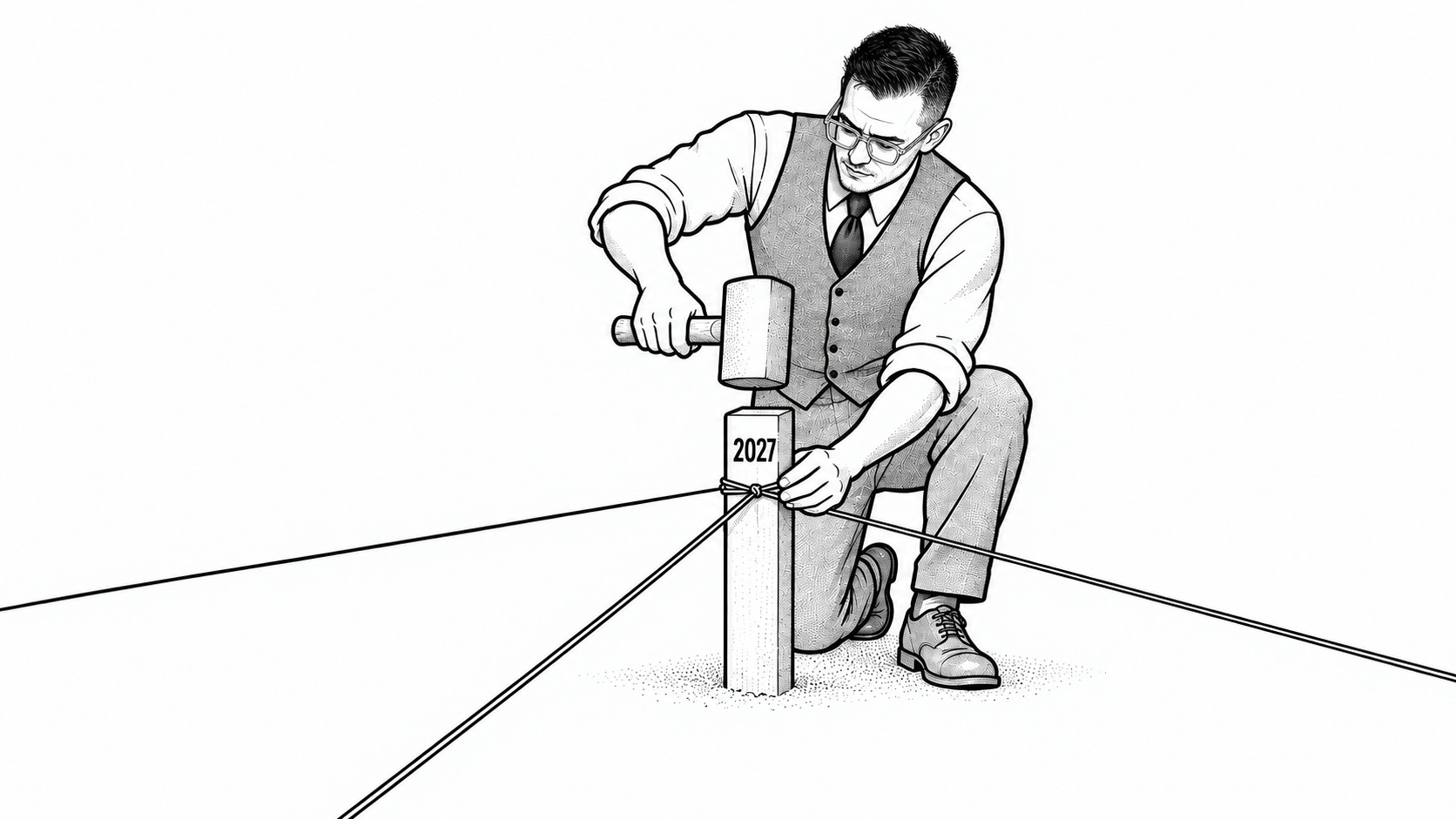
It’s planning season! And like every year, most execs start by setting a traffic target that breaks down into revenue. But depending on what industry they work in, that doesn’t make sense anymore for most brands.
Last November, we wrote that SEO budgets buy capacity and that click-based ROI had decayed. A week later, we argued that leadership buys controlled learning when certainty is off the table. Both couldn’t be more relevant today.
So what changed for your 2027 planning? How much of the work now happens where no click, cookie, or referral can see it?
Plan 2027 around the signals that happen before the visit… or despite it.
1/ What you need to change for 2027 planning
The November 2025 memo made 2 calls: Most SEO costs are fixed (salaries, tools, infrastructure), so the budget question is which capabilities to fund. And the split should come from scenarios instead of last year’s traffic. For example, 40% of capacity goes to digital PR, 30% to technical SEO, 20% to content operations, and 10% to research, adjusted by priority and weak spots. We also advised pitching tests and experiments that were well planned, had firm boundaries, and kill switches if they weren’t producing results.
Keeping all that in mind, 3 things have moved since then:
Zero-click searches rose from 60.45% of US Google searches in 2024 to 68.01% in early 2026, per SparkToro and Similarweb data. Roughly 2 in 3 searches now end without a visit, so a traffic baseline is doomed to shrink and undercount visibility before 2027 even starts.
AI tools moved into marketing teams as unbudgeted build time. Part 1 of the AI marketing automation series argues those hours often come straight out of brand work.
Attribution broke past the point of repair. Graphite estimates AI can be underattributed by 10x. Yikes. That means a plan developed on what can be cleanly attributed will cut resources from the channels that work.
2/ The visit isn’t where your planning should start
A buyer can read an AI answer, scan a Reddit thread, and see a peer’s LinkedIn post about your product before visiting your site once. In years past, planning for organic visibility treated the visit as the first measurable moment—or the ideal one. In 2027, most of the influence will land earlier.
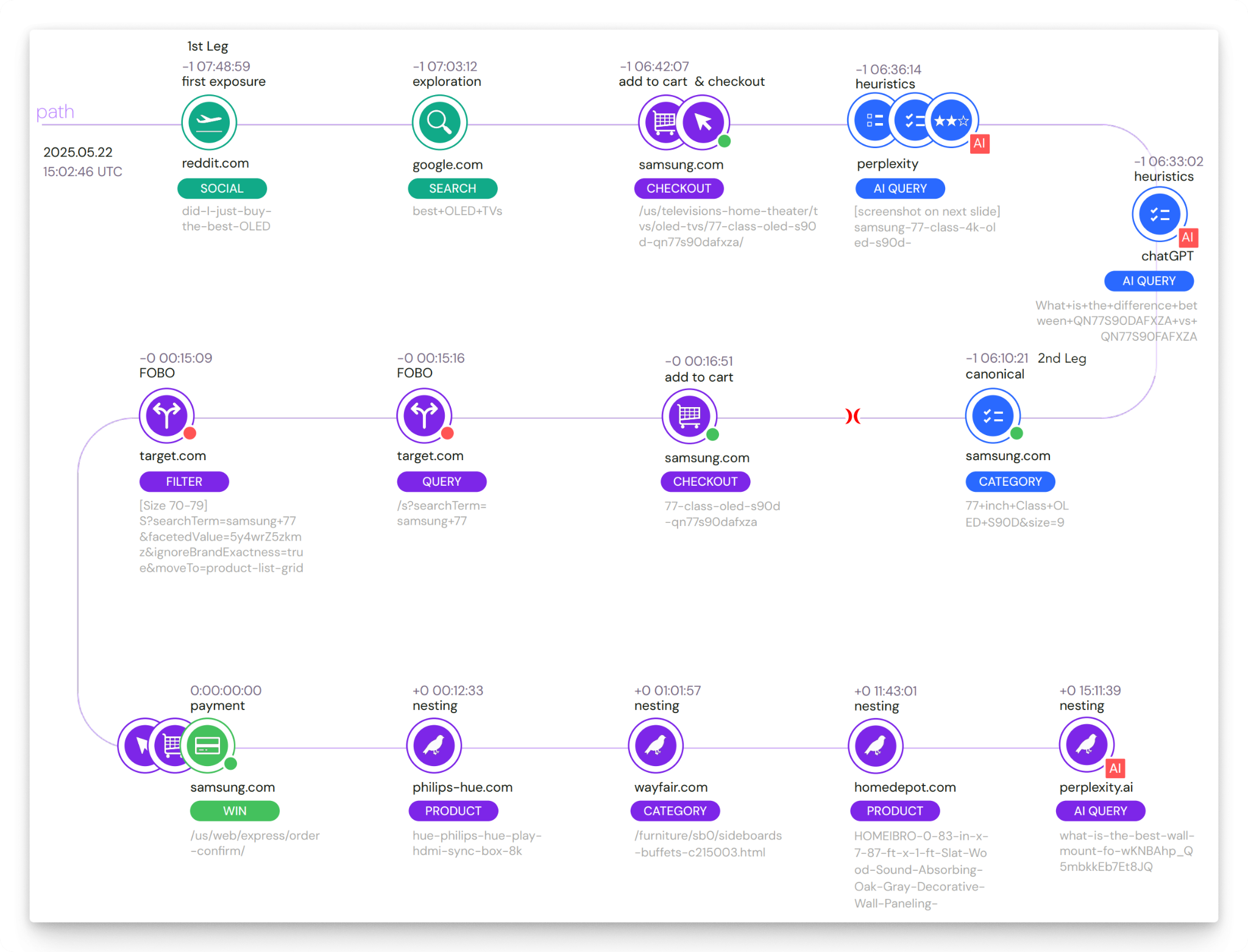
Look at this search journey for buying a Samsung TV, measured in Semrush, for example.
Or this one, of a user buying a foundation from Sephora.
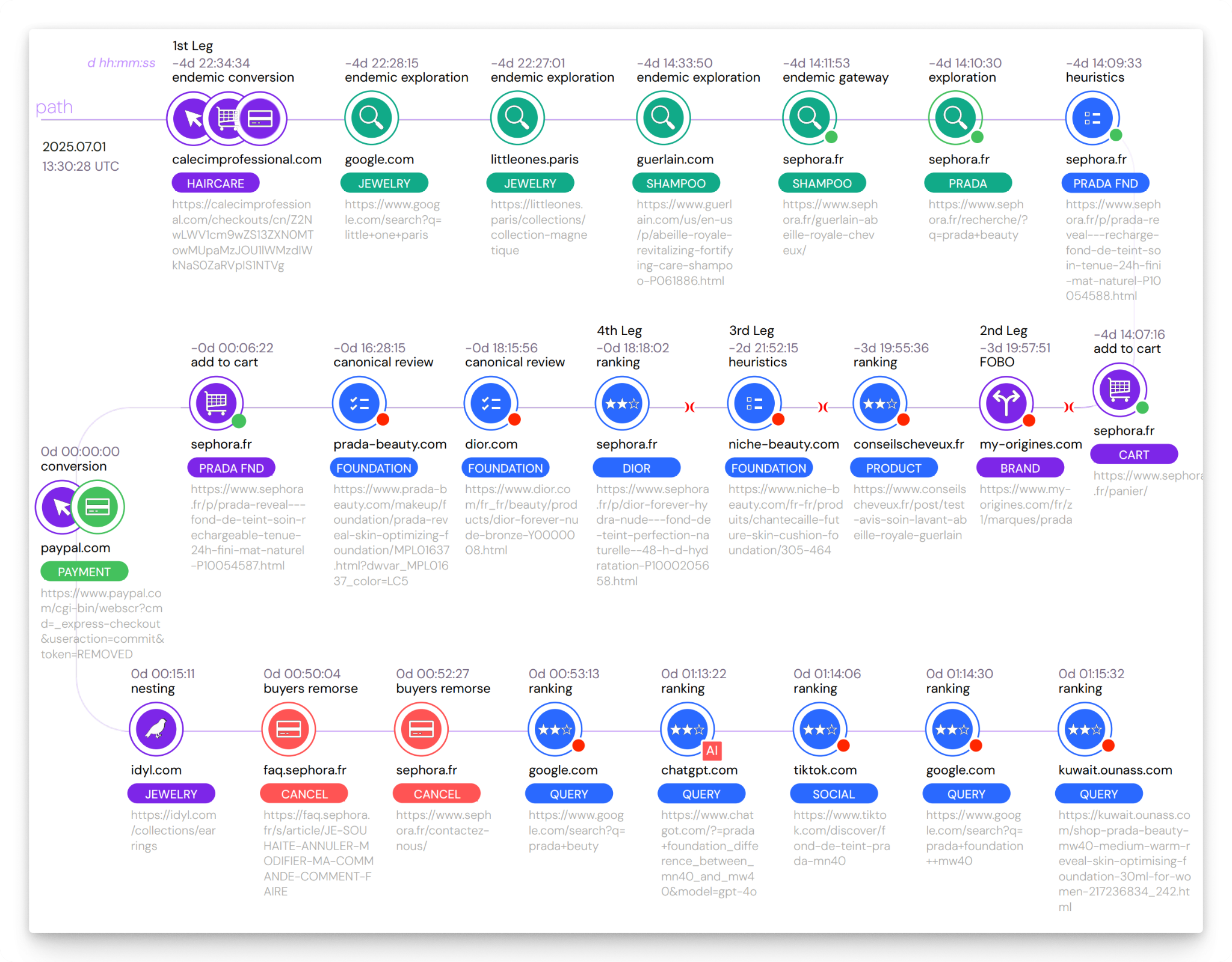
Disjointed. Messy. The Messy Middle!
And so far in 2026, only about 1/3 of searches produce any kind of click, according to Sparktoro. But the visits are still happening; they might just show up in the wrong column.
SparkToro and Similarweb tracked clickstream behavior for 7 days after AI recommended Capital One: Direct visits to those brands rose, while search visits ran about 15% lower, and the lift reached 14.2%. (So your dashboard that reads direct traffic as “unknown” or uncategorized is likely counting AI influence as noise.)
I chatted about this recently with my colleague and friend, Amanda Natividad, VP of Marketing at SparkToro and author of Zero Click Marketing, who puts the planning consequence plainly:
“If people are increasingly getting answers without clicking, then you need to plan for the signals that happen before, or instead of, the visit. That means prioritizing things like brand mentions, citations, discussions about your brand, and participation in the communities where your audience already hangs out.”
Those signals are spread thin across surfaces, with the AI citation/AI mention overlap between engines being minuscule: 91% of citations appear in only one of ChatGPT, Perplexity, or AI Overviews. So presence has to be planned surface by surface, much like social platforms.
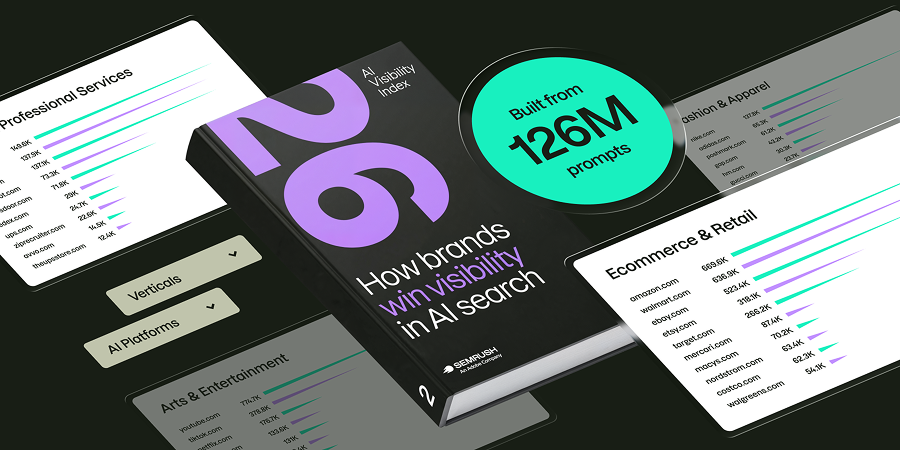
Before you allocate 2027 hours to PR, content, or community, check which brands AI recommends in your category and which sources it cites.
Semrush is sponsoring this week’s memo, and its free AI Visibility Index lets you compare thousands of brands across 22 industries and four AI platforms. Its flagship study draws on 126M+ real AI search prompts.
Use the source data to shortlist places where your team could earn mentions next year, and the accompanying free studies and playbooks to choose tactics to test. Bring that shortlist into your planning meeting: which sources deserve a person’s time, and how many hours can you commit?
3/ Off-site distribution and community time need their own budget line
This year, if you gave a hefty amount of your planning resources to digital PR, it makes sense: 2025 and 2026 analyses found that it’s crucial to AI visibility. In fact, AirOps found that third-party signals drive 85% of brand visibility in LLMs.
Natividad extends that line past earned third-party signals:
“Budget for creating and distributing content beyond your own website, and actually engage with those communities. Then focus on creating ideas worth talking about, that also get mentioned and cited by other credible sources, and showing up in the places where people are already having relevant conversations.”
Community participation is labor, and should be planned for accordingly. And a community or UGC line with no named owner is the first one cut when Q2 gets tight, so budget it as hours per week with a person attached.
“Ideas worth talking about,” as Amanda mentioned, is a research cost. In 2027, fund the proprietary data that gives other sources a reason to cite you, the core of the brand authority series. Community expenses can be folded into the same capacity line item as SEO because its cost is pretty much fixed. Spend 5% (maybe 10% in some cases) of your marketing budget on community. (There’s a slide deck in the premium library to help explain this concept of brand authority multiplication to your team.)
4/ No single metric proves influence, so measure the signals as a set
Natividad’s measurement advice starts where attribution stops:
“Measurement has to expand, too. Look at search and AI visibility, citations and mentions, but also platform signals like impressions, engagement, branded search, and eventually conversions. None of those metrics individually proves that you influenced someone. But together, they give you a much better picture of whether your brand is actually reaching people.”
Last week’s memo on the collapse of attribution called this triangulation:
Combine three signals with different blind spots: an exposure metric, a behavioral signal, and a business outcome. For AI visibility, that could mean Share of Voice, self-reported discovery or CRM tags, and conversions; confidence rises when they move together, while divergence tells you where to investigate.
Natividad’s own recommended list maps onto 3 layers:
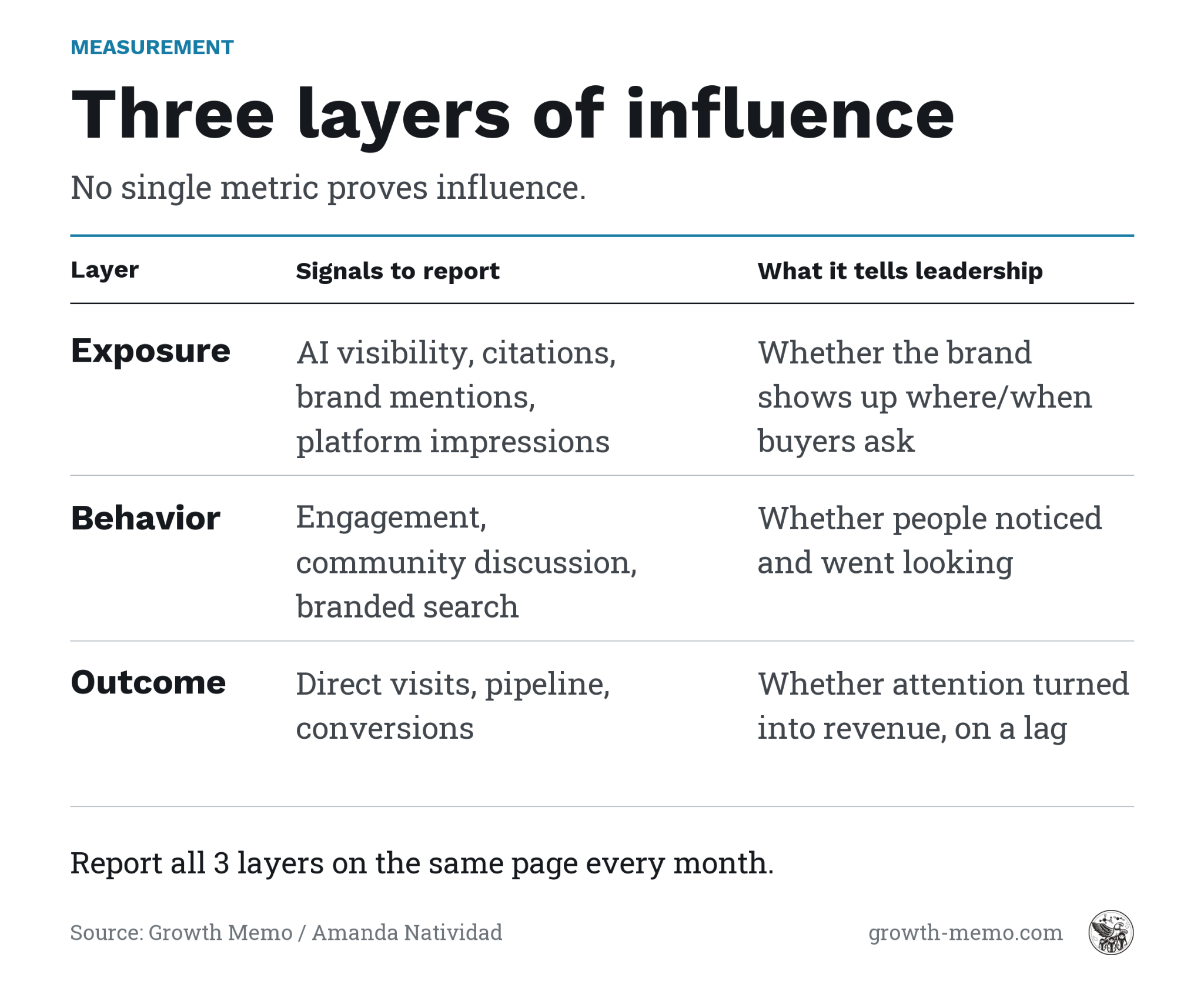
Report all 3 layers on the same page every month. A few examples:
Exposure up, but branded search flat. Mentions aren’t landing with buyers. A distribution problem: move content and participation into the communities and channels your audience uses.
Branded search up, pipeline flat. People went looking and didn’t convert. This is a conversion problem: Fix the pages they land on, the offer, or the handoff to sales.
Branded search up, direct visits up, AI citations flat. Something off-site is working (a podcast, an event, a partner, word of mouth) and AI hasn’t caught up. Find the source and fund more like it.
Exposure and branded search both down. Someone else is taking the mentions. This is a competitor problem: Audit who AI recommends in your category now and which sources it cites for them.
Each mix of the three layers points to a different fix.
“All of these systems are trying to understand and reflect human behavior,” Natividad shared with me. “Mentions, citations, discussions, engagement, and recommendations are all proxies for real people paying attention.”
And that’s what you need to communicate to the c-suite.
5/ Sell 2027 as a “planned portfolio” with kill dates.
Set your 2027 organic targets as presence on surfaces where your audience is and your potential buyers are researching. Develop goals to build:
1/ Visibility with AI engines your customers actually use
2/ Authority with online communities and publications where your category gets discussed, and
3/ Organic branded search volume.
Last year, we were all working to sell experiments to our leadership teams. Your 2027 plan, however, needs 3 separate “buckets” of work that you’re resourcing, each with its own rules:
Proven work, funded at full capacity: The tactics (born out of 2026’s learnings) that are providing you competitive growth in your vertical, along with technical SEO, content refreshes, and the digital PR that already earns citations.
Learning work, capped with one owner and a kill date: AI marketing team automation pilots and new search surfaces you haven’t tested.
Unmeasurable bets, funded on judgment: community, events, and brand work tests. Ramp’s George Bonaci said in last week’s memo that attribution alone “would have led us to cancel all brand marketing, stunts, direct mail, events.”
Current search volatility argues for shorter commitments, so lock the annual budgeting total you can work from, and re-split the buckets every quarter against the 3-layer measurement set. The Growth Memo premium library has the SEO budget planning tool to help you build the case.
I would recommend quarterly re-forecasting, and many of the CMOs that I work with are comfortable with this regular reevaluation of resourcing. Ultimately, your team needs the freedom to adapt as things move before the next biannual or annual budget planning.
Directors who walk into 2027 planning without a defensible AI SEO investment case will lose budget to paid. But you don’t have to.