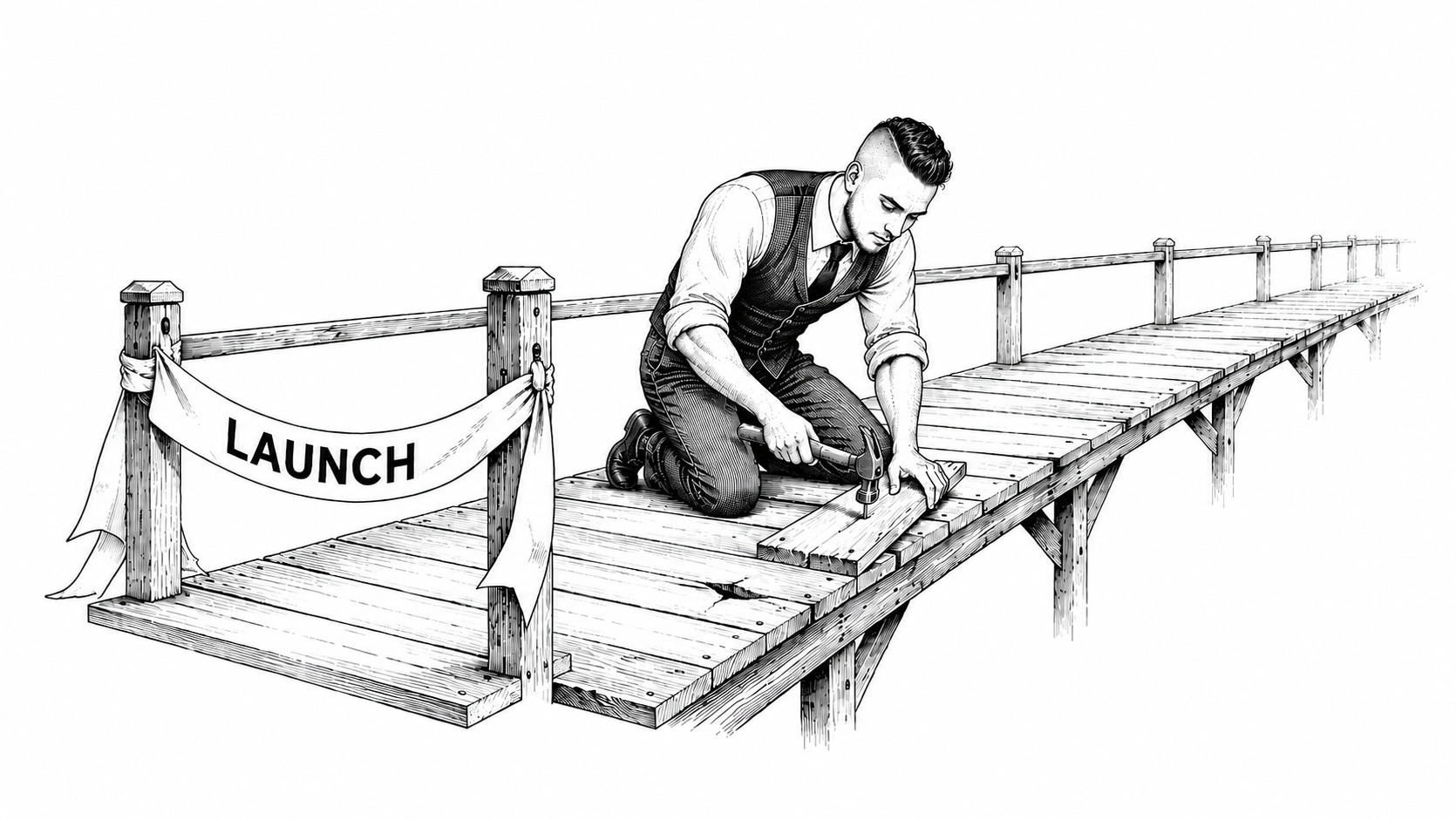
Your marketing team has never spent more hours working in, on, and with AI. I (Kevin) think every marketer, especially every SEO, has this backlog of tools or shortcuts that they always wanted to build, unrestricted by engineering. But in the process, we end up building things that we could often pay (little money) for.
I’m pro AI use (that’s pretty clear if you’ve been reading for some time), and I’ve seen the positive impact of vibe coding and AI automation. But efficiency isn’t automatic. It comes from asking “when”, “what” and “why”.
In late 2025, METR ran 16 experienced developers through 246 real tasks, half with AI tools and half without.
The developers expected AI to make them 24% faster. It made them 19% slower. Even after seeing their completion times, they still believed AI had made them about 20% faster.
That gap is the AI productivity paradox. AI can make work feel faster while moving effort into prompting, waiting, checking, correcting, and maintaining the system. (The METR study above has since rerun the study in 2026 with higher productivity but admittedly skewed results.)
Marketing teams are especially exposed because they’re building their own workflows. Every hour spent maintaining an internal tool is an hour not spent publishing, earning mentions, or strengthening the brand that search engines and AI systems recommend.
This new “homebrew AI work” doesn’t have the visibility of “real work,” so it’s often unaccounted for and the true cost is unanticipated. It’s “meta” work: working on how to get work done.
That cost is paid from somewhere, and organic visibility work often pays the bill.
AI removed moved the work
HubSpot reports 91% of marketing leaders say their teams use AI, and 66% say their company builds its own internal AI tools for marketing. Many of those projects don’t appear in your team’s marketing plan or project management tool.
Simply asking your marketing team whether internal AI tools are saving them time won’t actually tell you whether or not it’s doing so. Just like the 2025 METR study, they will say yes, they will mean it, and they’ll probably be wrong.
Growth marketers and organic search strategists are among the earliest adopters of AI tooling and workflows, because (1) understanding the technology is now a part of earning visibility inside it and (2) because LLMs are literally built on language, which is central to organic search and marketing overall.
The time it takes to learn, pressure test, and examine the technology is a requirement of the job now. It is also real new work stacked on top of the old work, and the old work didn’t shrink.
This past year I have watched internal teams build custom AI workflows and tools, on top of the ones they already pay vendors for.
Building your own in-house AI tools is addition, not necessarily efficiency. While it feels like instant productivity, with a rush of extra dopamine on the side, it also involves maintenance over time.
AI doesn’t delete work, but instead removes work from doing the task to building, learning, and maintaining the thing that does the task. That time investment shows up on no dashboard, and the bill for those hours? Often paid for by the work that has a longer lead time before it hits a strong ROI (like earning more organic AI mentions).
Your team isn’t an outlier when it comes to these hurdles, and the frustration surfaces when stakeholders ask why the AI tooling hasn’t paid off yet in scaled content production.
The AI work itself is a new production line item.
When 4 people working on the same marketing team each believe something different is happening, the fix is intentional communication. The AI SEO Change Management Plan is a 45-day implementation checklist plus a team education deck. Premium subscribers get both.
One person’s shortcut becomes someone else’s time suck
Your growth and organic search team’s new work is paid for out of the old work. The hours often come out of content production, digital PR, community and UGC presence, and third-party review campaigns.
BetterUp Labs and Stanford surveyed 1,150 full-time US workers about what they call workslop: AI output that looks “finished” and isn’t.
41% got workslop in the previous month. Each time, it took an average of 1 hour and 56 minutes to sort out. At a 10,000-person company that runs past $9M a year.
The sender saved 20 minutes. Someone else spent 2 hours sifting through what was sent. On a dashboard that counts output, the sender looks great, like they saved time. The time savings were eaten elsewhere.
Workday’s study puts a number on the rework: for every 10 hours AI saves, companies hand back about 4 in fixing and rewriting weak output. An Upwork survey of 2,500 leaders and workers reported the itemized version: Among employees who use AI and say it added to their workload, 39% point to time spent checking and fixing AI output, 23% to learning the tools, and 21% to just being handed more work.
Before your team builds it, check whether the answer is already in the premium library. 45+ checklists, light tools, AI workflows, and stakeholder decks.
When marketing attention gets pulled, the work with a slower ROI or murkier attribution is what gives to the meta work of homebrew AI or wading through workslop. The unsexy, unglamorous work that multiplies brand authority is often the production flexible enough to steal time from, because it’s a longer-term play for customers. Things like:
Publishing enough depth on a topic that you become the obvious source
Earning mentions on the sites AI answers actually pull from
Showing up in the Reddit and YouTube threads your buyers read
None of that work produces a quickly visible result or an easily attributable lead, sometimes for weeks or months after the work is initiated. (Even though some of the tasks can be automated with AI.)
If you want to see what that compounding work looks like in practice, this Memo’s sponsor Semrush shows which brands are winning and the strategies behind their visibility latest in the AI Visibility Index.
Semrush has published its biggest AI visibility study yet, covering seven months of data alongside free playbooks and studies that unpack the trends and tactics behind the winners.
The analysis draws from:
126M+ real AI search prompts
22 industries
4 AI platforms
Thousands of brands
See who made the leaderboards, why they’re on top, and what you can borrow from their strategy.
That opportunity cost may be one reason teams resist adopting custom AI workflows.
Every AI workflow becomes software to manage
A workflow works on the day you finish it. All the time spent in meetings, AI engineering, and team (ie, user) interviews exists as work even prior to having the usable workflow.
Then, on the first day it’s used by your team, it immediately starts to degrade.
Then the model version changes, or someone surfaces an issue or hurdle that appeared when using it. The tool it plugs into ships an update, and the thing stops working on a Tuesday, and it throws a wrench in the rest of the week. (In Part 2, we’ll discuss how to avoid some of this.)
From a practical perspective, every single workflow your team builds creates a small permanent job to maintain. Those jobs accumulate over time.
What your executives think is happening: You’re using AI to build more efficient workflows and save time and money.
What your individual contributors think is happening: AI doesn’t work right. Every output they receive needs deep revision or a workflow or project doc needs regular updating and tweaking to solve.
What your strategists think is happening: Tons of time spent on workflows, not enough resources to invest in growing and repairing brand visibility in organic search.
What is really happening: The team is building tools to make the brand work faster, and the brand work is often moved to the back burner. The tools and workflows will get finished (or tossed/replaced) eventually. The 9 months of citations, mentions, and reviews that were not earned this year cannot be backdated.
The job must have an owner, and the owner often is whoever built it (which isn’t always the right person long-term). The owner is the only one who knows what it does when it breaks, so when they take PTO, the task reverts to manual until they’re back.
None of that maintenance shows up anywhere over time on your marketing team (unless you hire a position for this responsibility alone, like a content engineer or marketing engineer), same as the build.
This isn’t an argument against building. I (Kevin) am building and testing new things for myself and my clients continuously, and building is essential.
But this has shown me that homebrew AI is still uneven. It genuinely collapses some tasks and quietly makes others much slower, and the 2 look identical from the distance of your leadership board (until somebody has spent 3 weeks on building and fixing something).
For smart marketing leaders, the skill worth developing right now is being able to clearly name and defend:
1/ When an AI workflow or automation makes sense for your team, and when it doesn’t and
2/ When AI work experimentation is increasing efficiency vs draining time from the real brand-building, lead-generating work.
Don’t reinvent the wheel. I (Kevin) made this mistake at Shopify when I was leading a small army of engineers: I spent way too much of their capacity building tools from scratch that we could buy, which prevented us from building more impactful work. Skip doing this to your growth team.
If you’re trying to work out which AI projects are worth the hours, this month we’re releasing tools and frameworks to help you guide these conversations and decisions with stakeholders in the premium resource library. Keep an eye out.
Next in Part 2: which of this work to buy, which to hand to someone who has already built it, and how to build and manage the right kind of AI work that is left.