


Welcome to another Growth Intelligence Brief, where organic growth leaders discover what matters - getting insights into the bigger picture and guidance on how to stay ahead of the competition.
Today’s Growth Intelligence Brief went out to 567 (+33) marketing leaders.
As a free subscriber, you’re getting the first big story. Premium subscribers get the whole brief.
This week, we’re looking at the infrastructure of the Agentic Web and the inversion of traditional internet economics. We’ll cover:
Cloudflare’s “Markdown for Agents”: How the barrier to entry for agent readability just dropped to near zero.
Contentsquare’s 2026 Benchmark: Why the traditional growth playbook of traffic and conversions is breaking.
WebMCP: How standardizing agent actions is turning technical SEO into tool optimization.
The SEO/AEO Landscape: New AI prompt data in the SSI and the impact of the recent Gemini 3 update.
I’ll also connect the dots on what this all means for you.
Cloudflare just made every website agent-ready by default
Here’s what happened:
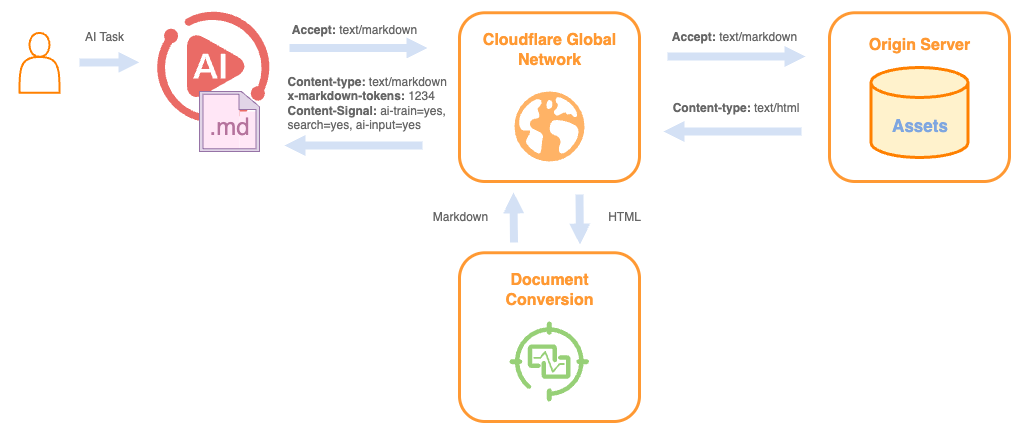
Cloudflare launched “Markdown for Agents,” a feature that automatically converts HTML pages into clean Markdown when an AI agent requests it. Any website using Cloudflare can enable this at the network level, no code changes required.
When an AI system sends a request with a text/Markdown content negotiation header, Cloudflare’s edge network converts the HTML response to Markdown on the fly. Markdown burns fewer tokens than raw HTML, which means agents can consume more of your content within their context windows and process it faster.
Why this news matters:
This is infrastructure-level plumbing for the agentic web, and it matters because Cloudflare powers roughly 20% of all websites. With a single toggle, millions of sites can become dramatically easier for AI agents to read, parse, and act on.
Until now, making your site “agent-friendly” required deliberate technical work: building APIs, cleaning up markup, publishing structured data. Cloudflare just commoditized the first layer of that effort. The barrier to entry for agent readability just dropped to near zero, which means the sites that don’t enable it will stand out for the wrong reasons.
My take on this:
This is a quiet but significant shift in who controls the agent experience layer. Cloudflare is positioning itself as the translation layer between the human web and the agent web, sitting between your origin server and every bot that wants to read your content.
Think about what this means strategically: your CDN provider now influences how AI agents perceive your brand. If Cloudflare’s Markdown conversion strips context, misreads your page hierarchy, or drops critical structured data during the conversion, the agent gets a degraded version of your content and you may never know it.
The bigger implication is competitive. In last week’s brief, we talked about how the agentic web infrastructure is complete: eyes (Clarity), hands (Auto Browse), and wallet (UCP/ACP). Cloudflare just added “translation” to that stack. Sites that serve clean, token-efficient content to agents will get consumed more thoroughly. Sites that serve bloated HTML will get truncated or skipped when the agent hits its context window limit.
We’re entering a world where your CDN configuration is a growth lever.
I welcome the change. I’ve tested Markdown pages with clients and saw clear citation growth. Plus, Markdown is much more token-friendly (and therefore, more environmentally-friendly too). Agents are not incentivized to send traffic to websites anyway, so why not make it easier for them to parse your content?
What I do expect, though, are more safety guards against cloaking. Nothing prevents you from serving a Markdown version of your page that has much more content (and potentially toxic prompt injections).
Here’s what to do:
Enable Markdown for Agents today. If you’re on Cloudflare, turn it on. It’s a free, zero-risk way to make your site more consumable by every major LLM and agent.
Test the output. Request your own pages with the text/Markdown accept header and audit what the agent actually sees. Check whether your key content, CTAs, product information, and structured data survive the conversion intact.
Don’t treat this as “done.” Cloudflare’s auto-conversion is a baseline, not a strategy. The real winners will layer purpose-built agent content (JSON-LD, dedicated API endpoints, tool schemas) on top of this foundation.
If you’re not on Cloudflare, talk to your CDN or hosting provider about equivalent capabilities. This is going to become table stakes fast.
