



Should you keep your content strategy focused on a few core topics, or can you go broad to really widen the “funnel”?
In Does topical authority matter in AI Search?, I tested the core topical-authority claim in AEO by examining repeat presence across categories. I found that there is indeed a pattern of “category owners” who sustain their lead over months.
This Memo asks a different question: Once a brand has proven authority in one topic or category, does that authority carry into adjacent or distant categories? And if so, does it still look like an LLM recommendation or only a source in a citation set?
In this memo:
Brands have good chances of getting cited outside their established expertise, but not mentioned.
A small but robust effect that suggests brands that “own” a category are more successful at expanding into other categories.
The topical authority effect in AI Search does not show up equally across industries.
A category is not won until the brand earns repeat mentions, not just citations.

Explore changing behaviors in how people find, click, and buy

Our latest State of Search Q2 2026 report just landed. Built with Datos’ clickstream data, the largest of its kind, it tracks how search behavior continues to shift. AI adoption, changing click patterns, zero-click growth, and where Amazon, Reddit, TikTok, and YouTube fit in. Utilizing real market-wide data, from across the US, UK, and EU.

The data behind the findings
To test the hypothesis, Semrush was kind enough to provide me with a broad sample of AI Visibility Toolkit data across about 1,000 categories. I ran 3 tests:
The relatedness test compares a brand’s new category appearances with categories where it had already appeared in at least 3 of 5 prompts.
The future performance test traces brand mention and citation appearance across 6 months.
The breadth vs depth test compares whether brands that are cited or mentioned in many categories see any detriment in covering content topics in breadth vs depth.
Semrush provided the following US ChatGPT data from the AI Visibility Toolkit: 1,094 categories, 5 prompt variants per category, January through June 2026.
The breadth tests draw on 283,215 citations and 76,493 named-brand-mention observations, each paired with the following month’s outcome.
The relatedness test draws on 45,578 expansion appearances by 1,458 mapped brand entities.
Every number here is an association after controls, so the models cannot prove that publishing or category expansion caused the later result.
Full methodology, measures, models, and scope limits are at the end of this Memo.
1/ Topical Authority is different for mentions vs citations
The Topical Authority concept in SEO says that brands cannot or should not try to rank in all sorts of topics, but instead focus on topics that are closest to their core expertise. There are exceptions. But is that also true in AI Search? To find out, I embedded the ~1,000 categories in the study data and matched them against the core expertise of the brands we examined.
The results: Brands have good chances of getting cited outside their established expertise, but not mentioned. In distant categories from their core expertise (based on semantic similarity measurements), 50% appearances are citations and only 25% are mentions. Only 9% get both.
In close categories that are more topically relevant to a brand, 74% are cited, 44% are named, and 34% get both.
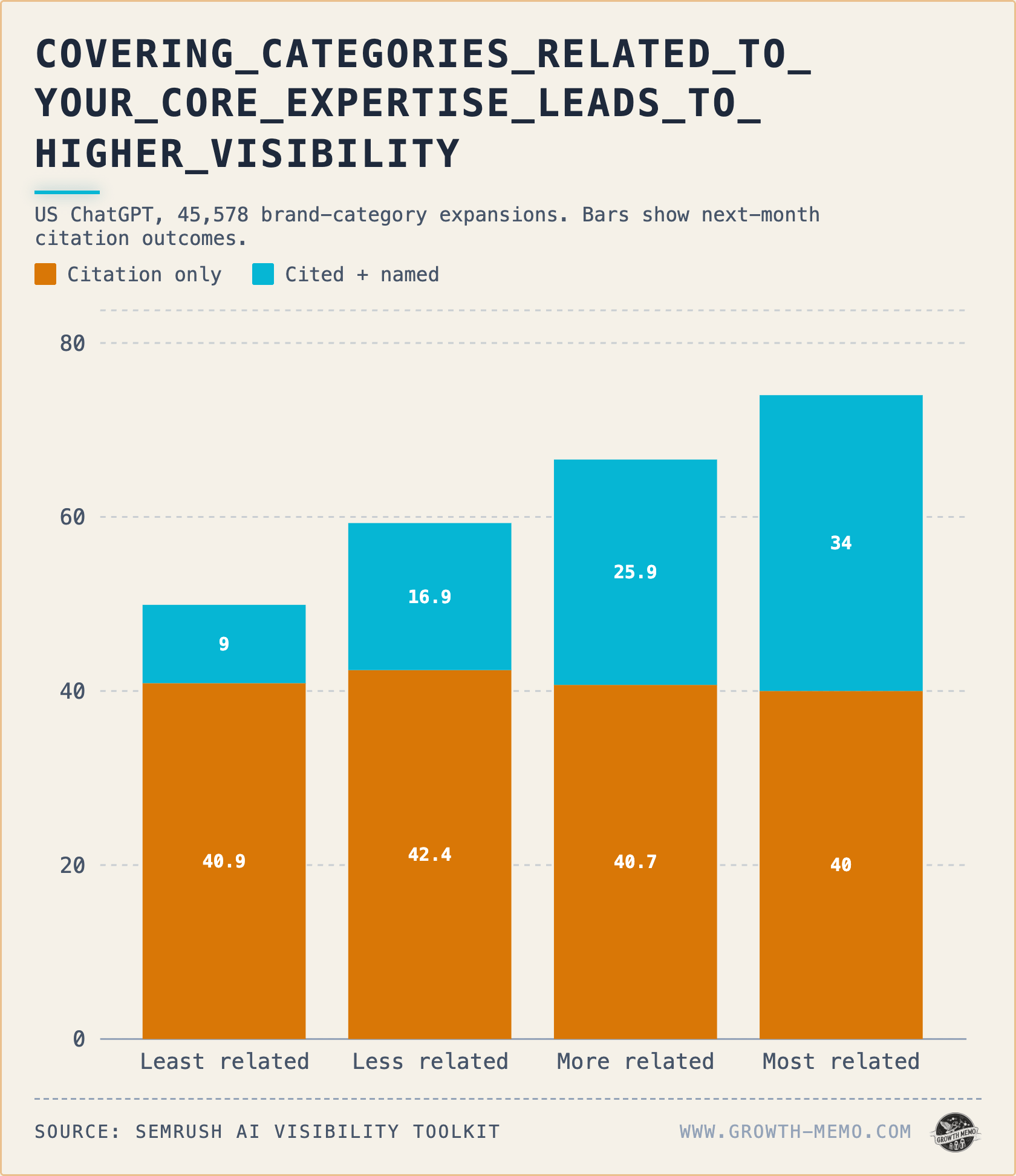
Citation-only presence barely changes across category relevance: 41% in distant categories versus 40% in close ones.
In other words, you can be a source on pretty much any topic if it matches the regular criteria for source citations. But the AI recommends you in core topics.
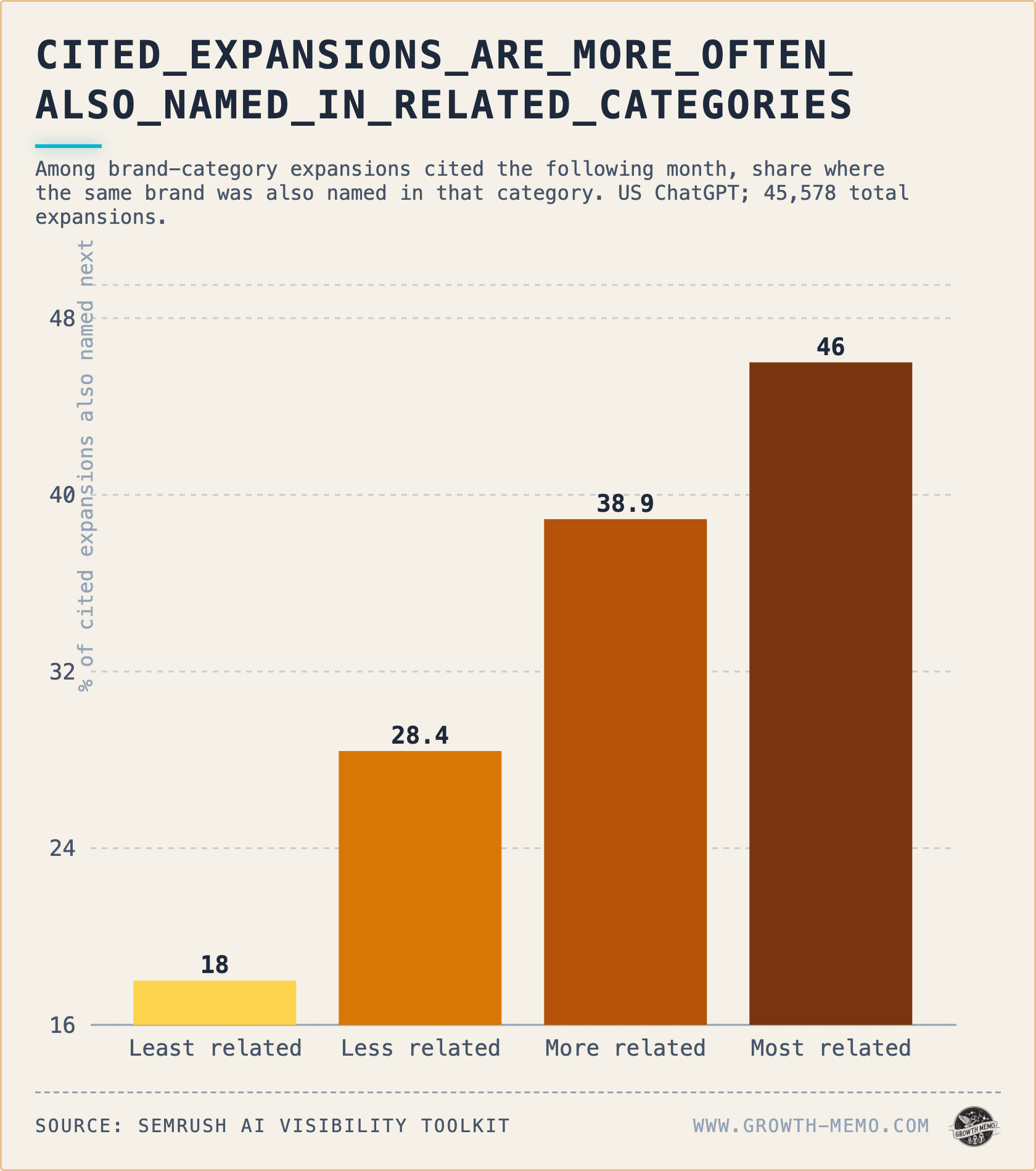
2/ Topical Authority requires depth
A domain can surface once in 20 categories and own none of them.
Presence in answers for the topic measures whether the brand appears at all.
Depth in the topic measures how many of the 5 prompt variants the brand appears in.
Category performance measures its share of the citations or brand mentions in the answers.
In Does topical authority matter in AI search?, we saw repeat presence as the early signal of topical authority. This Memo adds a constraint: The authority only carries brand recognition into categories that are close to the brand’s demonstrated expertise.
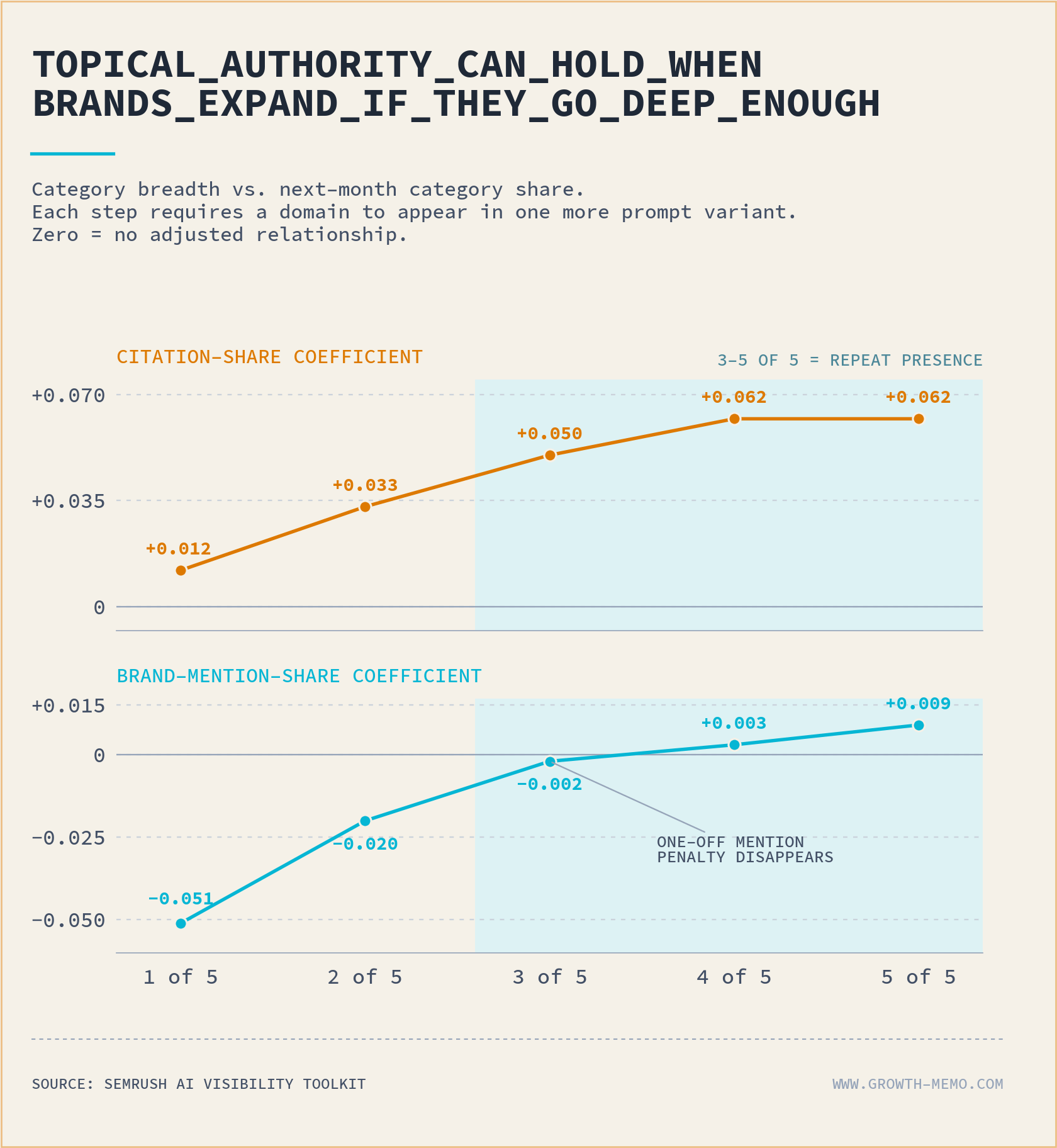
Once again, I found no detriment when showing up across many categories for citations. The association rises from +0.012 when appearing in 1/5 category prompts to +0.062 when a domain appears in all 5. Being cited in many categories does not show a spread-thin effect in this sample.
Brand mentions tell a different story. Being mentioned in 1/5 category prompts across the categories a brand appears in is associated with a lower mention share at -0.051.
But at 5/5, it’s slightly positive. In plain words, we can see a small but robust effect that suggests brands that “own” a category are more successful at expanding into other categories.
Overall, this data shows trying to be everywhere is associated with fewer brand mentions; being in many categories you actually own may help slightly. The “spread too thin” penalty is really a penalty for shallow presence, not for breadth itself.
Keep in mind that there is no defensible universal category limit. The data does not support the claim that a site can serve an unlimited number of categories, either.
The other thing is that the associations here are very light, and we should be careful not to overvalue the effect on topical authority on overall visibility. Other factors, like writing style, overall brand authority, and 3rd party web mentions might outweigh topical authority.
A checklist beats a style opinion when 4 writers are shipping against the same standard. The AI Writing Implementation Kit gives your team the audit criteria in writing. Premium subscribers get the kit plus 40+ other tools, checklists, and stakeholder decks.
3/ Not all industries show Topical Authority equally
The topical authority effect in AI Search does not show up equally across industries.
Finance and real estate show the strongest repeat-citation pattern:
In finance, the citation-breadth association rises from +0.054 at 1 prompt variant to +0.139 at all 5.
Real estate rises from +0.021 to +0.135.
In those industries, broader repeated coverage is associated with stronger source visibility. That makes category expansion a viable citation strategy. That does not mean every finance or real estate brand can win every adjacent category.
It means we don’t see an obvious “spread too thin” penalty for sources in these markets. When a domain appears repeatedly across a category’s prompt variants, it tends to hold more citation shares in the following month.
Legal and healthcare place a tighter constraint on brand mentions:
In legal, the mention-breadth association remains negative even at full 5-prompt coverage, -0.058.
Healthcare follows the same pattern at -0.037.
More consistent coverage can improve a domain’s citation position, but it does not reliably translate into more named-brand visibility. A likely explanation is that these topics involve higher-stakes choices, where being a credible source is not enough to make a brand the recommended answer.
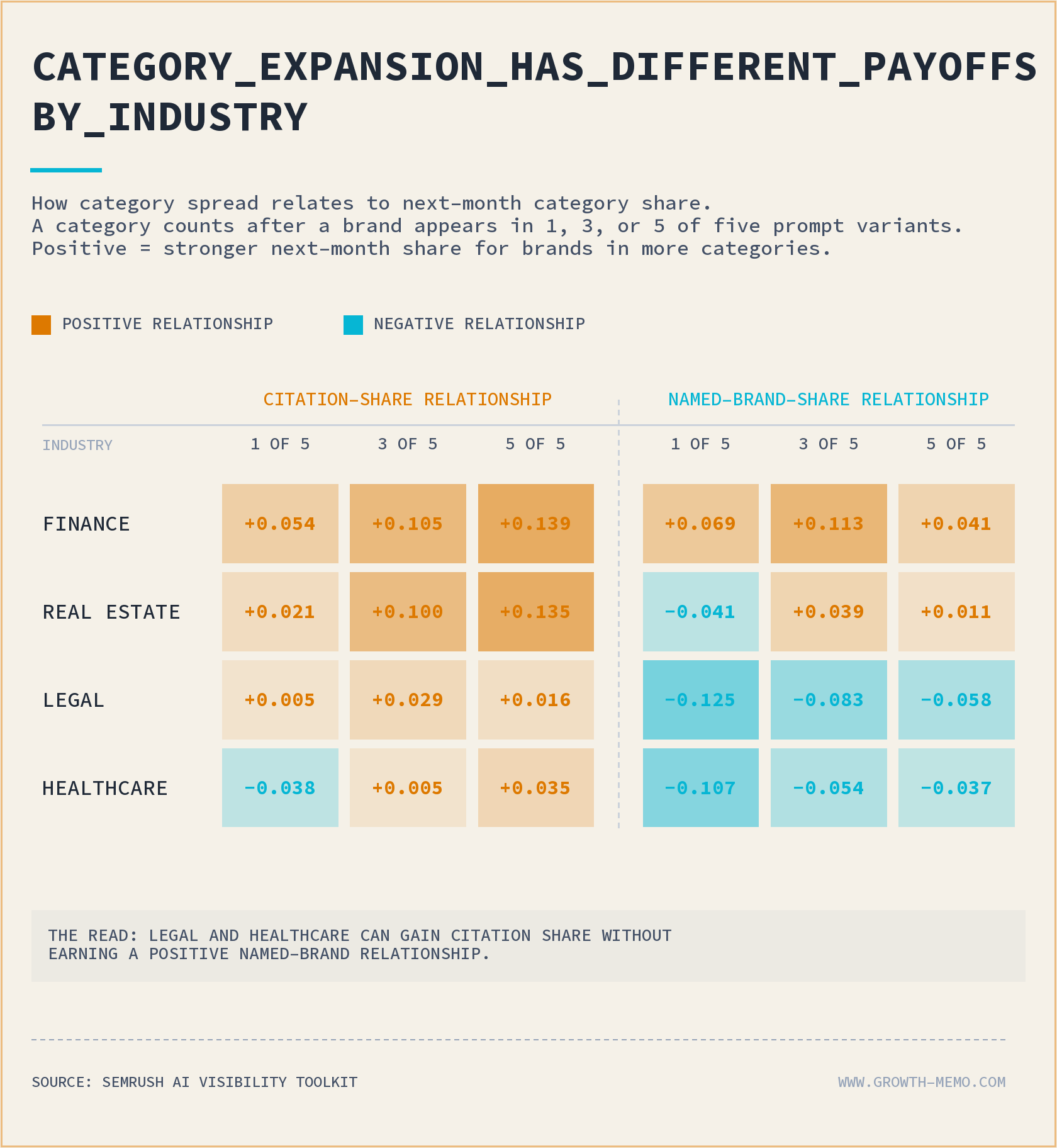
Positive means wider breadth is associated with higher next-month share after controls; negative means lower share.
The practical implication is simple: Finance and real-estate teams can test expansion into related categories with citations as an early success metric. Legal and healthcare teams should use a higher bar. A category is not won until the brand earns repeat mentions, not just citations.
Methodology
Sample
The study uses Semrush’s US ChatGPT dataset from the AI Visibility Toolkit from January through June 2026:
It includes 1,094 categories and 5 prompt variants per category in every monthly snapshot.
The breadth models use 283,215 citations and 76,493 named-brand-mention domain-category observations from January through May. Each current-month observation has a next-month outcome. A domain that disappears from the category receives a share of zero.
The relatedness analysis uses 45,578 expansion appearances by 1,458 mapped brand entities across all 1,094 categories. It has February through May, starting snapshots because each appearance needs prior history and a following-month outcome.
Measures
Citation share is a domain’s share of all source citations in a category’s answers. Brand-mention share is its share of all named brand mentions. The study does not combine them because ChatGPT produces more citations than named brand mentions.
Depth measures the number of a category’s 5 prompt variants where a domain appears. Breadth measures the number of categories where it appears in the current month. The sensitivity test defines a breadth category using 1one through 5five prompt appearances.
For the relatedness analysis, demonstrated expertise means appearing in at least 3three prompt variants in a category before the target-month appearance. An expansion appearance is a brand showing up in a target category where it had not previously reached that depth. Category relationship comes from multilingual semantic similarity between the target category’s title and prompts and the brand’s prior expert categories.
Models and controls
The breadth models estimate the relationship between current breadth and next-month citation or mention share within the same category. They control for current share, current depth, the other signal’s share, Authority Score, organic traffic, branded search demand, and category-month differences.
The relatedness model compares close and distant expansion appearances while controlling for current citation and mention depth, current citation and mention share, breadth, Authority Score, organic traffic, branded search demand, same-industry status, and category-month differences.
Entity matching and scope boundaries
Citations are domains, and named brands are text entities. Semrush maps both to a first-party brand entity where possible. The relatedness results, therefore, describe mapped brands, not every raw citation or name in the source data.
The design measures associations, not a randomized expansion program. It cannot establish that publishing, brand strategy, or category expansion caused the later outcomes. It also does not produce a reliable maximum number of categories a site can serve.
Premium: Build the category map before you expand
The next question is which categories are close enough to pursue, and how to prioritize them.
Below, premium subscribers get my category-map method, including:
How to identify your existing authority anchors
Score the closeness of new categories
Separate source opportunities from recommendation opportunities, and
Turn the result into a quarterly expansion roadmap.
