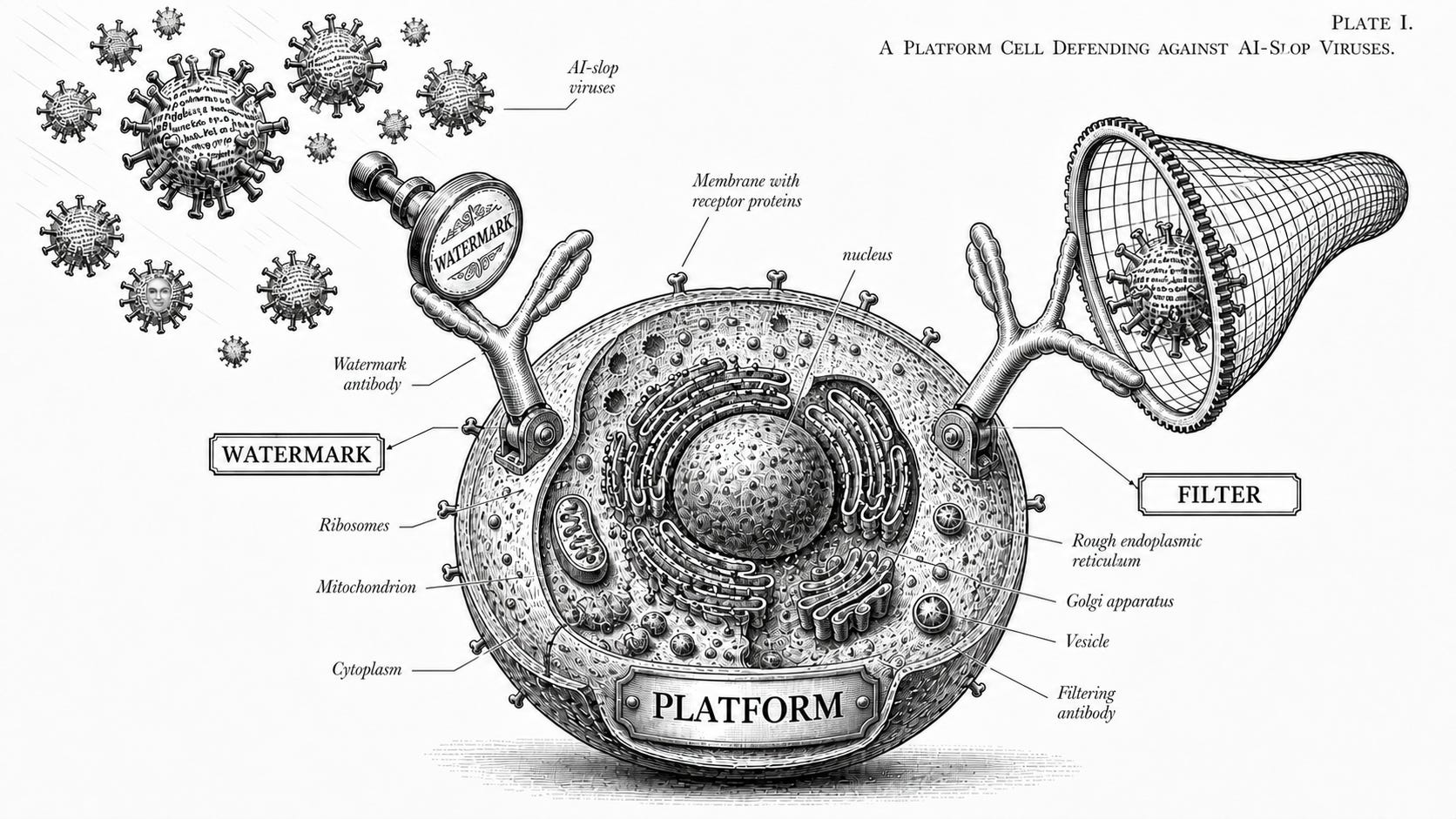
Slop Antibodies
The connection between Slop, watermarking and Commodity Content shows us the blueprint for successful content in the AI era

Most comments on my LinkedIn posts look like this lately:
Slop. Of course.
Viruses have no metabolism of their own and need a host to reproduce. Slop comments regurgitate back to me what I wrote (the host) with 0 value. My desire to be on LinkedIn is getting closer to dentist-visit level ever since the platform enabled and encouraged the use of AI.
But LinkedIn is seeing the problem. In 10 weeks, the platform:
deployed systems that identify slop and limit its distribution beyond a poster’s immediate network1
started testing a “Seems like AI Slop” button for users to flag posts and comments2
killed its own “Enhance Post” button, replacing it with a proofreader that fixes grammar without rewriting your voice3
Antibodies do 3 things: spot a target, neutralize it, and remember it so the next encounter is faster. Anti-slop systems flag low-value content, throttle its reach, and feed every catch back into the model. LinkedIn is building Slop Antibodies, and every other content platform does as well:
Substack rolled out site-wide use of Pangram to detect AI use in writing.4
Youtube demonetizes “repetitive, low-effort, emotionally manipulative video”. In January 2026, it terminated 11 channels and wiped 6 more, erasing ~4.7B lifetime views, 35M subs, and ~$9.8M in annual revenue.
Reddit went the anti-manipulation route rather than labeling. July 2026: AI-based detection of “manipulated and spammy content,” claiming 23M spam views blocked and ~2M inauthentic votes revoked daily.
Pinterest: uses AI detection to label content plus feed control that lets users dial down “AI-modified” content in specific categories.
TikTok requires AI labels, embeds invisible metadata watermarks, shipped a “limit AI content” feed toggle in Nov 2025, and in July 2026 started testing detection aimed at accounts dedicated to AI spam.
Meta has “AI info” labels on FB/IG/Threads since 2024, extended to ads in June 2026. Labels only, no user-side filter.
Spotify attacked supply: 75M+ spammy tracks removed, an impersonation policy, spam filters, and DDEX-based AI disclosure in credits.
Cheap synthetic content floods platforms, and the immune systems react: labels, reporting flows, filters, demonetization, spam detection, and supply-side removals. LinkedIn’s defense system has 94% accuracy. That’s 60x worse than Gmail’s spam filters, which would mean that one in 17 spam emails would be flagged as a false positive.
This changes how demand flows in profound ways: Production cost collapses to near zero, which puts pressure on distribution as it moves under machine control. So the scarce asset is selection. Content production efficiencies are worthless if that content doesn’t reach the target audience.
This is what a paid subscription now includes:
The full asset library (45+ tools)
All Growth Memo archives
New tools and workflows published monthly
Log in, explore, use a tool, and reply with what I should build next. Those replies shape what enters the Library.
Kevin
Watermark panic
On August 11, Anthropic announced machine-readable watermarks on Claude text and file output at the model level worldwide, so it persists across the API, Claude, Claude Code, and cloud access through AWS, Google Cloud, and Microsoft Foundry.5
Anthropic didn’t do this out of the goodness of its heart. The EU AI Act’s Article 50 requires providers of generative systems to mark their output in a machine-readable format, with penalties up to €15M or 3% of global turnover. Every lab serving the EU owes that duty, whether or not it also signed the Commission’s voluntary code on top.
Anthropic’s watermarking is the upstream version of the same immune response from content platforms: Instead of asking LinkedIn, YouTube, or Reddit to infer whether a post was generated by AI after it enters the feed, Claude can make generated text easier to identify at the source.

I’m not worried about the impact of watermarking (on marketing):
Watermarks just prove that an AI model touched text, but not to what extent. It’s not an indicator of quality.
Detectors need a minimum amount of text to work. Published benchmarks land at roughly 100 tokens at best, and SynthID’s own evaluation truncates everything to 200. A LinkedIn comment is 20 to 50 tokens. The slop I opened this piece with sits below the floor.
Editing, paraphrasing, translating, combining the response with other text or chaining models can weaken or remove the mark.
If Anthropic makes watermark detection publicly available, it will lead to a cat-and-mouse game in which actors reverse-engineer ways to break the watermark, and Anthropic must figure out how to harden it.
A paraphrasing attack presented at ICML 2025 achieved near 100% success against seven recent watermarking methods at $0.88 per million tokens. source
The escape hatch is open weights. Watermarking is applied by the sampling pipeline at inference, so if you run the model yourself, there is nothing to strip. If marked output ever gets penalized, slop moves to the models nobody marks.
Fun fact: Gemini has been applying SynthID watermarks since August 2023, but there was no outcry. The web’s reaction to Anthropic’s announcement says a lot about Google’s AI position.

At the heart of this fear of watermarking is my key argument: We shouldn’t confuse “AI-generated” with “bad.” One could argue Slop existed before AI: poor or machine-automated work, legal and finance speak, press releases, and every SEO article that opened with “in today’s digital landscape”. It is ultimately about quality. Where the fear is justified is that quality has become a blurry but critical filter for distribution.
Distribution bottleneck
The advice to avoid generic content isn’t new, just widely ignored. But AI raises the viral load faster than the filter can clear it.
Content production is no longer the constraint. Permission to distribute is.
What we learned over the last 24 months is that the production gains from AI do not offset the losses in distribution. You could argue that AI Overviews reduce clicks by 50% on average6, but you can grow content output +2x to compensate for it. But that output growth comes at the sacrifice of quality, which can hurt your overall distribution terminally. An article or post that smells like AI can cost you fragile trust with readers to an irreparable degree.
The census above was platforms protecting their own feeds. The layer that decides what AI answers cite is doing the same thing, one level up. Google shipped a spam update in June 2026 aimed at scaled content abuse. Wikipedia went furthest: speedy deletion for suspected LLM-generated articles in August 2025, then an outright ban on using LLMs to write or rewrite article content in March 2026. Google demotes, Reddit detects, Wikipedia bans.
Premium is $150/year. That’s less expensive than your next AI SEO mistake. The Growth Memo Premium Resource Library has 45+ (and growing) checklists, light tools, AI workflows, and stakeholder slide decks to build your confidence in your marketing tactics for the AI visibility era.
Shouldn’t AI Slop hurt the distribution of content platforms themselves? After all, LinkedIn, Reddit and Youtube are the most cited domains and bigger slop slingers.7
Why are they not penalized by search engines and LLMs?
First, they are, but more targeted. Reddit’s machine-translated ?tl= pages collapsed from 6.14% of ChatGPT’s Reddit citations in April 2026 to 0.30% by early June, while Reddit rose in aggregate over the same period.8
Second, we don’t know what LLMs filter out for training data versus live retrieval.
Third, engagement may act as a rough filter. Semrush’s study of 89k cited LinkedIn URLs found the cited ones carry at least decent engagement.9
Most cited posts have moderate engagement (15–25 reactions), while about 75% of cited authors post frequently (5+ posts in four weeks) and nearly half have over 2,000 followers.
(This issue is sponsored by Semrush) Notice the domains: AI models don’t just cite brand-owned content. They build narratives from YouTube creators, Reddit threads, and LinkedIn voices. The brands that curate and show up consistently across these touchpoints shape their industry narratives.
Semrush’s Enterprise AIO gives you the capabilities to track and steer exactly that: which creators, channels, and subreddits your audience and the models actually pull from, then ranks where to show up.
So, it seems that at least some sort of slop filtering of content platforms is happening. But what’s the cost to distribution for companies? Several studies looked into this.
A Copenhagen Business School study published in Electronic Markets ran two experiments (n=325, n=371) on Instagram content labeled human-created, AI-enhanced, or AI-generated, and found labeling as AI-generated or AI-enhanced reduced both affective and behavioral engagement by about half, with the effect strongest on emotional content and weakest on rational or informational content.10
TikTok field data (1 million posts) shows AI disclosure leads to ~7% less engagement because people infer lower effort.11 Pretty tame in my mind. Pangram scanned 1M+ posts between April and June 2026 and found 41% of LinkedIn long-form posts and 23% of comments were fully AI-generated, the highest of any platform.12
Run the numbers on yourself. LinkedIn says it catches 94% of slop and caps flagged posts at your immediate network. In my analytics, 71% of impressions come from beyond that network. Multiply the two: an account posting nothing but AI should expect to lose roughly two-thirds of its LinkedIn reach. Post AI a third of the time, and it lands closer to 20%. Add 7% on short-form video, and 40 to 95% in SEO if you scaled a content operation.13
Commodity Content
At the beginning of the article, I mentioned that LinkedIn slop comments regurgitate my original post and provide zero value. That might remind you of the concept of Information Gain and Commodity Content - and it should. In 2021 (!), I wrote:
Second, if the key feature is easy to replicate, you have a problem. You have a commodity; you’re one choice of many. Commodities compete heavily on price and cost. As a business, you have to weigh the cost it takes to create the product against the returns it brings. Are you in a stronger position when you compete with minimal advantage for a small share of ad views?
Fast forward to today, Danny Sullivan shared an important slide at the Search Console Live Toronto conference about commodity vs. non-commodity content.

In Danny’s words, non-commodity content is:
Unique: Brings a viewpoint, information or content that others lack or can’t easily replicate.
Specific: Talks about a specific instance, situation or thing, not general rules, steps or generic information.
Authentic: Demonstrates first-hand knowledge or experience.
It hits the whole slop discussion on the head. It’s the universal anti-slop recipe. Look at how similar LinkedIn’s VP Laura Lorenzetti’s frame of AI Slop is to Google’s:
This includes technology systems built in partnership with our editorial team that have been trained to recognize signals of AI slop and learn over time by identifying content that adds perspective, context, or expertise and content that feels generic or repetitive, even if it appears polished on the surface.
Or what Reddit CEO Steve Huffman recently said on the company’s Q2 earnings call:
As AI makes information more abundant, the challenge is no longer finding content; it’s finding context, personal opinion, and first-hand accounts. Everything online feels flat, polished, generated, or sponsored, so consumers are overwhelmed and increasingly skeptical,” Reddit CEO Steve Huffman said.14
3 organizations coming to the same conclusion: generic content has no value. Is that new? No! What is new is the binary nature and cost-effectiveness. Generic content could gain some residual traffic until a few years ago. Now, Google won’t even index it, and LinkedIn downranks it. Panda ran on proxies: Links, clicks, dwell time, pogo-sticking, because judging whether a document contained a (good) idea was economically impossible when it launched in 2011. Now, an LLM can assess this quickly and at low cost.
A COLM 2026 paper15 from Maryland and Google DeepMind ran 61,608 stories through a classifier that was deliberately denied every style signal and told to work from structure alone. It kept over 97% of the accuracy of models that were allowed to see word choice and sentence rhythm. The finding: Slop has a shape pattern.

Now, scroll back up and look at the shape of my LinkedIn comments from the beginning. Spotting the uniform shape?
But there are even more similarities between the COLM study and slop: AI states the moral outright in 77% of stories versus 52% for humans, and 79% of AI stories contain zero subplots versus 57% for humans. Over-explaining and single-track tidiness is exactly the LinkedIn comment pathology.
So the antidote is owning something a model cannot produce on demand:
Proprietary information. Your own data, your own experiments, your own customer conversations. If a model can generate it, it is a commodity by definition.
Attributable identity. A named author with a track record, and on LinkedIn, a verified one. Lorenzetti’s post buried the tell: you can now filter the feed for LinkedIn’s 100M+ verified members. Verification is an antibody.
An owned channel. Email, community, direct relationships. Somewhere the filter is not standing between you and the reader.
The test for all three is the same: would it be expensive for someone else to fake?
Wish for the filters to work. Every throttled slop comment is oxygen back for someone who actually had something to say. Just make sure that when the feed finally clears, you are the source the machine decided to keep.
Humbly,
Kevin