



Earlier this year, I (Amanda) sat in a meeting where a marketing leader explained that an internal tool their team was building would replace a content optimization platform I use with every client. It wouldn’t have. The 2 tools did completely different jobs, and they didn’t fully understand which job either tool did.
That’s 2 problems stacked: (1) a misread of what AI can do and when/how, on top of (2) a misread of what their own team does with it. Neither problem is unusual.
69% of senior executives report using AI less than 1 hour a week, but a lot of them are setting the automation agenda for the marketing teams who use it.
Parts 1 and 2 of this series assumed you got to make the call. But plenty of us don’t get to make the call when it comes to AI automation on our marketing teams. The instruction often arrives from above, with no definition of done and no real resourcing attached.
This isn’t an argument about whether AI automation “works,” because it does when it’s done right. No real debate there.
Your actual job here isn’t just “managing up.” Managing up is the wrong frame for AI marketing automation mandates, as it assumes the person above you understands the work and needs convincing.
If most executives use AI less than an hour a week, they need educating, and it’s highly likely you’re the best person to do it (since we’d argue SEO teams are some of the earliest adopters).
Automation mandates come from people who statistically use AI way less than you
Guiding stakeholder conversations on behalf of your growth marketing team takes real “educating upwards.”
While about 69% of CEOs, CFOs, and senior executives use AI less than 1 hour a week, 28% never use it at all, according to a NBER working paper that surveyed about 6K senior executives across 4 countries.
Set that against the workforce they’re directing. EY surveyed 15K employees and 1,500 employers across 29 countries and found 88% use AI every day, while only 5% use it to genuinely change how their work gets done. (Everyone outside the 5% is using it to run searches and summaries. But that’s great news for us B2B organic search folks trying to get seen.)
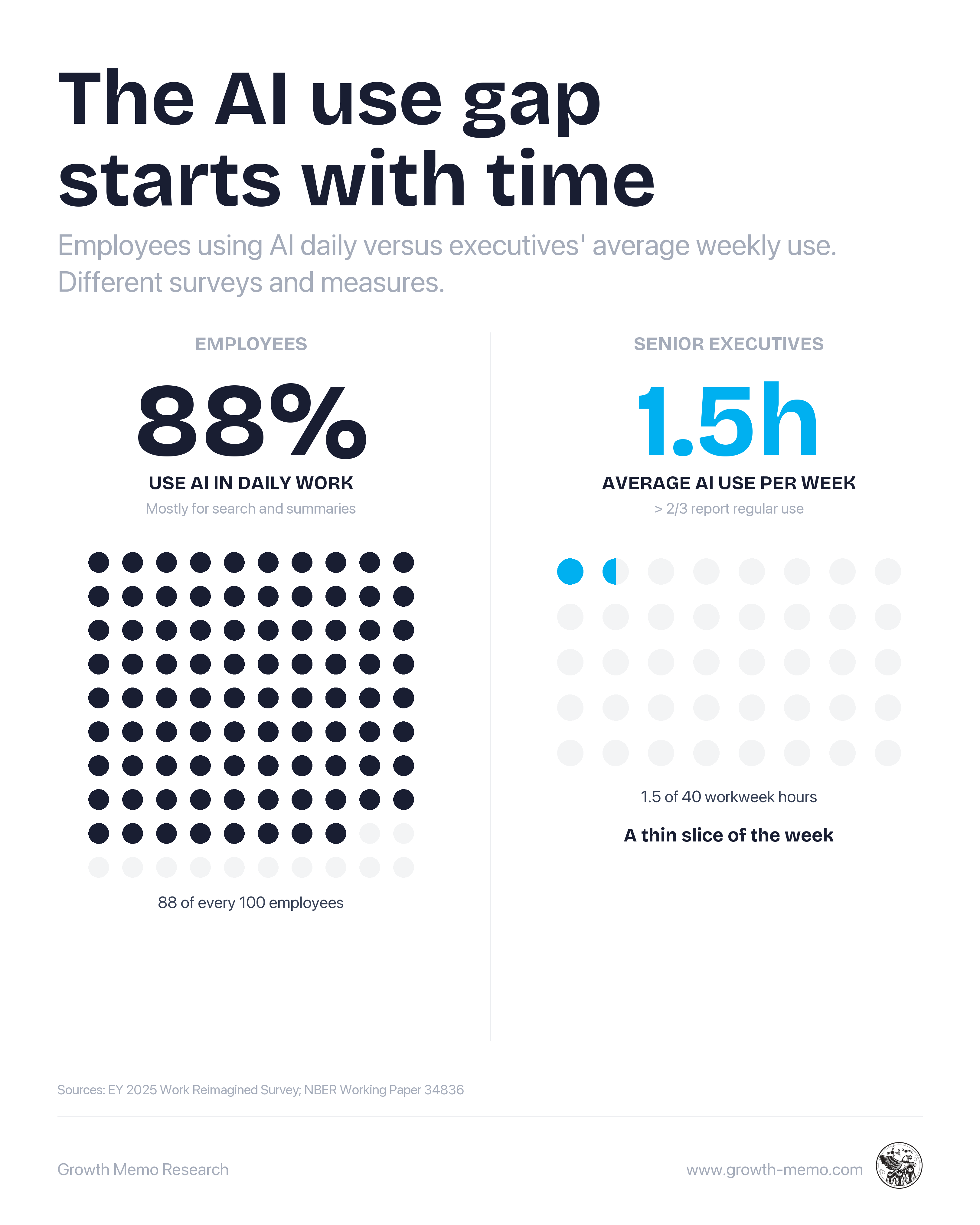
Daily use of AI for production work is where you learn that a 15-step workflow takes 3 weeks to build, breaks 3 days after you roll it out for daily use, and that every output needs a final human verification. An hour a week of use? That’s where you learn that AI is simply “fast.”
A mandate handed down from your executive team, without a definition of done or guidance around use, leaves you and your team filling the gap yourselves the best you can. WalkMe’s State of Digital Adoption 2025 report found 78% use AI tools their company never gave them and 51% get conflicting directions on when to use AI at all. 60% say it often takes longer to figure out how to use AI than to do the task by hand.
(I, Amanda, can’t tell you how many times I have fished through a CMS to manually link a new URL rather than fire up a Claude skill, because some days it really is just faster.)
<<insert change management CTA here>>
Unapproved tooling, conflicting company guidance, and employee learning time that nobody logged add up to work that happened and was never really seen as actual work completed by your marketing team.
Execs definitely have an expectation for teams to use AI and work more efficiently, although they’re often hesitant to be specific about their expectations. But you can’t defend a budget (time or money) for expectations or production work that nobody wrote down.
What you need to know before you walk into conversations where you need to do a little “educating upward:”
In Validity’s State of CRM Data Report 2026 (with 500 survey respondents), nearly 60% of C-suite respondents and 52% of SVP/VPs said they feel pressure to implement AI tools now, while knowing the data inputs underneath those tools aren’t ready.
Senior leaders also reported that they acted on AI recommendations that they later suspected were wrong at roughly 2x the rate of individual contributors.
One of the big advantages as a growth marketer that you have over executive teams is the proximity you have to the work and how LLMs work.
So then your responsibility to educate has a couple of crucial functions:
You’re trying to hand someone a defensible answer and solution for the person (the board, stakeholders, CFO) who’s directly pressuring them.
You’re providing high-level information about LLMs’ work so leaders know why human checkpoints/reviews are needed.
Translating what you can see from up close, how long AI automation builds take, how long it takes to check the output, what work hits the backburner, and what the actual costs can be is the best route your executives have to a good decision.
And that means whatever you bring to those stakeholder conversations has to have defensible numbers attached. (If you’re a Growth Premium Member, there’s an interactive AI automation work router for this exact decision in the premium library. It also estimates cost calculations.)
Walking into that conversation with an opinion is one thing. Walking in with the hours, the sort, and the slide deck is another. Premium subscribers get all 3.
Bring clear numbers, not objections
The fastest way to lose this conversation is to argue about whether AI marketing automations are valuable.
Bring numbers instead, specifically: Your team’s hours.
“96% of C-suite executives say they expect the use of AI tools to increase their company’s overall productivity levels. Yet, less than a third of these leaders (26%) have AI training programs in place for their workforce and only 13% report a well-implemented AI strategy.” Source: Upwork, “From Burnout to Balance: AI-Enhanced Work Models”
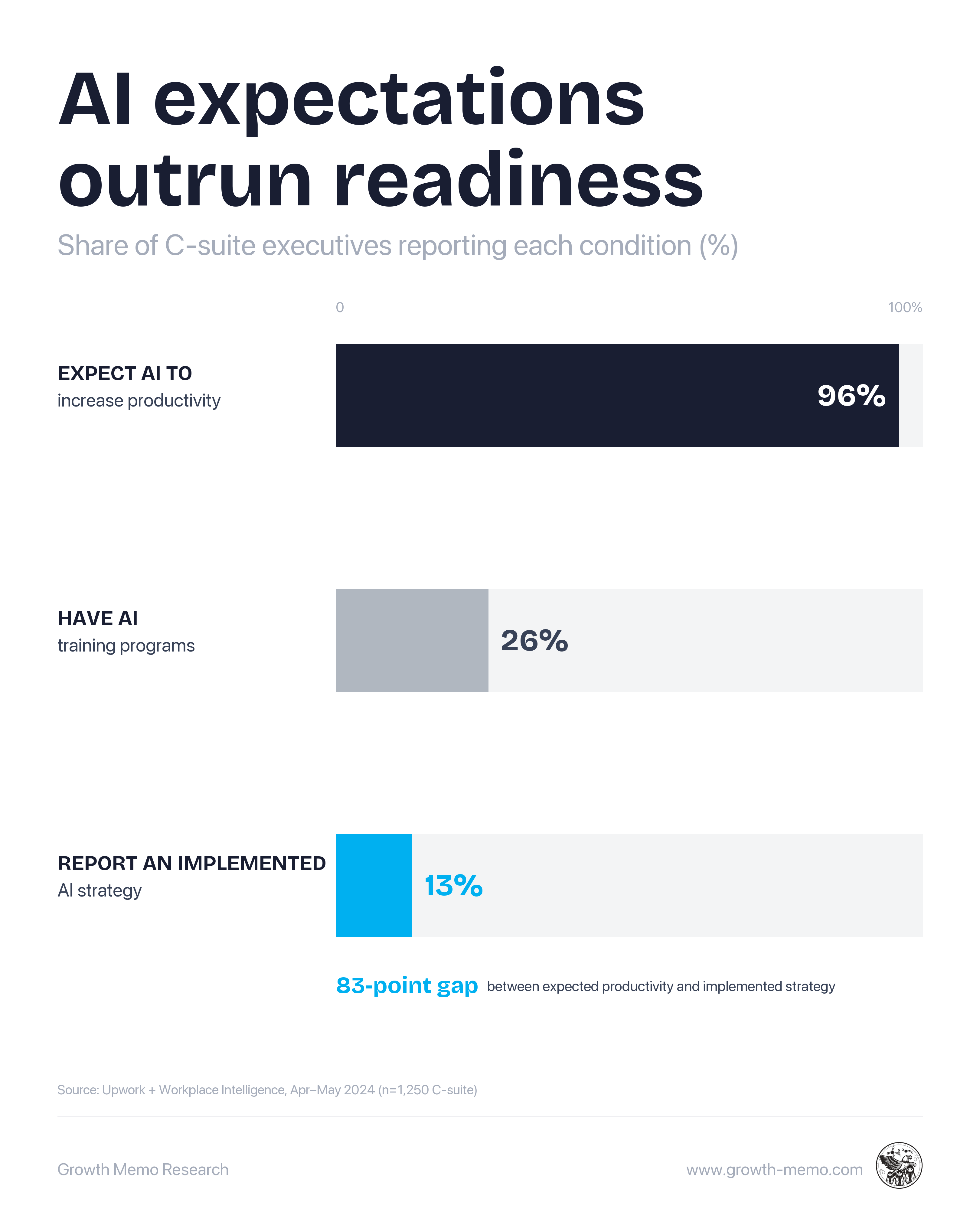
Have each person on your marketing team tally AI hours for 30 days against 4 categories (an idea borrowed from Upwork’s survey linked above):
Time spent checking and fixing outputs
Time spent learning tools (like how to build custom GPTs or skills)
Time spent running AI workflows
Time spent copyediting and fact-checking long-form outputs (like content drafts)
Make it clear nobody on your team is being evaluated. (If there’s a way for your team to submit calculations anonymously so you can group them all together, even better, because you’re counting, not grading.)
Then the meeting has 3 clear points you’re getting across:
“We spent 60 hours on AI workflows last month. Here is what each of those hours was for.”
“Here is the brand and organic work those 60 hours would have covered, and what that work’s estimated ROI is on a 6-month horizon when it’s properly maintained.”
“Here is what we want to keep running with, what kinds of pre-built solutions or outside help we want to buy instead, and here’s what we need to stop to make room for our other marketing work that’s slipping.”
An executive who waves off asks like “we need more time for content reoptimization to earn AI visibility” or “we need to invest time in earning third-party mentions and to run a G2 review campaign,” can actually engage with the 60 hours number.
By bringing the concrete numbers, there’s a clear, measurable tradeoff, because resourcing is a conversation they’re equipped to have. With an hour count, you’ve given them clearly defined ammo to take to the boardroom if needed.
SEO/AEO consultants: You don’t get to skip this step as someone who doesn’t work in-house. If you’re seeing your client’s in-house people struggle with losing marketing work time to AI automation work, you can guide your primary contact in the same way.
Here’s how to guide your team
Experimenting earns its keep. But setting a cap is what makes experimenting survivable (and efficient) when you’re still working out all the knots.
The strongest way to manage an AI mandate upward is to bring a better AI plan from below.
AI experimentation should begin before the mandate arrives. The people closest to the workflow can see which steps repeat, which outputs can be verified, and where human judgment still carries the risk.
Leadership sets the outcome and the guardrails. But your team should choose the workflow, run the test, and report the result. (That bottom-up loop gives executives an AI plan they can actually fund and defend.)
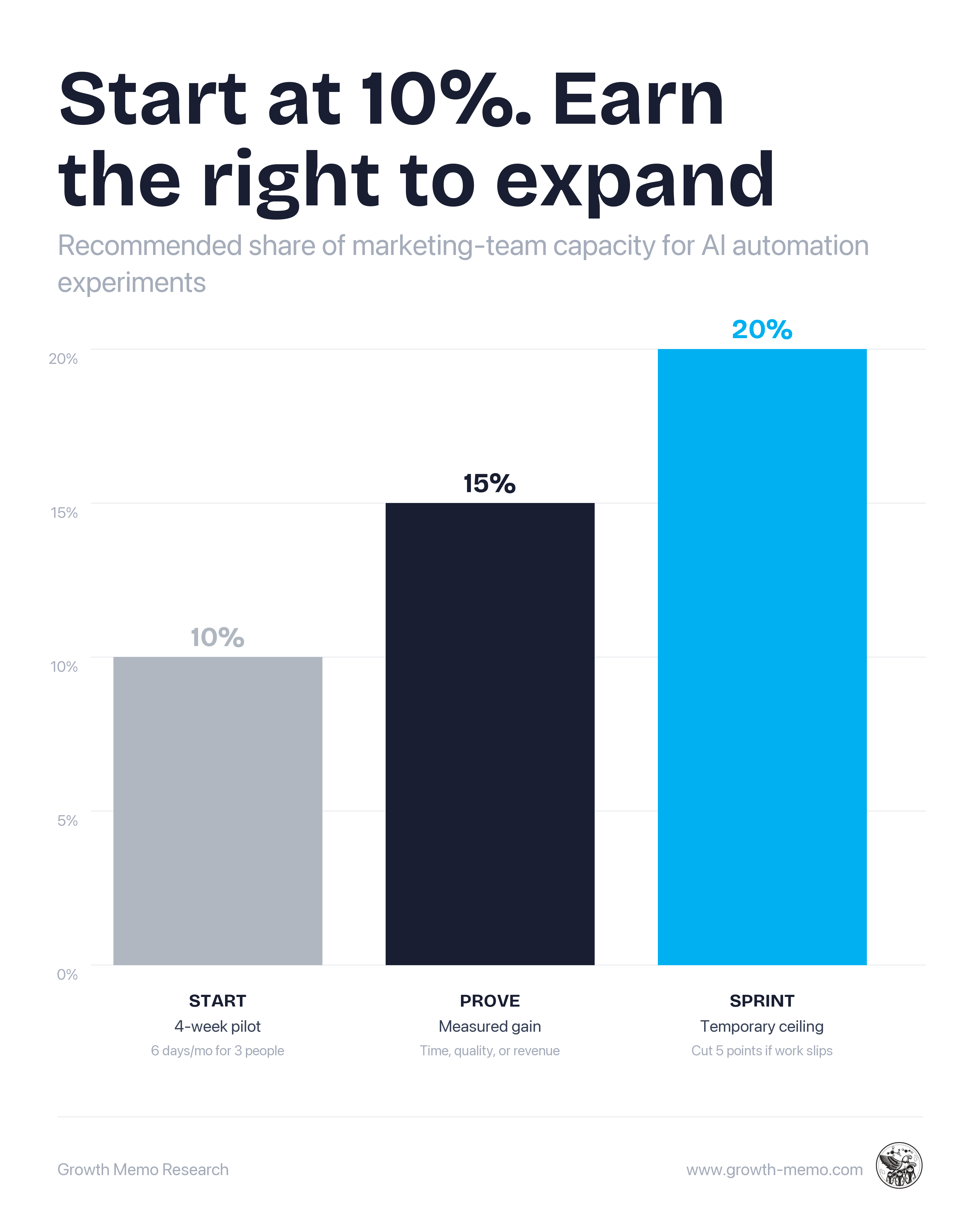
Start with 10% of your marketing team’s available capacity, measured over 4 weeks. A 3-person team gets about 6 person-days per month, enough for one active experiment. A 20-person team gets 40 person-days, enough for 2 or 3 experiments with named owners.
You can increase the capacity budget to 15%, but only after a completed pilot has delivered measured gains (time, quality, revenue, etc). Use 20% as a temporary ceiling for a fixed rollout sprint. If experiments delay other planned marketing work, reduce the capacity budget by 5%.
Company maturity can change (and should) your budget allocation.
Pre-PMF companies should spend only 5–10% on AI automation because their workflows still change too quickly.
Scaling companies with repeatable acquisition motions can spend 10–15%.
Mature companies should keep 5–10% inside functional teams and fund dedicated automation capacity separately.
After you set your capacity budget, create rules around every AI automation experiment:
1/ Name one owner. Not a group. One person who runs the experiment and reports what happened, including time loss/savings.
2/ Set an end or kill date before you start. 2 weeks handles most tool and workflow evaluations. If the date arrives and the answer is still murky on whether it has improved efficiency or stolen more time from other marketing work than expected, well, the answer is no or not yet.
3/ Budget for tokens and cap the spend. Token spend is the first AI cost that shows up on an invoice, so set the expectation early.
4/ Budget for time and record it. Tokens are the small cost. Your team’s hours is the big one, and hours show up nowhere. A finance team asking why the API bill doubled is asking the less expensive question.
5/ Write down what winning looks like in one sentence. “Cuts brief prep from 3 hours to 1” can be tested. “Helps us move faster” cannot, which is why failed experiments never officially end.
6/ Turn “use more AI” into a defined outcome. Ask leadership to choose the primary goal: lower cost, faster delivery, higher quality, or more output? A generic AI mandate can’t be evaluated.
7/ Present options rather than objections. Bring 3 choices: preserve the current workflow, run a bounded pilot, or fund a full implementation. Show the required hours, expected gain, risk, and displaced work for each.
8/ Run new workflows in shadow mode. Keep the existing process running for 2 cycles while the AI workflow operates beside it. Compare elapsed time, correction time, output quality, and failures before replacing anything.
Anything past the cap is a project, not an experiment, and projects get a budget line like everything else.
The cap does something for your stakeholders, too. It converts “the team is doing AI automation stuff” into a clear number they can approve, defend, and show to whoever is pressuring them. Very few executives object to 15% of capacity with an owner and a kill date.
Name specifically what the cap protects
Write down what the other 80% of your team’s work time is for, in the same sentence you use for the cap.
The work that multiplies organic brand authority is the work that often gets under-resourced or set off to the side, because attribution is a huge challenge right now. Name things like:
Publishing enough depth on a topic that you become the obvious source
Earning mentions on the sites AI answers actually pull from that are related to your target topics
Showing up in the Reddit and YouTube threads your buyers actually read
Keeping your entries and/or responses current on the review sites that get cited
None of the above clearly produces a visible result in the same week it’s done. (But it is work that influences whether your brand gets still named favorably in an AI answer 3 months from now.)
Today’s sponsor, Semrush, has a useful example of why this slow work matters.

Semrush’s YMYL Mini Study analyzed millions of prompts across 22 topics and four AI platforms. Semrush found that when people ask AI about health or finances, government and official sources dominate, citation pools shrink, and brand-owned content has a harder time cutting through. If your brand operates in a high-trust category, you can download the free study to see how the source mix changes when the stakes rise.
Smaller teams often can see this more easily: A 3-person team that hands 20% of its week to an AI build has stopped doing something, and the something is almost always the slow work that takes time to see the ROI.
If a finding this week changes a decision for your brand, the premium resource library has 45+ checklists, light tools, AI workflows, and stakeholder decks to put it to work.
If you just do one thing this week: Put the 30-day tally on the calendar and tell your team it starts on Monday.
A month from now, you will have the only data that can reliably move this conversation into protecting marketing work that moves the needle for AI visibility growth, and your leadership team will have something they can defend more easily.