


Welcome to another Growth Intelligence Brief, where organic growth leaders discover what matters, get insights into the bigger picture and guidance on how to stay ahead of the competition.
As a free subscriber, you’re getting the first big story. Premium subscribers get the whole brief.
Today’s Growth Intelligence Brief went out to 660 marketing leaders.
This week, we’re looking at:
Microsoft openly redefining what the search index is for in the age of AI answers
Ramp’s 32-day A/B test that killed the schema-first playbook for AI agents
Amazon’s LLM-built knowledge graph that quietly added hundreds of millions in revenue
I’ll also connect the dots on what this all means for you.
Microsoft just redefined what the search index is for
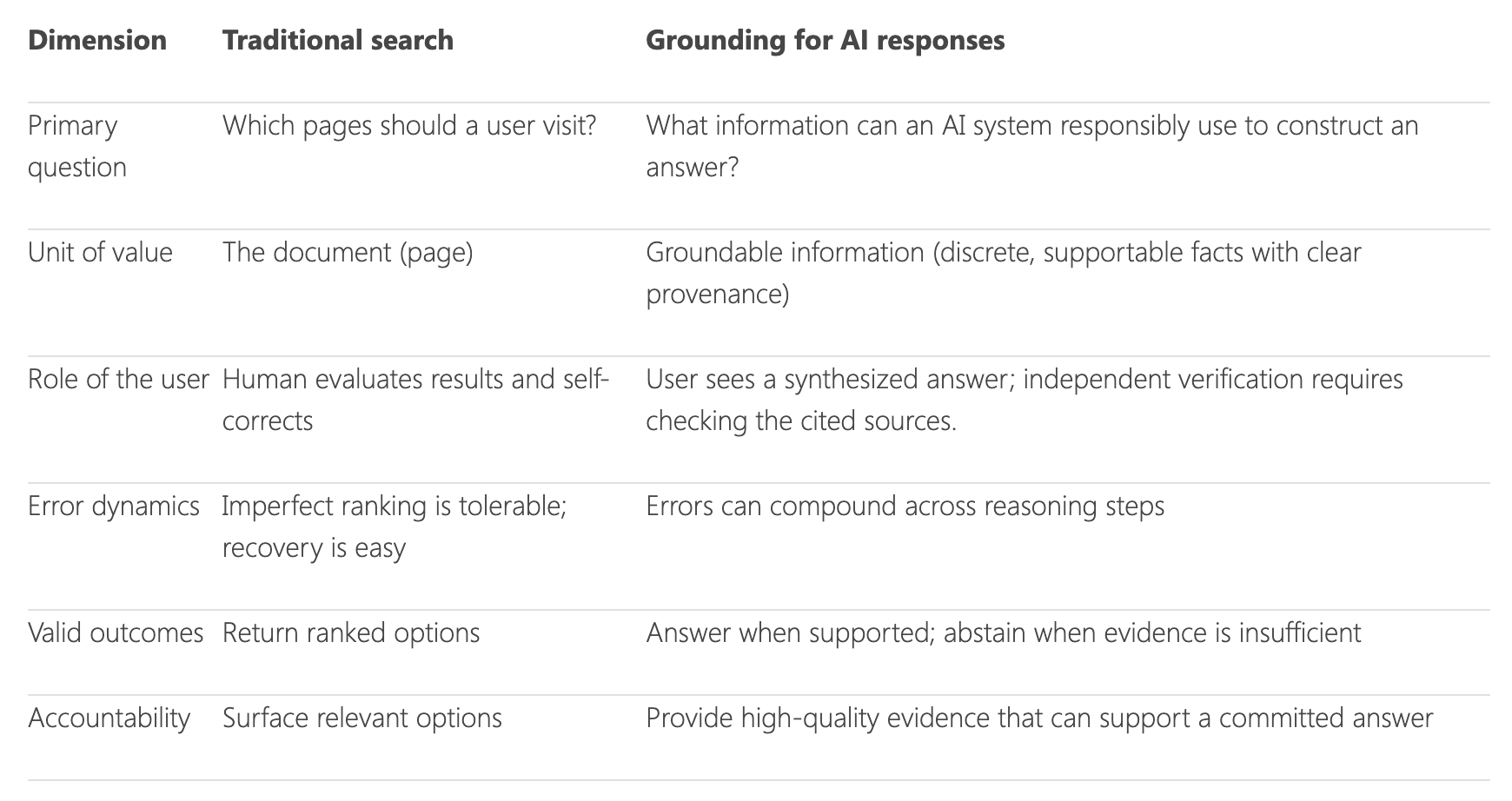
Here’s what happened:
Microsoft’s Bing team published a post on May 6 making the most explicit case I’ve seen from a major platform on how AI search inverts the role of the index. The core argument: When an AI system grounds an answer, the index is no longer pointing to information, it’s using it. The unit of value shifts from documents to “groundable information,” discrete facts with clear provenance that a model can responsibly cite.
The post lays out 3 specific shifts.
The goal moves from “fetch the best documents” to “fetch the best information to synthesize into a reliable, verifiable answer.”
Factual fidelity becomes the key quality metric: Does the indexed representation of a page accurately preserve the meaning of the original content?
Freshness failure carries a categorically different cost when the index is grounding an answer instead of surfacing options.
Why this news matters:
This is the first time a major search platform has publicly written down what the new optimization target is. Most of the AI search discussion still treats the problem as “how do I rank in AI Overviews,” which is the wrong frame. Microsoft is saying the right frame is “how do my facts get retrieved into a synthesized answer.”
That changes what counts as a win. A grounding function is accountable for the quality of evidence it provides, not the order of links it returns. The metric is whether the model picks up your specific facts, attributes them correctly, and surfaces your provenance to the user when the user wants to verify.
My take on this:
This is the doc I’ve been waiting for. Volume sits with Google’s surfaces, but the conceptual leadership is coming from Microsoft. Bing is the one writing down the playbook, partly because they have less to lose and partly because they got there first with Copilot integration.
The piece I’d add to Microsoft’s perspective: Grounding has a discoverability problem. A model can only ground against content it has seen, parsed correctly, and stored as retrievable evidence. That’s a 3-step funnel, and most SEO teams are still optimizing for step 0, which is “rank in a SERP.”
The new funnel? Crawl, parse, retrieve. If there’s a break in any of those 3 steps, you don’t get cited.
Here’s what to do:
Audit your content for 3 things this month:
1/ Are your key facts written as distinct, attributable claims rather than buried inside narrative paragraphs?
2/ Do your pages carry author bylines, publication dates, and visible source links that a model can use to assign provenance?
3/ Can a non-Google crawler (try a tool like Firecrawl or run a Cloudflare bot log audit) actually retrieve the parts of your page that matter, or are they hidden behind JavaScript that AI crawlers won’t execute?
The fastest tactical win: Rewrite your top 20 product or category pages so the load-bearing facts (price, feature, comparison, capability) appear in clean text inside the first 600 words. That’s the part the grounding layer will read.
