


Welcome to another Growth Intelligence Brief, where organic growth leaders discover what matters - getting insights into the bigger picture and guidance on how to stay ahead of the competition.
As a free subscriber, you’re getting the first big story. Premium subscribers get the whole brief.
Today’s Growth Intelligence Brief went out to 639 (+9) marketing leaders.
This week, we’re looking at:
New research shows that 65-85% of what people ask ChatGPT is invisible to traditional keyword tools
Why AI Overviews are wrong far more often than Google’s scale can afford
Shopify’s bet that the next product discovery layer will be built for AI agents, not humans
I’ll also connect the dots on what this all means for you.
Most of what people ask ChatGPT can’t be tracked in traditional keyword tools
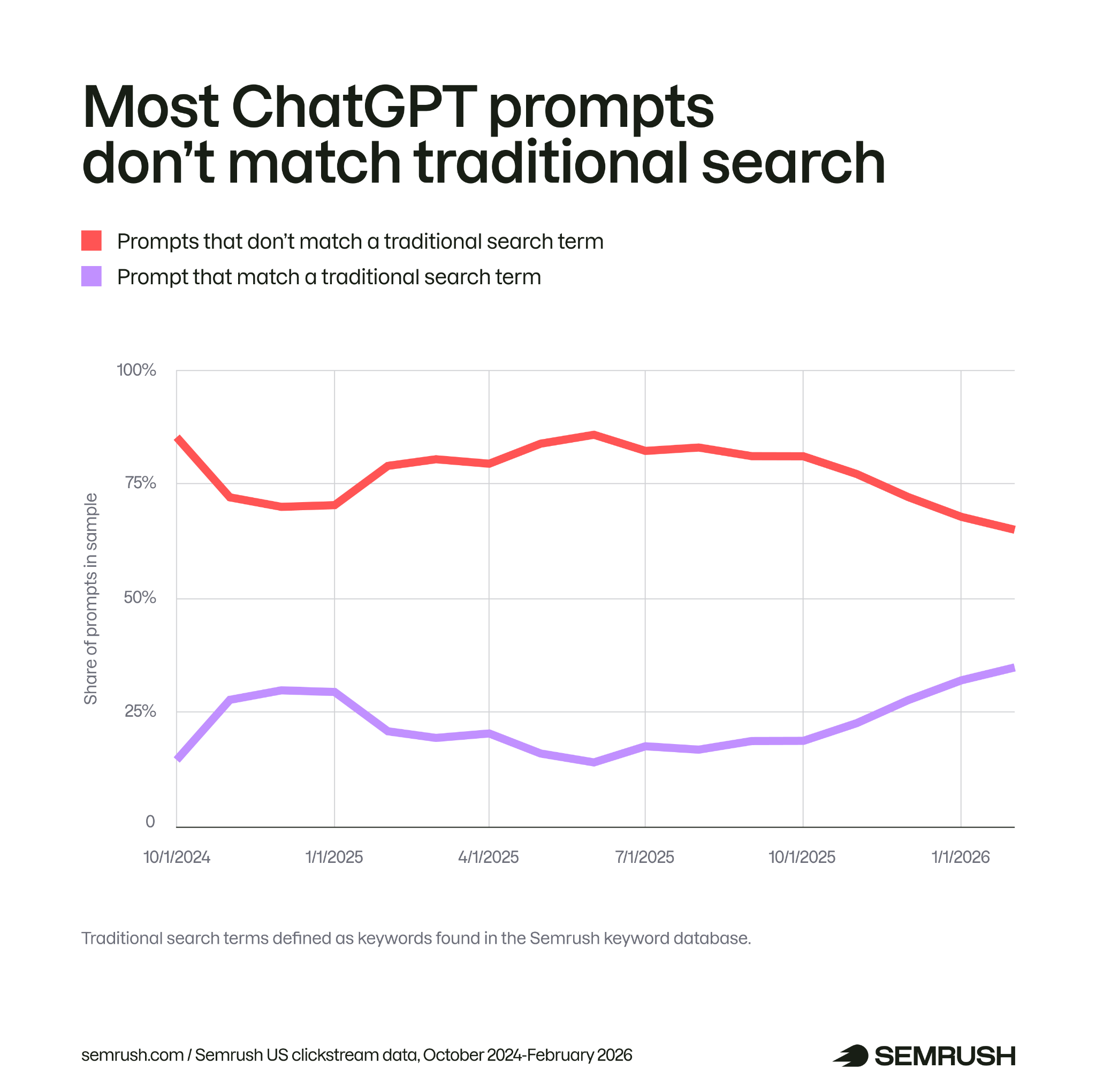
Here’s what happened:
Semrush published a clickstream analysis of 17 months of ChatGPT usage data. The headline finding: between 65% and 85% of ChatGPT prompts have no matching keyword in Semrush’s database. They’re queries that simply don’t exist in traditional search.
Meanwhile, ChatGPT’s outbound referral traffic grew 206% year over year (Jan ‘25 vs Jan ‘26), and the share of that referral traffic going back to Google climbed from 14% to over 21%.
Why this news matters:
This data puts hard numbers to a problem: The majority of AI-driven discovery is invisible to existing measurement tools. If 65-85% of prompts don’t match any keyword, then optimizing for keywords only captures a fraction of the surface where your brand could show up.
The referral traffic growth also flips the narrative that ChatGPT is purely cannibalizing Google. It’s creating a new discovery loop where users bounce between AI and search.
My take on this:
This is the strongest evidence yet that AI search and traditional search are becoming complementary surfaces, not substitutes. The keyword-invisible prompts are where the opportunity lives: long, conversational, context-rich queries that reward brands with deep, authoritative content. The fact that ChatGPT sends a growing share of its referral traffic back to Google suggests users treat ChatGPT as a starting point for research, not a final destination. Sites need to show up in both places.
Here’s what to do:
Stop treating your keyword list as the complete map of how people find you.
Start monitoring your AI citations (tools like Ahrefs and Semrush now offer this).
Look at your analytics for referral traffic from chat.openai.com and chatgpt.com.
Find real user questions in sales conversations or customer research.
If these are both growing, that’s signal that your content is being cited in prompts you’ll never see in a keyword report. Build content for the questions your customers actually ask, not just the queries they type into Google.
