


Welcome to another Growth Intelligence Brief, where organic growth leaders discover what matters - getting insights into the bigger picture and guidance on how to stay ahead of the competition.
As a free subscriber, you’re getting the first big story. Premium subscribers get the whole brief.
Today’s Growth Intelligence Brief went out to 637 (+18) marketing leaders.
This week, we’re looking at:
New research reveals how much of ChatGPT’s citation surface sits outside standard keyword tracking
What Bing’s latest AI Performance update means for the teams trying to close that gap
Why Google Personal Intelligence is creating a measurement layer that third parties may never reach
I’ll also connect the dots on what this all means for you.
95% of the queries driving AI citations don’t show up in your keyword tools
Here’s what happened:
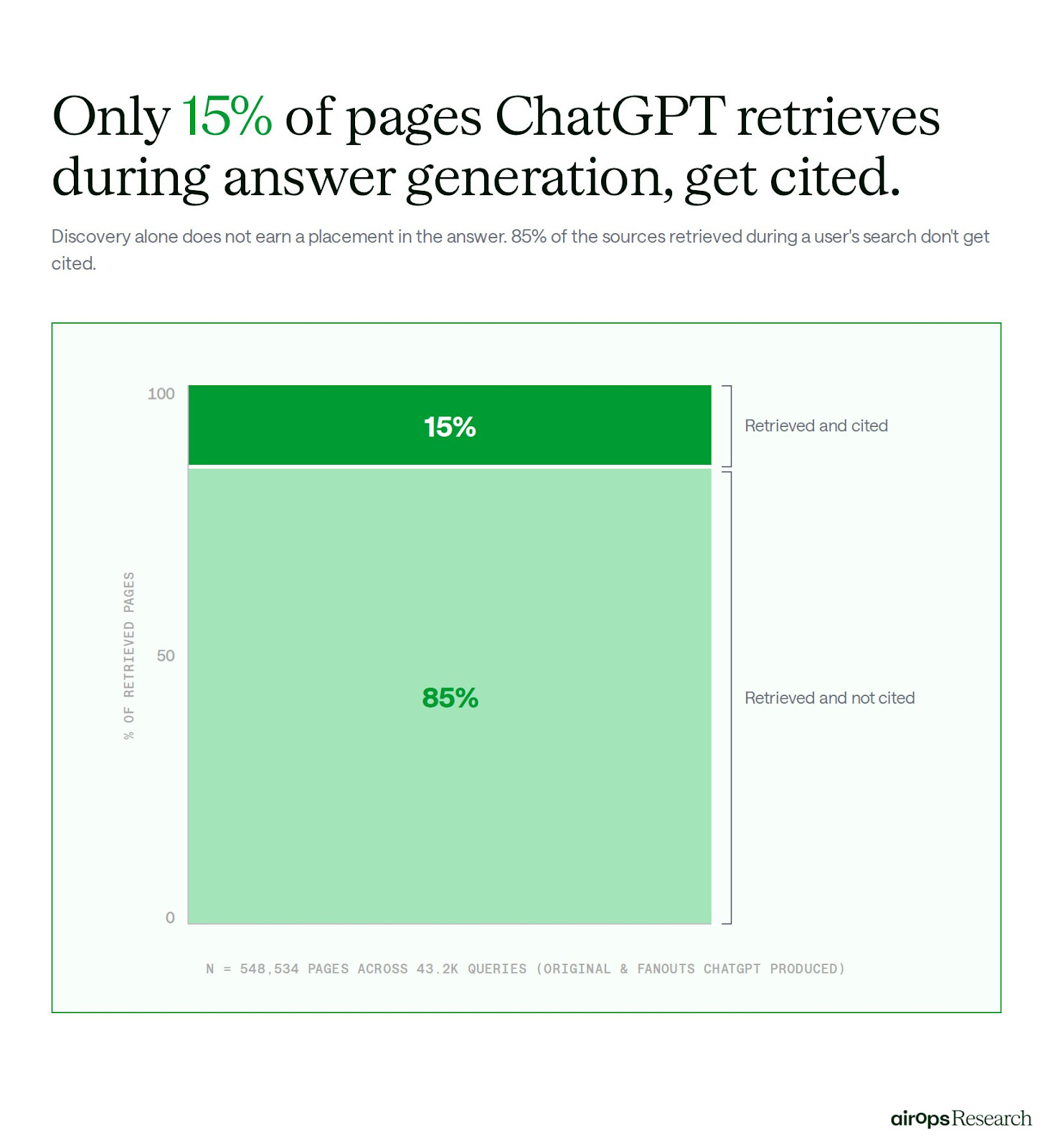
AirOps analyzed 548,534 retrieved pages across 15,000 original prompts: The headline finding is that 85% of pages ChatGPT retrieves are never cited in the final answer.
The more operationally significant finding is about fan-out: ChatGPT generates 2 or more follow-up searches on 89.6% of queries... and 95% of those fan-out queries had zero monthly search volume by traditional metrics. Zero volume search queries matter.
That gap has direct consequences, though. 32.9% of cited pages appeared only in SERPs for a fan-out query, not the original prompt. Brands tracking primary keywords only are missing nearly a third of the citation surface entirely.
AirOps found that Google rankings still carry over. Pages ranking #1 in Google were cited 3.5x more often than pages outside the top 20, and 55.8% of all cited pages ranked in the top 20 for at least one query.
Pages with 50% or greater title-to-query overlap had a 20.1% citation rate versus 9.3% for pages with less than 10% overlap - a 2.2x lift from alignment alone.
Much of their findings track with the analysis I did with Gauge on The science of how AI pays attention.
Why this news matters:
Most AEO / AI SEO strategies are built around the queries teams already track or have tracked for years. And this data says that approach accounts for roughly 2/3 of citation opportunities at best, and misses the follow-up searches that ChatGPT generates while building an answer.
Fan-out queries behave differently by intent type. Commercial queries decompose into sub-queries covering pricing, comparisons, alternatives, and features - meaning a brand optimizing only for the head term is absent from the supporting research ChatGPT does before it writes its answer.
My take on this:
The data shows how important fan-out queries are for visibility in ChatGPT. Where it gets interesting is that about ⅓ of queries would not get caught by classic keyword research because they have zero search volume. For us, this means we need to factor fan-out queries into our research process and then systematically target those keywords. Thinking one step further: how many of those queries really don’t have any searches (always hard to tell without access to GSC, and even then it can be sampled). And how would Google treat domains that have content that has no search demand from humans but from bots?
Here’s what to do:
Build content for zero volume searches that are crucial to your brand authority
Audit your content against the fan-out pattern, not just head terms. For your top 10-20 commercial keywords, manually prompt ChatGPT and document the follow-up searches it generates. Those sub-queries (pricing, comparisons, alternatives, “[brand] vs [competitor]”) are your actual citation surface. If you don’t have content for them, you’re invisible for ~1/3 of citations.
Prioritize title-to-query alignment as a discrete optimization lever. AirOps found a 2.2x citation lift from title overlap alone. Review your top pages and tighten title tags to match the phrasing AI models use in their sub-queries, not just what humans type into Google.
Don’t abandon traditional SEO to chase AI citations. Pages ranking #1 in Google still get cited 3.5x more than pages outside the top 20. The playbook isn’t “pivot to AI optimization”; it’s “keep winning in Google AND cover the fan-out surface you’ve been ignoring.”
