



This Memo was sent to 26,431 subscribers. Welcome to +97 new readers! Subscribe to get the free memo weekly or upgrade to Premium for the full archive, research, frameworks, and templates.
Come join me at AirOps Next in NYC on May 13th. We’re joined by the greats from Airbnb, Ramp, Anthropic, etc.

How LTM Interactive achieved +400% project ROI with Semrush for Enterprise

Global businesses operate under relentless pressure. But LTM Interactive successfully juggled more clients, growing expectations, and tighter margins by consolidating their search operations into Semrush for Enterprise.
After cutting fragmented tools and turning wasted manual work into high-value client delivery, their teams improved search project ROI +400%.

Am I still an advisor? Or a builder? I’m having an existential moment.
My work has forever changed in a way I’m still trying to understand. 6 months ago, agentic vibe coding crossed a threshold. Since then, I have used AI to raise my impact by a magnitude.
I designed landing pages end-to-end for a major travel brand that made it into production.
I automated topic prioritization, SEO testing, and SEO reporting for my clients with full-blown apps.
I built an array of useful applications for myself, from automating the SSI (SEO Site Index found in the bimonthly Growth Intelligence Briefs) to Openclaw agents that help me with research and charts.
The work I shipped improved, while it also became harder to define. But when the cost of building collapses due to AI, judgment is the only thing that doesn’t compress. Meanwhile, most operators are still hiring, budgeting, and measuring as if execution is the constraint.
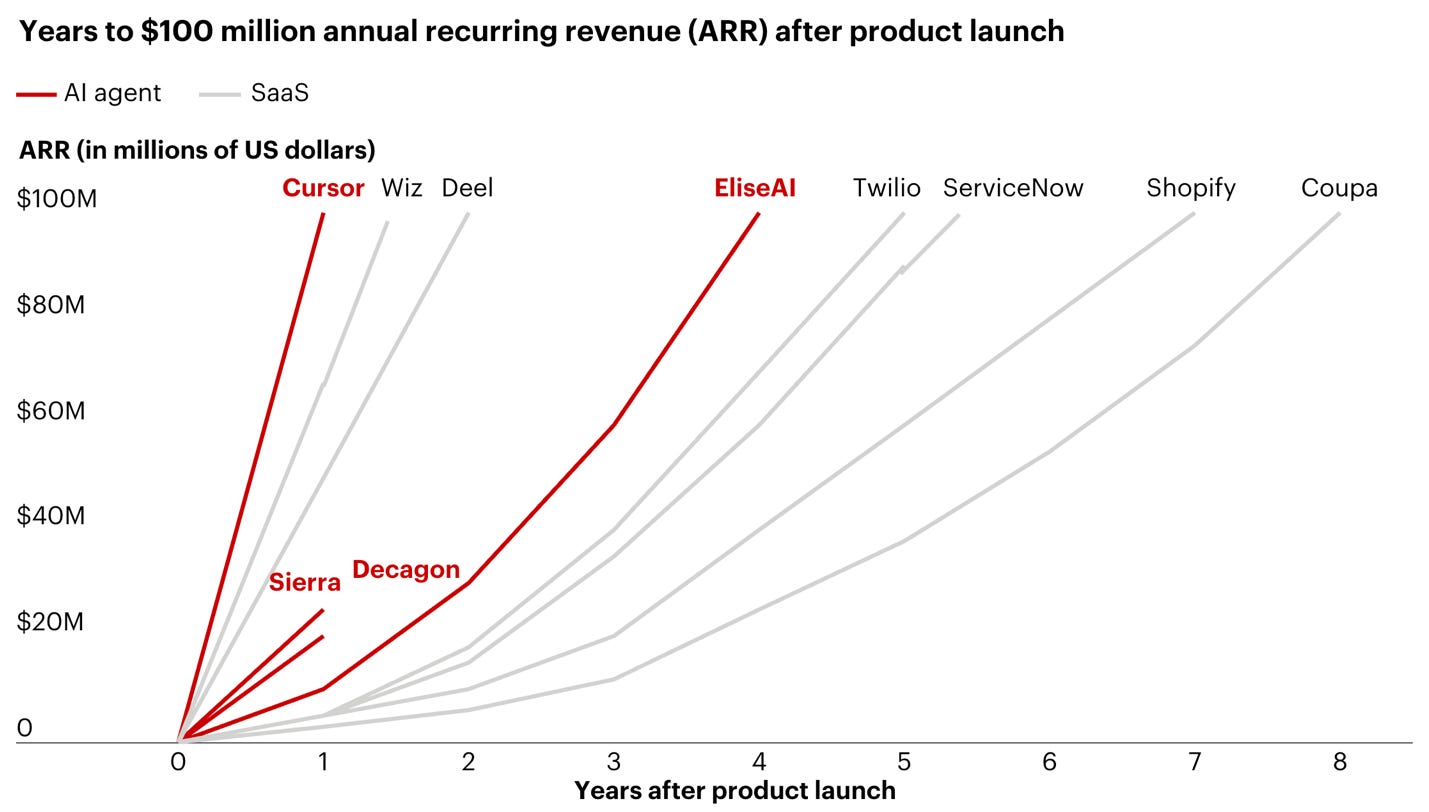
I’m not alone: AI companies are reaching $100M ARR faster than ever, in large part because they’re AI native. Their whole product development philosophy is fundamentally different. Heck, Anthropic went from $9 to $30 billion USD in 6 months and is now worth about as much as Starbucks, Mastercard, or McDonald’s.
And I have my feelings about Matt Schumer’s essay “Something Big Is Happening,” but with reportedly 80 million views, it clearly hit a nerve.
So, I want to take a beat from publishing research this week and take measure of how agentic coding changes software, distribution, and people.
The effect on software
In 2024, I made a bold prediction that AI agents would hit 100 million users in 2025. I was off by about a year. Agents didn’t hit 100 million users in 2025, but they did hit production in 2026, and the gains are measurable:
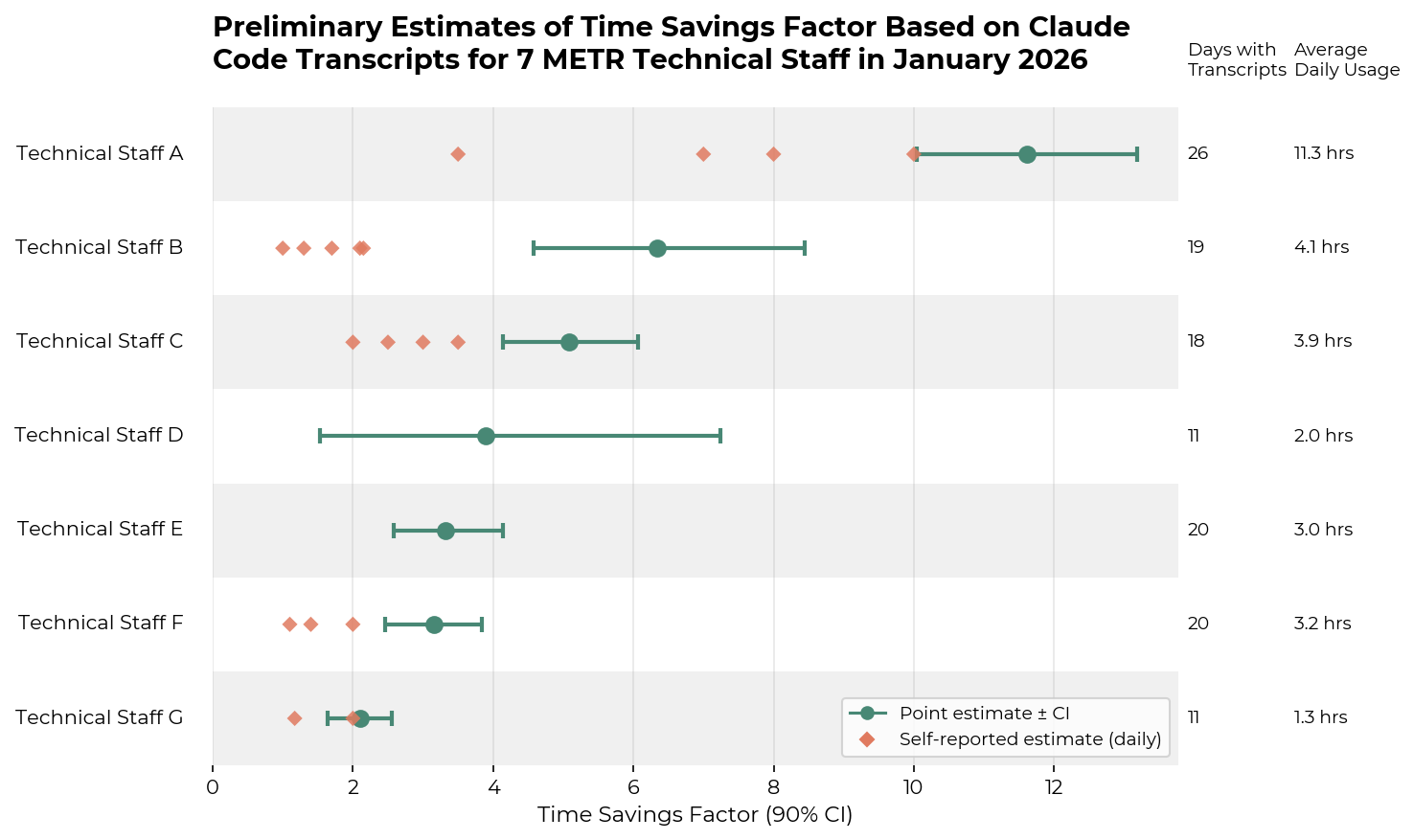
METR found 1.5 to 13x (!) time savings when technical staff used Claude Code.
A 40% reduction in cost and 60% reduction in time from agentic AI is not unrealistic.
Bain & Co estimates a 30-50% gain in productivity from deploying AI agents and automation.
What happens to software when non-engineers can ship code?
After the iShares software ETF (IGV) cratered 24% in Q1 2026 (steepest quarterly drop since Q4 2008), you could sense a panic in the air that AI would make software companies redundant. But software is more than code.
Enterprise software has strong guards against AI redundancy. Anyone who has ever purchased a CRM or migrated to another vendor knows how hard this is and how much is involved.
Enterprise software is more than code. It’s code plus integration, security, uptime, sales and support… all wrapped up in procurement cycles, IT review, and legal sign-off.
AI can chip away at any one of those pieces. For example, an agent can handle an integration, run a security audit, even book a demo. But no agent shows up to get sued when a mission-critical system goes down at 3 am. Accountability is the part that doesn’t unbundle. Enterprise companies don’t replace this stack; they build their own agents and AI workflows on top of it.
Self-serve software is a different beast. Anyone can now spin up a simple task tracker in a Kanban format. I personally rather pay a few dollars a month and spare myself the hassle of bug fixing, but it’s possible and quick. Self-serve products need to move upmarket. The playbook shows up in Notion’s, Figma’s, and Canva’s moves into enterprise.
In this shift, 2 archetypes stand out:
Data providers
System of records
1/ Data providers provide value by making data that the market could not otherwise access. These companies lose leverage from their user interfaces but gain it from their data. For example, let’s say a data provider gives you app store rankings. The user interface for that company is slowly turning into friction as more people can code their own dashboards. But their data becomes much more interesting. The durable levers for APIs / MCPs in this world are data completeness, uniqueness, stability, and cost. The logical move is to shift to a headless experience for early adopters and keep the user interface for legacy users.
2/ Systems of record (SOR) are the canonical place where a company’s own data lives. Salesforce, Workday, or Coupa are the bane of existence for many people, but they’re billion-dollar companies because they’re extremely hard to replace. The moat is the tangle of permissions, audit trails, integrations, compliance posture, and decades of workflow conventions built around that data. An agent can generate a CRM in an afternoon; replacing Salesforce at a Fortune 500 is a multi-year change-management project. These companies have already started and will continue to use AI more to provide better user experiences. But their levers are depth of integrations, compliance and audit posture, switching cost, and the quality of their agents. The winners in the SOR space are the ones whose agents make the existing system of record more useful, not the ones trying to replace it.
The effect on distribution
Distribution is more important than product, or so the saying goes, but getting it in 2026 is hard. Platforms are closing (by reducing clickouts and keeping users inside), and they’re taking opportunities away to convert or build direct relationships with visitors outside of the platform.
AI Overviews and AI Mode make more than 50% of clicks redundant and keep users on the Google platform.
AI chatbots send a tiny fraction of traffic out.
Social is flooded, word of mouth is uncontrollable, and paid gets more expensive.
From The Brand Tax:
Cost per visit climbed 9.4% in 2025 alone, adding to a 30% cumulative increase over 3 years. Conversion rates fell 5.1%.
How do you get distribution in this AI-first world? 2 levers compound:
Velocity
Product
1/ Velocity means you execute faster (and better) than your competitors. When all distribution channels decline and no alternatives open up, the only way to grow is to leverage them better. Play the game better than the competition. Fast shipping speed becomes table stakes, and ideas + compute become the differentiators.
PwC found AI speeds content production up by 3-10x. In plain words, we need to automate more. But not at the cost of trust. When you lose trust, you lose the game.
2/ Product is the marketing now, with 2 distinct effects:
AI sees through marketing gloss. Agents can read ingredient lists, parse reviews, compare specs. “We’re the best X in the world” doesn’t survive an agent that actually checks. But strong products get chosen consistently.
Free product is the new top of funnel. Standalone tools that solve a real problem are easier to build than ever, and they acquire better than ads. Ramp Sheets routes users toward Ramp’s core product without a marketing budget.
When product is the marketing, the emphasis shifts to product growth: onboarding, engagement, retention. The fastest growing products these days all have product-led growth motions. So, marketing and product development melt together.
The effect on people
AI capability is racing ahead, but human cognition… isn’t. Until we reach AGI (God knows when; I hope not any time soon), human cognition is what limits AI productivity. We can only ship as much as we can review.
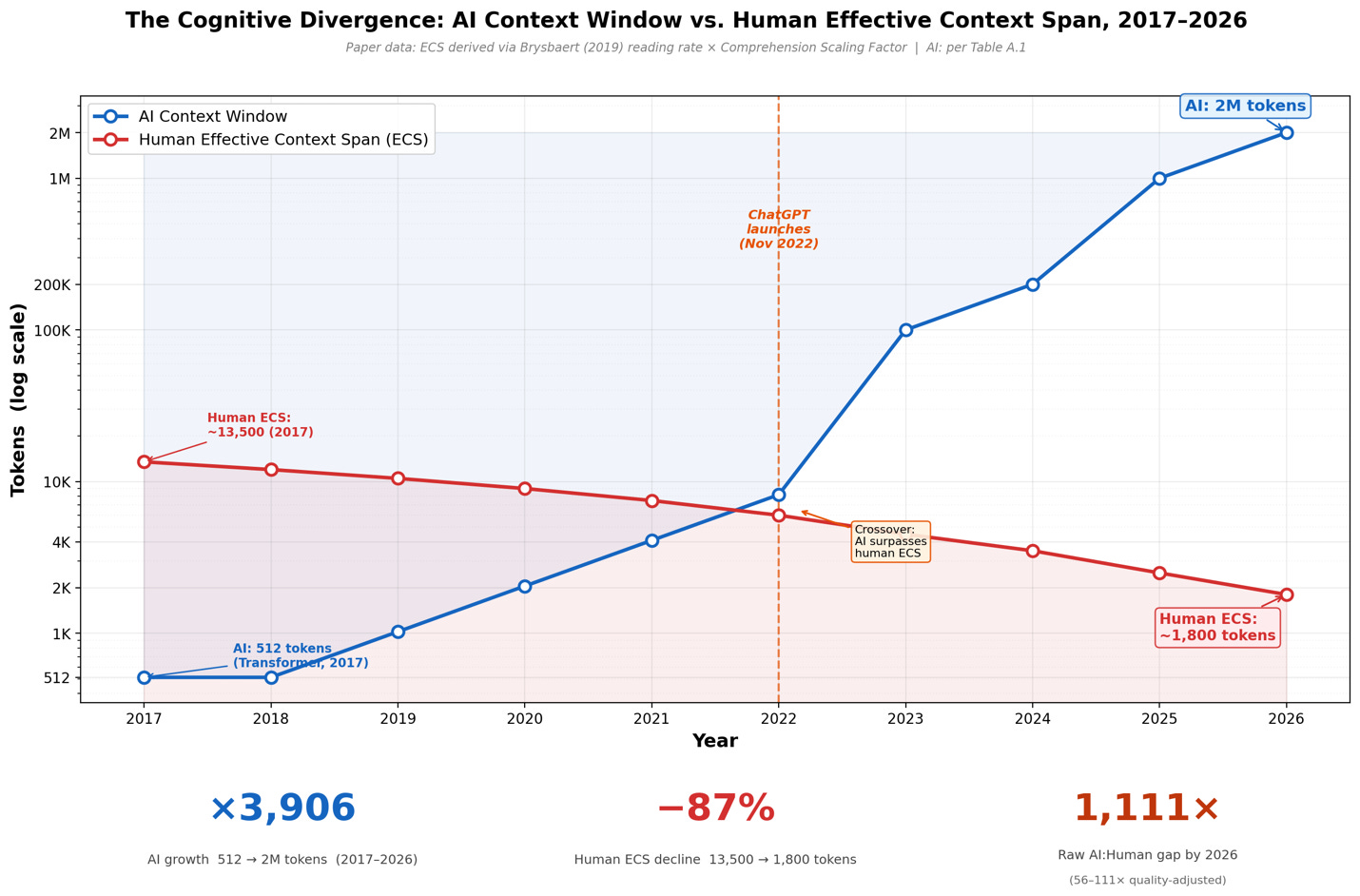
AI tools can take in more input than ever before, while our own human attention span is declining: AI’s context windows grew 3,906x (!) over the last 10 years, from 512 to 2 million tokens, while human attention has shrunk. We’re outsourcing thinking faster than we’re learning to check it.
Two cost curves are racing each other: the Cost to Automate (exponential decay) versus the Cost to Verify (biologically bottlenecked). In “Some Simple Economics of AI,” Catalini et al. argue that tasks with a verifiable output will be automated the fastest. Work that requires a human to check it compounds slower, so we’ll automate work that’s easy to measure faster. I feel it whenever I’m running four terminal windows at once: the focus drain is as high as the throughput. At scale, what holds us back is how much we can proofread and direct.
When anyone can build anything, the ways we’re limited change: Skill and tools matter less. But judgment, ideas, and time decide whether you run in the right direction or in circles. It’s very easy to get distracted with AI because the cost to build is now so low.
Judgment is the part that doesn’t compress. I can ask Claude Cowork for a contract review, but I have to know what it missed. Claude will happily write me a Q4 plan, but it’s only as good as my read on which market to attack and what my competitors are about to do.
Over the last 6 months, I implemented more agentic and automated systems than I’ve done hands-on work. My clients now have access to unique software they can’t get anywhere else that solves their unique problems.
3 things are now compressing toward zero: the cost to build software, the cost to produce content, the cost to spin up a tool. But another cost is trending far away from zero: The cost to know whether any of it is right.
I’m not directly “doing” the work anymore in a traditional sense. I’m now building the thing that does the work, then checking it. The work that matters now is the part I can’t hand to an agent… knowing what to build, what to kill, and what the agent missed. And I’m here to figure out what that means - with you.
Premium: My 4 top rules for AI automation
At Shopify, we built the initial concept of a “keyword universe” when I was there between 2020 and 2022. I wrote about it publicly for the first time in February 2024. In June 2025, I republished the post with a Claude Artifact that helps you build your own keyword universe. In March of this year, I built a full web app in Next.js for my client. I could probably charge a decent subscription fee if I were to publish it.
That keyword universe arc shaped how I work with agents today.
The same patterns power an SEO testing system I built for another client: 4 rules carry across both.
